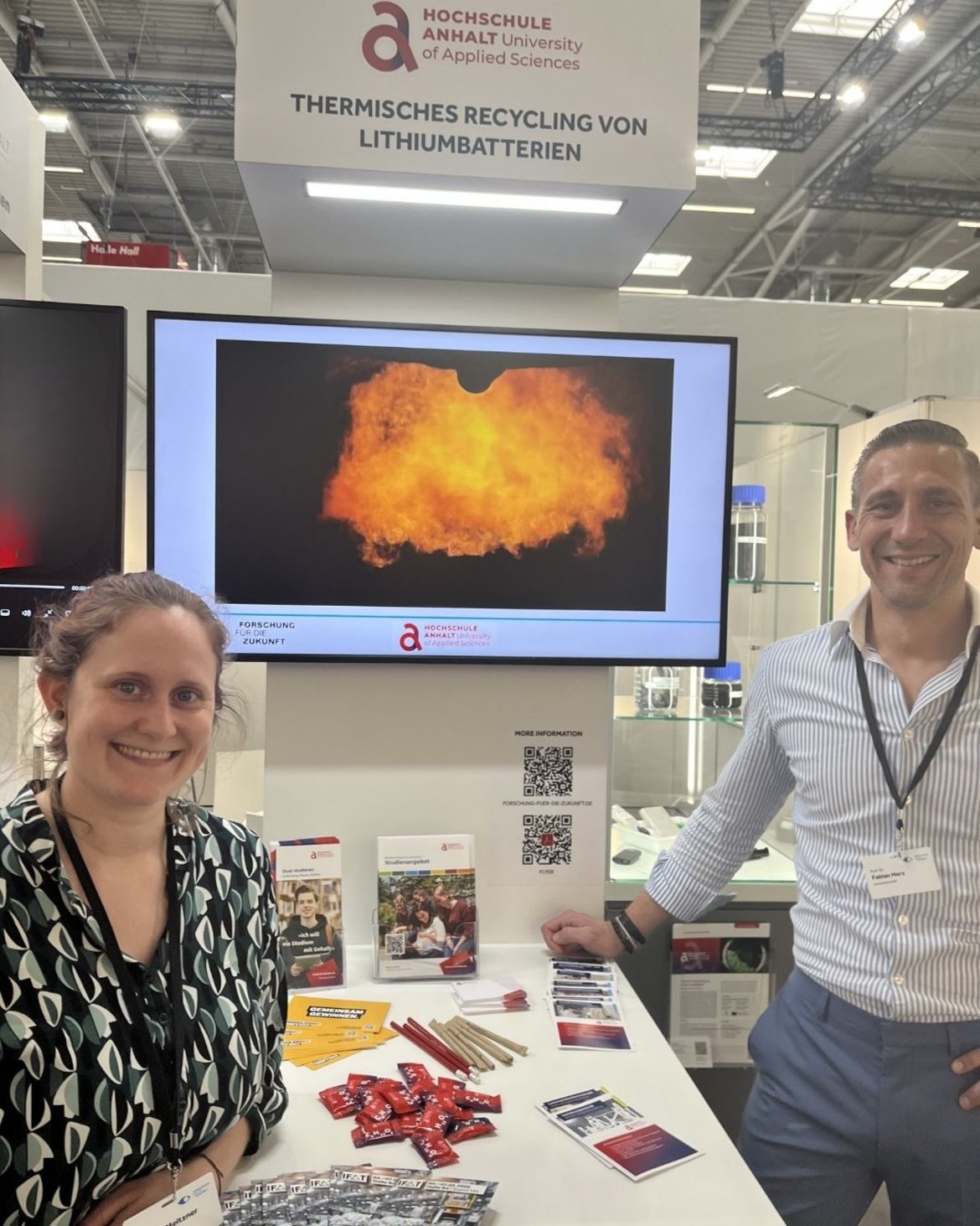
Dr. Claudia Meitzner works at Anhalt University of Applied Sciences as part of the Thermal Process Engineering team. Among other things, the team focuses on the thermal treatment of bulk materials. To this end, a process is being developed at the Campus Köthen that allows lithium batteries to be recycled without having to be disassembled first. She recently presented the project at IFAT, the world’s leading trade fair for environmental technologies, and promoted the degree program in her Department of “Applied Biosciences and Process Engineering.” A conversation about rotary kilns, sustainability, and the question of what actually drives students.
Math, Physics, Sustainable Industry
-
 © hochschule anhalt
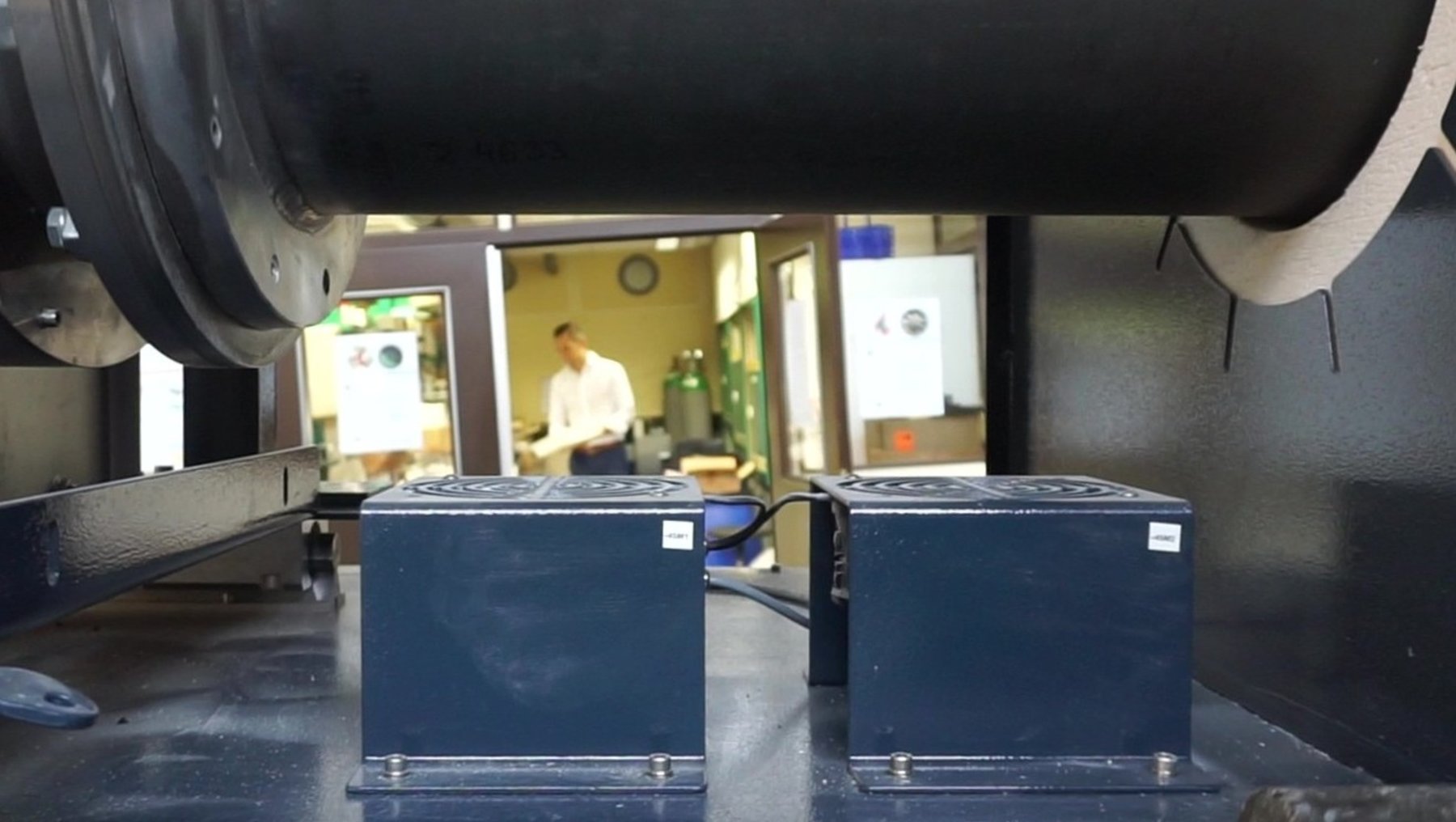
Thermische Verfahrenstechnik an der Hochschule Anhalt: Für Lehre und Forschung sind die Labore unerlässlich.
Dr. Meitzner, a background in thermal process engineering typically stems from a degree in Process Engineering. What kind of students apply to your program?
Mostly people who like math and physics, maybe chemistry too—and who feel like they want to do something meaningful with those subjects. I think the motivation is definitely to do something related to sustainability, to do something good for the planet, but also, in a way, to find oneself in the natural sciences. Very few people know exactly what Process Engineering entails when they start out. That’s because the field is so broad.
What exactly is Process Engineering?
Process Engineering deals with how materials are transformed: through thermal or chemical reactions, biological processes, or mechanical action. Those who plan industrial processes ask: How does a material heat up? How does it cool down? How can energy be saved in the process? Behind every answer lies a plant that processes raw materials, manufactures products, or treats waste somewhere.
A key tool in the industry is the rotary kiln. This involves activities such as plant planning and design. A rotary kiln is a cylindrical reactor that slowly rotates around its own axis. Granular or lumpy materials, known as bulk materials, move through the inclined reactor and are heated, dried, or transformed in the process. The principle sounds simple. The design of such a plant is not.
 © hochschule anhalt
How can this be used to recycle lithium batteries?
That was exactly the topic we covered at IFAT, the world’s leading trade fair for recycling in Munich. And we will also be presenting the project at Battery Recycling in Frankfurt (Main). The project team led by Prof. Dr. Fabian Herz is researching the thermal recycling of lithium batteries—that is, in a rotary kiln—without prior disassembly. Individual batteries and even entire battery stacks are processed in the rotary kiln exactly as they are installed: smartphone batteries, power banks, e-cigarette cells—all mixed together. At least, that is the long-term goal of the project.
In conventional processes, lithium batteries are first discharged and then crushed to extract the “black mass,” a dark powder containing concentrated lithium, cobalt, nickel, and other valuable metals. The problem is that many used device batteries can no longer be discharged in a controlled manner, posing a risk of thermal runaway during further processing. The thermal approach circumvents this.
How far along is the process?
Research is still ongoing, but our initial results are promising.
There was also a lot of interest at IFAT. The fact that the system isn’t available for purchase yet has left some people downright disappointed. But engaging with industry is part of the plan: without real-world mass flow rates and material data, it’s impossible to design a system with precision. We are currently still working on a model to prepare the real processes as efficiently as possible.
How did you get into thermal processing technology?
I wanted to study a science-related field with a focus on sustainability. That’s why I chose the bachelor’s program in “Environmental and Energy Process Engineering” in Magdeburg. After that, I went on to earn a master’s degree in Process Engineering. Since I was very enthusiastic about the scientific approach and enjoy working with students, I then began working as a research assistant and completed my doctorate while doing so.
Learn more about studying in the Department of Applied Biosciences and Process Engineering: https://www.hs-anhalt.de/hochschule-anhalt/angewandte-biowissenschaften-und-prozesstechnik/studienangebot.html
In addition to Process Engineering, the department’s fields of study include Biotechnology, Pharmaceutical Technology, and Food Technology.
If you’d like to learn more, visit the university information day in Köthen on June 13: https://www.hs-anhalt.de/hochschule-anhalt/aktuelles/hochschulinformationstage/hochschulinformationstag-am-campus-koethen.html
The "Thermal Recycling of Lithium Batteries" project is funded by the European Union and the state of Saxony-Anhalt; the project began in February 2024. More information about this and other research projects, as well as the services and laboratories of the Thermal Process Engineering department at Anhalt University of Applied Sciences, can be found on the website.
Redaktion
Claudia Aldinger
If you’d like to learn more about studying in the Department of Applied Biosciences and Process Engineering, come to the College Information Day in Köthen on June 13: https://www.hs-anhalt.de/hochschule-anhalt/aktuelles/hochschulinformationstage/hochschulinformationstag-am-campus-koethen.html
