More than two-thirds of all consumers consider sustainability important when shopping. Nevertheless, sustainable products account for only one-sixth of all purchases at the checkout. Prof. Dr. Friederike Paetz is currently focusing particularly closely on this discrepancy. As a reviewer, she is evaluating submissions for a special issue of the “Journal of Sustainable Marketing” on sustainable retail. In this interview, she explains how customer behavior can be measured and what the retail sector, policymakers, and Administration can learn from these findings.
Research on Sustainable Retail: Why Do Customers Shop Differently Than They Say They Do?
-
 © hochschule anhalt | KI davinci

This topic reflects current social trends and, in particular, the expectations of our customers.
Professor Paetz, you will be examining articles for a special issue on sustainable retail. What makes this topic so urgent right now?
This topic reflects current societal trends and, in particular, customer expectations. For example, healthy eating is currently a major focus; there is, in fact, a veritable craze for high-protein diets and organic products. There is also growing demand for sustainable packaging—keyword: waste reduction. This reflects a need for control across a product’s entire value chain and thus has a major impact not only on the retail sector but also on producers. At the same time, the dynamic retail landscape is changing not only due to these structural market shifts but also because of technological developments. Consider, for example, AI in retail—such as smart shopping carts or even “just-walk-out” concepts, where a customer’s purchases are fully tracked by cameras and then billed via a smartphone app. All of this presents the retail sector with entirely new challenges when it comes to serving customers.
What distinguishes a research paper that truly brings something new to this field?
Research papers should embrace out-of-the-box thinking. Authors should move beyond conventional ways of thinking and introduce new ideas. With regard to AI, one could demonstrate here how the use of AI can, for example, influence or even shape customers’ awareness of sustainability. Of course, this applies not only to the food retail sector but can be extended to many other areas, such as the textile industry.
Which of the questions in the call for papers most directly relates to your own research?
In fact, my research focuses on both the mathematical modeling of sustainable consumer preferences and digital marketing. I always try to draw practical implications from this work, whether at the retail or manufacturer level. This call for proposals brings these two research areas together beautifully.
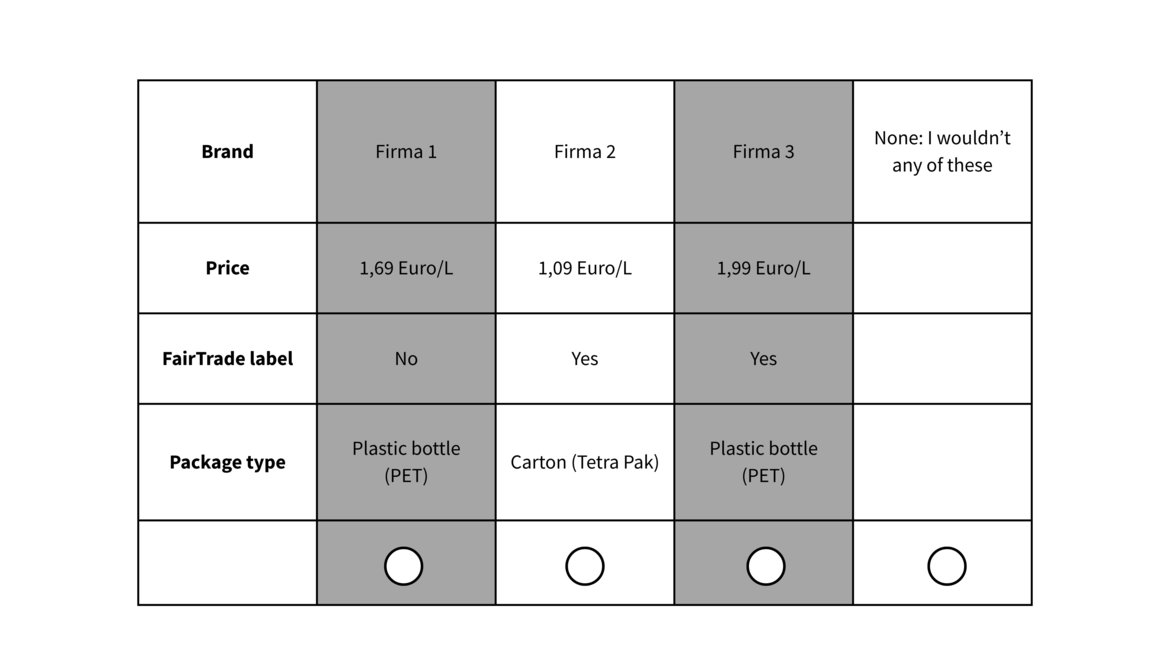
You work with discrete choice experiments. Can you use an example to illustrate how such an experiment is conducted?
Sure. Here, for example, they ask: “Imagine you want to buy some orange juice. You have the following options to choose from; which one would you pick? If none of these orange juices appeal to you, then you can’t choose any of them!”
 © hochschule anhalt
Why is it not sufficient to simply ask people if they want to shop sustainably?
Direct surveys also come up time and again. Unfortunately, they have the major drawback that they yield significantly inflated figures regarding people’s willingness to purchase sustainable products. Imagine if I asked you whether you’d be willing to buy a pair of sustainably produced pants instead of a pair produced conventionally. I’d tell you that with the sustainably produced pants, you could be sure that no child labor was used in their production. Who would answer that they’d still buy the conventionally produced pants?! This phenomenon is known as “social desirability bias” and can severely skew predictions of purchase likelihood. That’s why it’s better to ask indirectly, for example, using discrete choice experiments.
Can you name a result from one of your experiments that surprised even you?
Yes, and a fairly recent one at that: I’m currently working with two other researchers on a study comparing sustainable choices in online versus offline retail. In this study, they’re examining purchasing decisions regarding sustainable food. Surprisingly, preferences for sustainable food vary greatly between sales channels. We had suspected there would be differences, but not such large discrepancies. But that’s exactly what makes research so fascinating and inspires us to conduct further studies.
Is there a figure from your research that shows the extent to which people's stated intentions differ from their actual purchasing decisions?
General sustainability research indicates that slightly more than two-thirds of consumers say sustainability is important to them when making purchases. In reality, however, sustainable products account for only about one-sixth of all purchases. This varies greatly, however, across different product categories.
What are the limitations of discrete choice experiments? What can't they capture?
Discrete-choice experiments remain hypothetical in nature—so-called “stated preferences.” In these experiments, we only ask what people would buy, but we do not see what actually ends up in their shopping carts in real life. To determine this, we would need, for example, (scanner) panel data—so-called “revealed preferences.” Studies show, however, that while biases in purchase probabilities based on stated preferences do exist, they are not exorbitantly high. They therefore provide a solid and, above all, cost-effective basis for measuring preferences.
You work on mathematical modeling of preference heterogeneity. What does that mean for retail? Why do customers think so differently, and how can that be expressed in numbers?
For retailers, a high degree of preference heterogeneity means increased efforts to cater to as many customer groups as possible. For example, product ranges must be expanded, and extras such as cashless payment systems must be offered if certain customer groups demand them. If this does not happen, customers will switch to other stores or online retailers.
Can you give an example of two very different customer groups that have helped bring your models to life?
This varies greatly depending on the product: With orange juice, for example, there are customers who are very brand-loyal, those who are more focused on the (low) price, and also a small segment of customers who prioritize sustainability.
How can companies put this insight into practice? Is a one-size-fits-all approach no longer sufficient?
No, in fact, in the vast majority of cases, a single “one-size-fits-all” product is no longer sufficient. Companies must now not only develop the optimal product, but also offer optimal product lines.
 ©sascha perten
You also conduct research on Green Service Operations. What does this term mean, and how is it specifically applied in the retail sector?
Green Service Operations refers to the sustainable design and management of service processes with the goal of using resources efficiently and reducing environmental impact. This involves integrating environmental considerations—such as energy consumption, emissions, waste prevention, and sustainable procurement—into operational service workflows. We are currently conducting research to understand how consumers make decisions regarding various return options for defective devices, such as cell phones and laptops. This is of great interest to retailers, as—according to initial findings—consumers are already thinking about returns when purchasing electronic devices. Ultimately, this requires retailers to adjust their sales strategies.
Digital market trends are one of your areas of focus. Is online retail changing the way people make sustainable decisions?
Our findings show that differences in decision-making behavior currently exist, even though sustainable products have also become available in brick-and-mortar retail in recent years. Given the range of products available online, it can be assumed that consumers expect brick-and-mortar retailers to further adapt their product offerings. Discussions surrounding aspects of online retail—such as sustainability, working conditions, and product quality—are also leading consumers to be better informed and more critical in their purchasing decisions.
Among other things, the call for papers asks whether personalization through AI promotes sustainable consumption or tends to foster mistrust. What is your take on this?
Here, we see examples of work by research partners—for instance, from the Netherlands—that show AI can promote sustainable consumption. On the other hand, there are also studies that demonstrate exactly the opposite for certain customer segments and products. So, it remains an exciting topic!
What insights from your research should retail companies be aware of before investing in sustainable offerings?
Companies must always ask themselves who their target audience is. Even though there is no such thing as a generic “sustainable consumer,” studies show that women, younger people, and those with higher levels of education are increasingly paying attention to sustainable products and services.
What can local governments and administrations learn from preference research if they want to promote sustainable consumption?
In preference research, the direct stakeholders—in the example above, consumers and retailers—are often the focus of the study. When preferences vary, local governments, administrations, legislators, and policymakers in general must assess whether market developments align with policy goals. If action is needed, policymakers must intervene. Strengthening individual sustainability and public health while, where necessary, addressing the significant burden posed by last-mile delivery (to consumers’ doorsteps). The role of regional providers must also be considered and evaluated in this context.
What are your expectations for this special issue? What questions should research on sustainable retail address next?
The challenges posed by digitalization and sustainability are affecting several areas of the retail sector. We expect the submitted papers to provide insights into this so-called “twin transformation.” Given the dynamic nature of these developments, even the published papers will not address every question. We anticipate that the retail sector will have to solve further complex challenges, particularly in terms of shaping its future. In the coming years, research will also need to address the specific shaping of the retail sector in the face of digital and sustainability challenges. In particular, researchers should seek to better understand consumers’ reactions to digital sustainability measures, such as conflicts between perceived intrusiveness (reactance) and personalization. Researchers will also examine the transformation needed to reconcile environmental, social, and economic goals from the perspective of consumers as well as the value chain.
Prof. Dr. Friederike Paetz is editing the special issue of the “Journal of Sustainable Marketing” on sustainable retail in collaboration with researchers from Nipissing University (Canada), Bielefeld University of Applied Sciences, and the University of Hagen. The title is: “From Aisles and Platforms to Ecosystems: Rethinking Retail for a Sustainable Era.” Click here to access the journal: https://luminousinsights.net/journals/jsm/si/rrse
Dr. Friederike Paetz has been a full professor of mathematics, statistics, and specialized computer science at Anhalt University of Applied Sciences since May 2024. Learn more about her research and teaching on her personal page: https://www.hs-anhalt.de/hochschule-anhalt/service/personenverzeichnis/person/prof-dr-friederike-paetz.html
One of her recent publications explores ways to monitor forests using data. PhD student Henrike Wild analyzed extensive datasets on deciduous forests for this study. Read more in this KlimaBlog article: https://www.hs-anhalt.de/hochschule-anhalt/aktuelles/neuigkeit-1/waldmonitoring-die-duerre-trifft-nicht-jeden-wald-gleich.html
Publication details & link: Identifying drought signals of different forest types: Combining ground surveys and satellite data in Saxony-Anhalt, Germany / Wild, Henrike. - Published in: Forest Ecology and Management, Vol. 619 (2026), pp. 1–19. https://www.sciencedirect.com/science/article/pii/S0378112726005608?via%3Dihub
Redaktion
Claudia Aldinger
Back to the topics “Climate Adaptation in Municipalities and Organizations” on the Anhalt University of Applied Sciences Climate Blog
Back to the Climate Blog homepage
