Microalgae produce hydrocarbons that could replace fossil raw materials. However, there is a lack of efficient processes for widespread use. Algae biotechnology at Anhalt University of Applied Sciences is focusing on the extraction of extracellular algae oils in order to reduce production costs. In this interview, Dr. Christian Kleinert explains the technological hurdles and initial application prospects of his research.
Microalgae as a substitute for crude oil: how close are we to industrial use?
-
 © hs anhalt
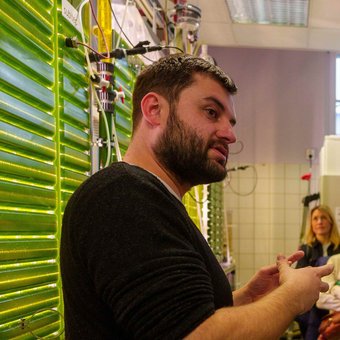
Compared to conventional methods, our in situ extraction process for obtaining extracellular hydrocarbons from microalgae is significantly more cost-effective - which was precisely our aim.
Dr. Christian Kleinert
Dr. Kleinert, research into the use of microalgae as a substitute for crude oil has been going on for a long time. What exactly makes your process special?
The valuable hydrocarbons are normally found inside the microalgae cells. Therefore, their extraction using conventional methods requires a complex process chain - from harvesting to drying and cell disruption. This workload drives up the costs considerably, which is particularly problematic as you have to compete with the price of crude oil. It was already known that the microalgae Botryococcus braunii releases these hydrocarbons during growth. I myself first came into contact with this phenomenon during my Master's thesis, which I wrote at the Competence Center Algae Biotechnology (CAB) at Anhalt University of Applied Sciences under the supervision of Prof. Dr. Carola Griehl. The central question was then: How can this process be used in such a way that the hydrocarbons are extracted during cultivation without damaging the algae?
Can you briefly explain how the extraction of extracellular algae oils works?
We have developed a cultivation system in which the culture suspension is passed directly through an extraction column containing a solvent during growth. This solvent absorbs the hydrocarbons while the extracted culture is returned to the system. A particular challenge during development was that the solvent is fundamentally harmful to the algae. However, the algae must remain alive and continue to produce hydrocarbons that can be extracted again. We have named the now patented process "in situ extraction".
What technical hurdles have you successfully overcome in recent years?
Thanks to funding from the Agency for Renewable Resources of the Federal Ministry of Food and Agriculture, we have been able to further develop the in situ extraction process since 2020. The aim was to scale up from laboratory scale to technical scale. Specifically, we transferred the process from bubble columns with a volume of 3 liters via 6-liter flat panel reactors to 28-liter flat panel reactors. With the enlargement of the cultivation system, the extraction of the hydrocarbons also had to be adapted. This included the fundamental question of which strains of the microalgae Botryococcus braunii were suitable, as it occurs in different climate zones worldwide with varying temperature and nutrient requirements. The selection of the appropriate strain was the first challenge, followed by the transfer to a new cultivation system with altered light and growth conditions, which required a new adaptation of the extraction methods. Another important aspect of the project was the development of methods to analyze the extracted hydrocarbons. The petroleum-like algal oils contain a mixture of hydrocarbons of different lengths, which are required by the industry in consistent purity. We are currently working on the publication of the results.
Next challenge: from technical to pilot scale
 © hs anhalt
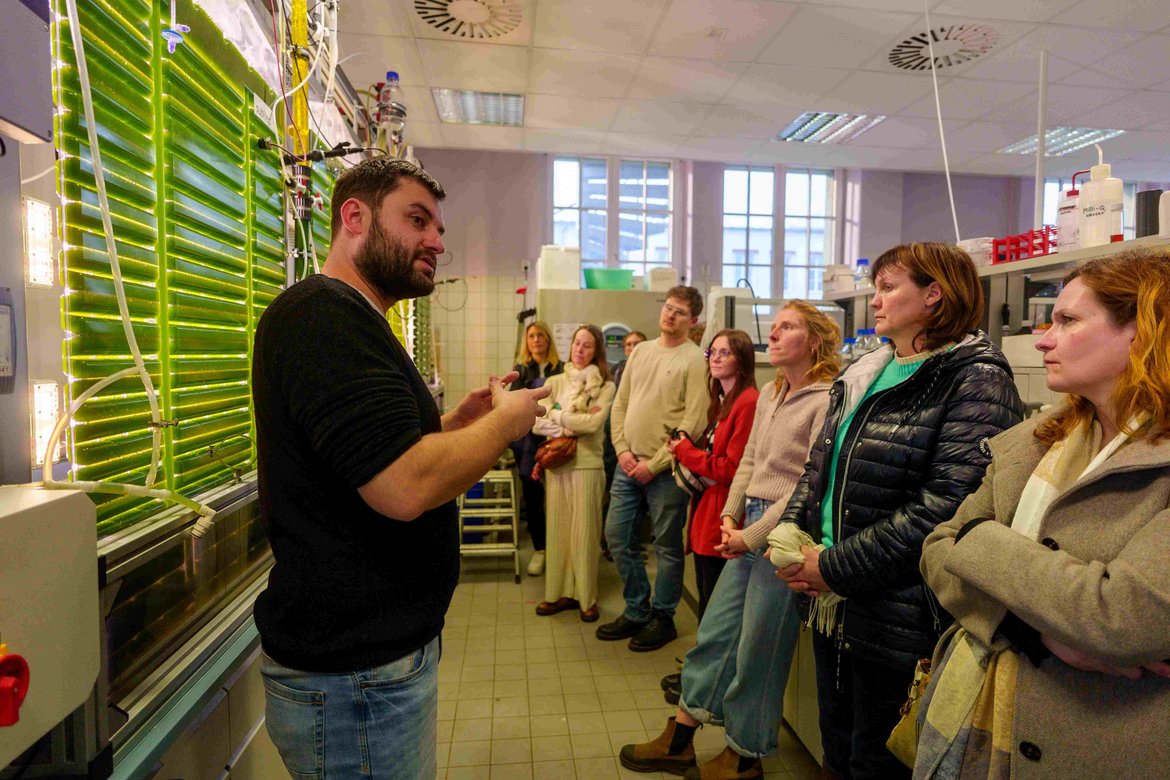
28 liters of algae biomass and 5 to 10 milliliters of algae oil can currently be produced by the Köthen algae biotechnologists. It has already been a long way to get there. With the help of the DATIpilot program, the next step is to transfer the process from technical to pilot scale. Cooperation partners from the fine chemicals industry and Stickstoffwerke Piesteritz are already interested. The photo was taken at the presentation of the funding decision for "AlgaHub" - a new algae network for Central Germany.
Where do we stand on the road to the industrial use of microalgae as a substitute for fossil raw materials?
Compared to the classic method of extracting intracellular algae oils, our in situ extraction process for extracting extracellular hydrocarbons from microalgae is significantly more cost-effective - which was precisely our aim. Nevertheless, depending on the location, cultivation costs are still too high to compete with fossil raw materials such as crude oil. Reducing them is feasible, but requires further development work. We also need the political will to promote sustainable sources of raw materials in a targeted manner.
Which industries could benefit from microalgae-based fuels or other products?
In principle, hydrocarbons can be used in all areas that currently rely on crude oil. However, our focus is less on fuel production and more on their use in fine chemicals. We are currently cooperating with Stickstoffwerke Piesteritz, who want to use the algae hydrocarbons to coat fertilizers. The Center for the Transformation of Chemistry (CTC) is also showing great interest in using these hydrocarbons in bio-based plastics in order to be able to dispense with petroleum.
What is still needed for microalgae to become truly competitive as a sustainable resource for fine chemicals?
For initial tests, companies need significantly larger quantities than we can currently produce. By way of comparison, we currently obtain 5 to 10 milliliters with our process, while around 50 liters are required for industrial tests. That is why we have been working since the end of last year in the DATIpilot program to transfer our process from technical to pilot scale - this means scaling up the cultivation from 28 to 180 liters and adapting the extraction of the hydrocarbons accordingly. This will allow us to extract 100 milliliters of oil per day while further reducing production costs. Industrial implementation is therefore progressing, but is still heavily dependent on individual initiative and funding programs, as many companies only become development partners when the production processes reach industrial standards.
Reliable data is crucial for creating trust in the use of sustainable raw materials such as microalgae. Findings from the laboratory must be transferable to industry.
Dr. Christian Kleinert
What role do biology and Process Engineering play in microalgae research?
Reliable data is crucial for creating trust in the use of sustainable raw materials such as microalgae. Findings from the laboratory must be transferable to industry, otherwise they will not be used. I completed my Bachelor's and Master's degrees in Biotechnology and specialized more in biological issues in my doctorate. Biotechnologists are basically good in both areas, but at a certain point you need specialists. One advantage of Anhalt University of Applied Sciences is that the training is engineering-based and students can choose to specialize in molecular biology or process engineering.
Research into crude oil from microalgae at the Hannover Messe:
Dr. Christian Kleinert will also be presenting his research and a model of the current bioreactor at the Hannover Messe from March 31 to April 4. Anhalt University of Applied Sciences will be exhibiting here together with Otto von Guericke University Magdeburg, Magdeburg-Stendal University of Applied Sciences and Harz University of Applied Sciences as well as the Thuringian colleges and universities at the joint stand RESEARCH FOR THE FUTURE in Hall 2/ Stand C16.
Algae biotechnology at Anhalt University of Applied Sciences:
The Competence Center Algae Biotechnology (CAB) at Anhalt University of Applied Sciences has been researching how microalgae can be used biotechnologically for over 20 years. The team led by Prof. Dr. Carola Griehl has extensive experience - from the selection and cultivation of algae to the extraction and analysis of valuable ingredients. The findings form the basis of numerous projects on the use of microalgae in the food industry, pharmaceuticals or as a substitute for crude oil. A collection of more than 300 algae strains from freshwater and terrestrial habitats serves as the basis for research. The specially equipped technical center makes it possible to transfer laboratory procedures into industrial processes. Milestones include the commissioning of a modular microalgae pilot plant in cooperation with GICON GmbH in 2011, the research group being awarded the Hugo Junkers Prize in 2013, the opening of the Center for Natural Product-Based Therapeutics ZNT in 2021 and the launch of the "AlgaHub" stakeholder network of companies and research groups in 2025. The Algae Biotechnology Research Group is also involved in disseminating its research and networking with regional partners through the "Algae Stammtisch". You can find out more and contact the team directly on these websites: https://www.hs-anhalt.de/hochschule-anhalt/angewandte-biowissenschaften-und-prozesstechnik/forschung/forschungsgruppen/kompetenzzentrum-algenbiotechnologie/ag-prof-dr-carola-griehl-algenbiotechnologie-in-koethen.html
Dr. Christian Kleinert
...studied Biotechnology at Anhalt University of Applied Sciences for his Bachelor's (2008 to 2011) and Master's (2011 to 2014) degrees. During his doctorate, his focus was on biology (2017 to 2022). Since 2012, he has been involved in the research projects of algae biotechnology at Anhalt University of Applied Sciences with the tasks of project coordination, cultivation of microalgae and cyanobacteria on a laboratory and pilot plant scale, upstream and downstream processing, product characterization (lipids, hydrocarbons, proteins, phycobilins, biogas). Since 2018, he has been in charge of the pilot plant for the cultivation of microalgae on a technical scale, including processing of the microalgae and maintenance of the photobioreactors.
Redaktion
Dr. Christian Kleinert
... is available for inquiries and requests by phone: +49 (0) 3496 67 2559 or by e-mail: christian.kleinert(at)hs-anhalt.de
... Current publication: Prevention and control of parasitic contamination in industrial microalgae cultures / Liebscher, Lea-Johanna. - Contained in: Journal of applied phycology (2024)
... more about his topics and tasks at Anhalt University of Applied Sciences at the end of the interview.
