Climate neutrality on campus: the aim of the KlimaPlanReal project is to support universities in Saxony-Anhalt in achieving this. Teams from various universities have developed strategies and measures to achieve this. The main ideas were to create opportunities for participation and a greater awareness of sustainability. A status report from Anhalt University of Applied Sciences on the climate blog.
Friendly Reminder: Acting sustainably in everyday university life
-
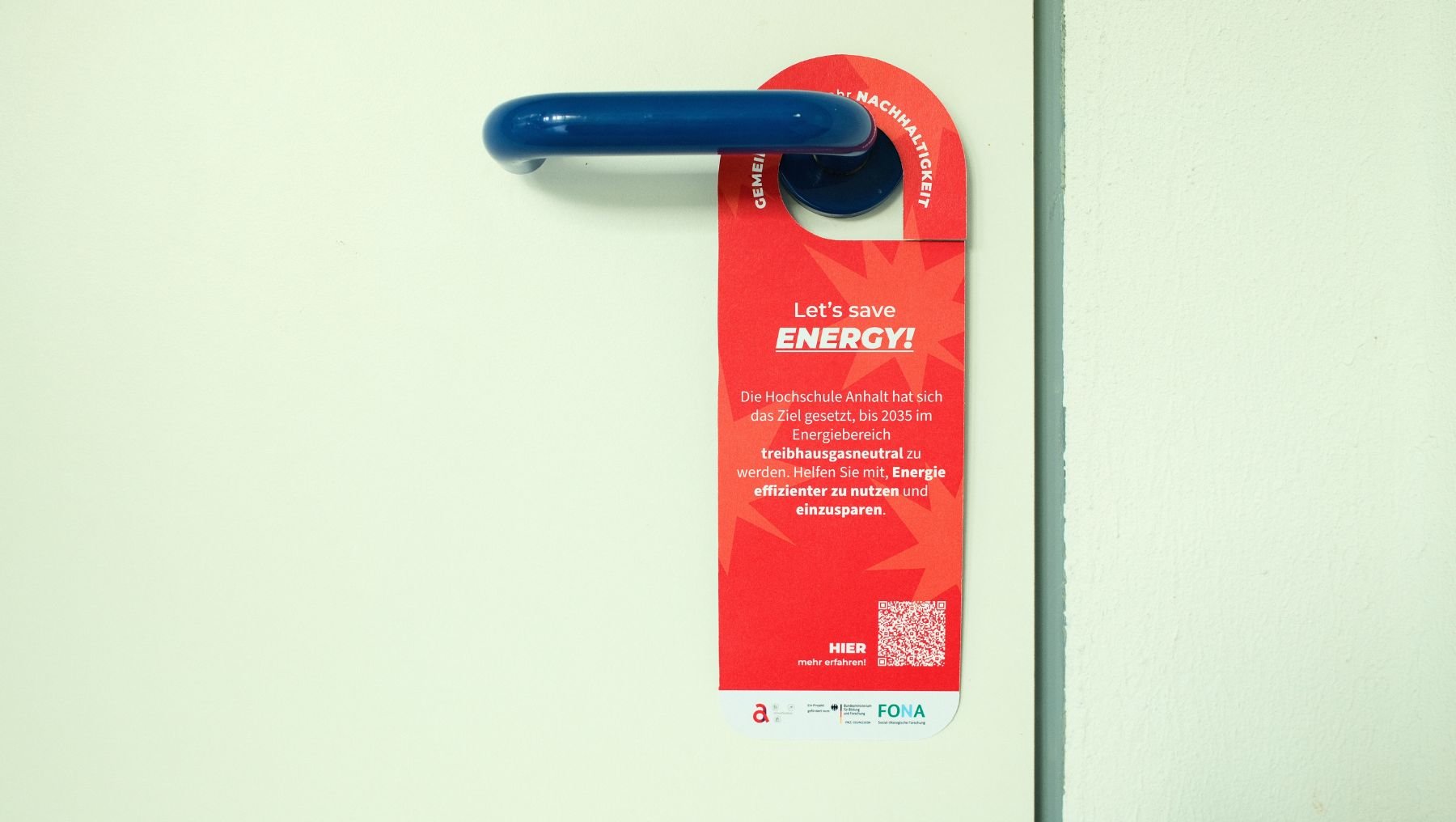 © hs anhalt
A real plan for climate-neutral universities: The project in a nutshell
Why the project is important
The path to climate neutrality is associated with relevant changes for organizations - and this applies equally to universities. Such change processes are intensive and require resources. The KlimaPlanReal project has provided support specifically via two transformation paths: the establishment of cross-status group university climate councils for the conceptual phase and the initiation of pilot projects for the - current - implementation phase. This change process is being evaluated in parallel: How effective are the transformative means proving to be? How effective are the individual measures?
What the project and the accompanying research have achieved so far
Anhalt University of Applied Sciences has had a climate plan since 2023. The proposals for this come from the university's Climate Council, in which stakeholders from across campus life are represented - elected by lot, similar to citizens' councils. Two measures were initially selected from six fields of action for the first implementation phase. The basis for the selection was an impact assessment based on various criteria. The transfer lab team has been working on these first two measures since January 2024:
- A central pool to borrow or pass on equipment and materials: the resource traffic circle: https://www.hs-anhalt.de/landingsites/nachhaltigkeit/pilotprojekte-zur-nachhaltigkeit-an-der-hochschule-anhalt/ressourcenkreisel.html
- Tips and tricks for saving energy in everyday university life: https://www.hs-anhalt.de/landingsites/nachhaltigkeit/pilotprojekte-zur-nachhaltigkeit-an-der-hochschule-anhalt/energiesparen-im-hochschulalltag.html
In November 2024, a new transfer lab team began implementing another measure, which is due to be completed by August 2025. It is dedicated to the topic of "More species-rich flowering meadows and area planting" from the biodiversity field of action. Further selected measures proposed by the University Climate Council are to be implemented beyond the duration of the project as part of the implementation of Anhalt University of Applied Sciences' sustainability strategy.
How the results can be used
The universities' approach, elaborated analyses, developed strategies and plans are already available on the project website. The findings derived from the accompanying research will be made available in the form of a digital best practice report and blueprints. This also includes experiences with the "anny" resource platform for the equipment pool and reactions to the tips & tricks for saving energy in everyday university life.
Climate neutrality with science and practice:
Outlook with Dr. Silke Rühmland from Otto von Guericke University Magdeburg, project manager and head of the sustainability office, and Michael Klein, project employee for energy and sustainability management at Anhalt University of Applied Sciences.

Sustainable action requires not only individual changes in behavior, but also systemic adjustments.
Dr. Silke Rühmland
Dr. Rühmland, what is actually so difficult about acting sustainably? And do individuals and organizations differ in this respect?While individuals often struggle with internal (psychological) and external (structural) barriers, organizations face even greater challenges due to Economics and institutional constraints. Sustainable action therefore requires not only individual behavioral changes, but also systemic adjustments to make sustainable choices more attractive and accessible. These changes need to be made in many places at the same time and also require us to be patient in order to adapt the new processes to our needs in a sustainable way.

Energy efficiency is considered one of the most important factors on the road to climate neutrality.
Michael Klein
Mr. Klein, hand on heart: how good can an equipment pool and tips and tricks for saving energy contribute to the university's climate neutrality?
Both measures make sense for various reasons: if devices are used several times, there are fewer multiple purchases. This reduces emissions associated with the life cycle of devices: Manufacture, delivery, disposal.
Another important point is energy efficiency: this is considered one of the most important factors on the road to climate neutrality. Both in the design of technologies and in their use. We want to remind you of this with simple tips: on how to operate thermostats correctly, what to look out for with radiators and how to save electricity with lighting. Although there is a broad consensus on these topics, I keep coming across incorrect assumptions and habits. This is exactly what the infographics address: Background to the recommended action, an easy-to-remember guide and facts instead of myths.
Save energy! Posters, postcards and other "friendly reminders" show how to do this easily
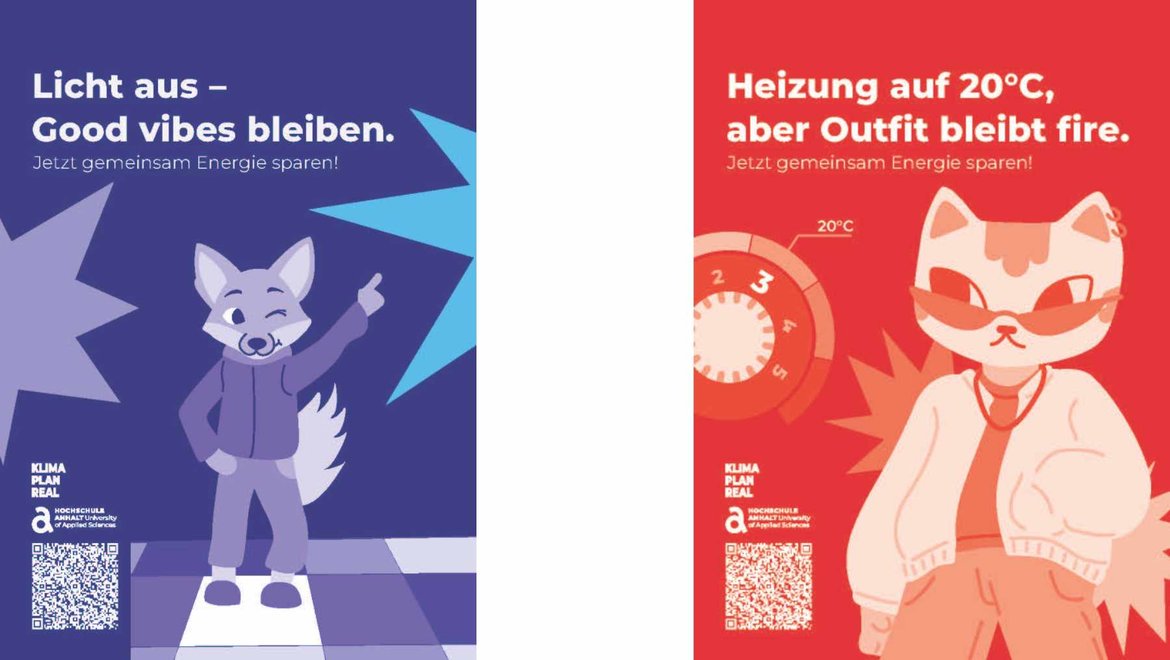 © hs anhalt
The transfer lab team has developed various reminders to help save more electricity and heat in the university's rooms. The posters, postcards and door hangers are placed in selected areas of the university where a change would be particularly desirable: for example, in rooms with high light and heat consumption and a lot of potential for savings. The content was developed by Michael Klein. Graphically implemented by two students from the Department of Design in Dessau.
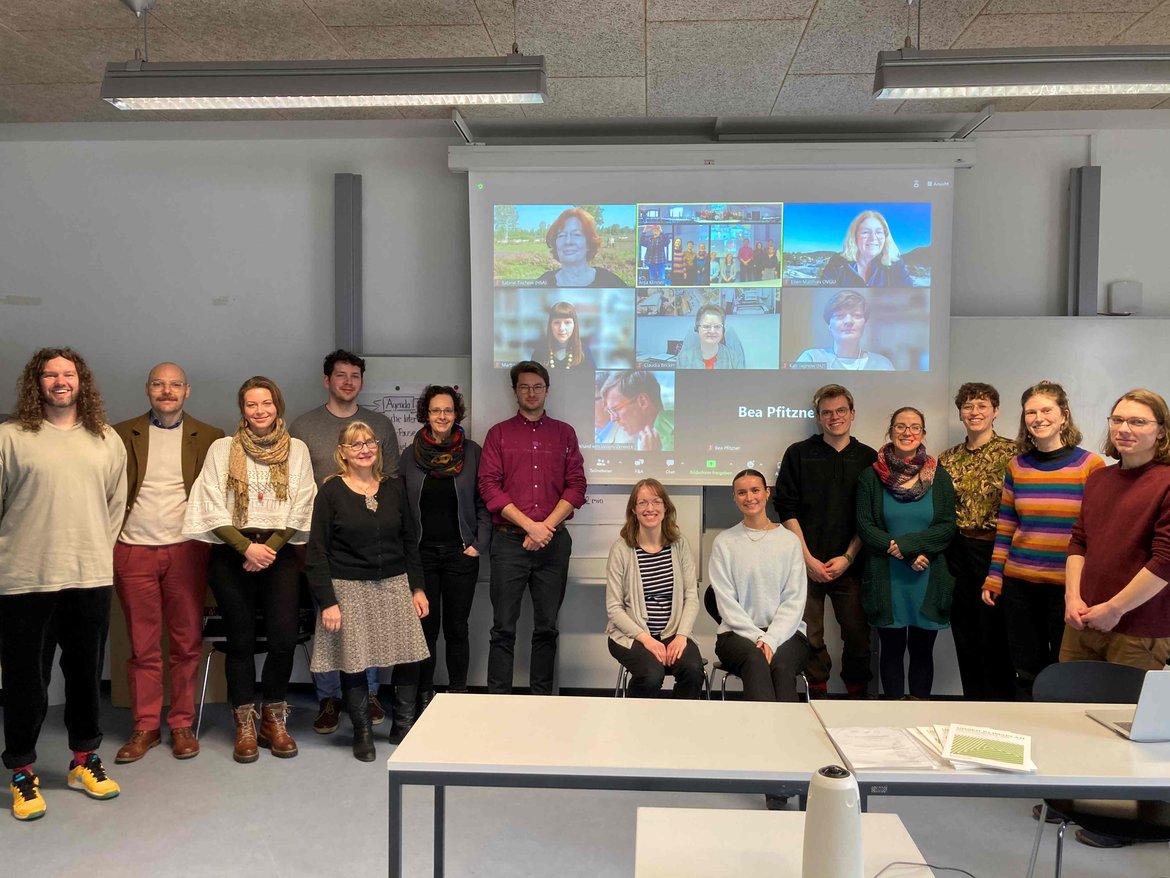
The joint project KlimaPlanReal
... includes Anhalt University of Applied Sciences, Otto von Guericke University Magdeburg (network coordinator), Martin Luther University Halle-Wittenberg, Magdeburg-Stendal University of Applied Sciences and Harz University of Applied Sciences. The Federal Ministry of Education and Research (BMBF) has been funding the project since September 2022 and it should be completed by September 2025.
 © Uni Magdeburg
Contact KlimaPlanReal at Anhalt University of Applied Sciences
... via Prof. Dr. Sabine Tischew, Tel.: +49 (0) 3471 355 1217, E-Mail: sabine.tischew@hs-anhalt.de or Heiner Hensen, Tel.: +49 (0) 3471 355 1229, E-Mail: heiner.hensen@hs-anhalt.de; Yannik Wehr, Tel.: +49 (0) 3471 355 1174, E-Mail: Yannik.Wehr@hs-anhalt.de
The topic of sustainability at Anhalt University of Applied Sciences
... has various facets. One of these is the KlimaPlanReal project. Others can be found on the pages of the sustainability working group. These include a sustainability strategy, the action plan for implementing the sustainability strategy, events and pilot projects.
Redaktion
