Development of multifunctional tools and the associated application processes for fine comminution and emulsification of fibrous amorphous products
-
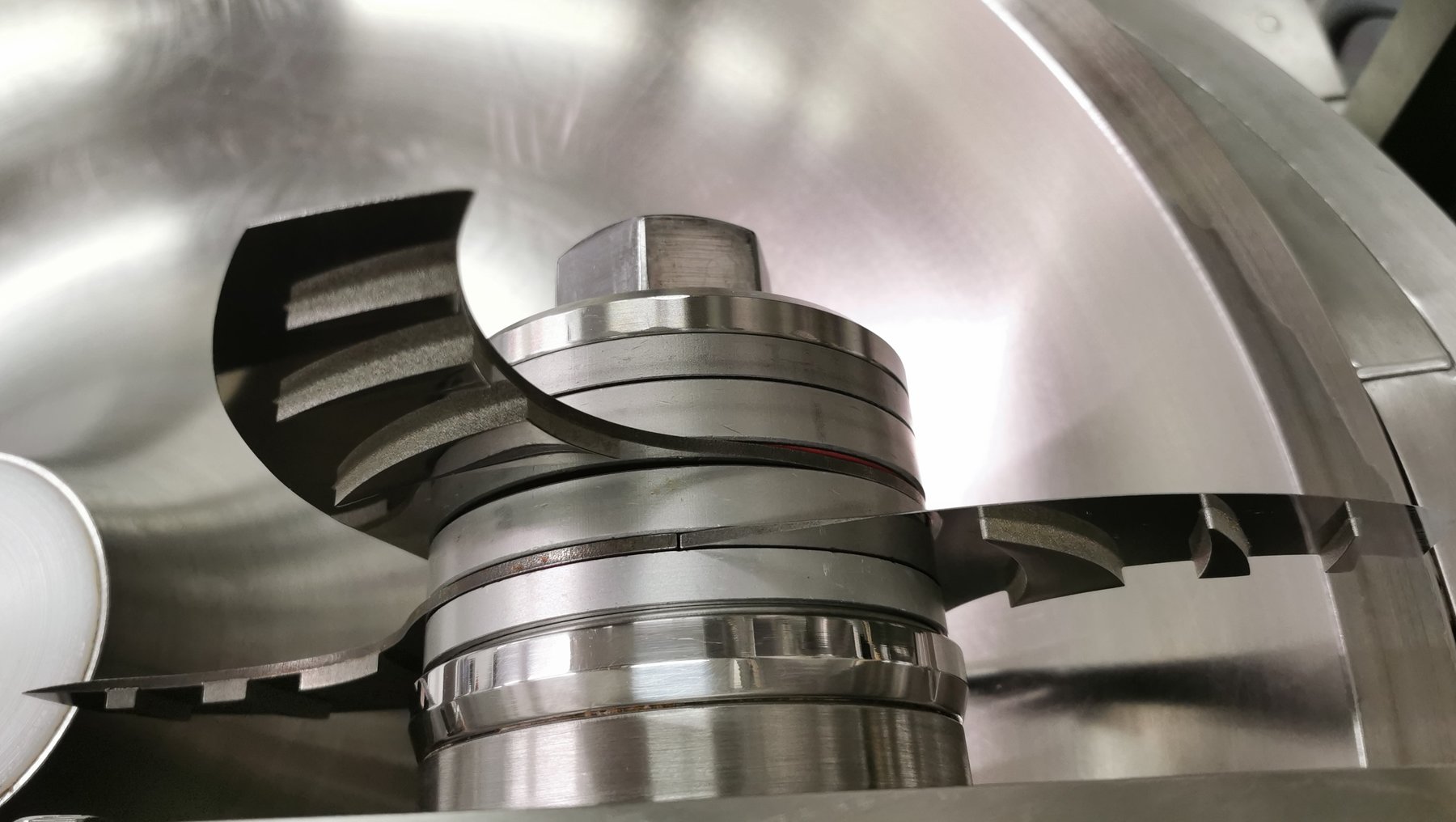 © CFSE
Development of multifunctional tools and the associated application processes for fine comminution and emulsification of fibrous amorphous products, in particular meat and fish, using a combination of cutting and impact
Combined application of impact and cutting stresses in straight and curved flow channels - development of constructive designs based on this for multifunctional tools and their applications in food processing
Prof. Dr. W. Schnäckel, Dipl.-Wirt.-Ing. (FH) I. Micklisch, Dipl. oec. troph. (FH) S. Warmuth
Funding
The project (ZF4184903PK7, 01.11.2017 to 30.09.2019) is funded by the Federal Ministry of Economics and Energy via the AiF as part of the Central Innovation Program for SMEs (ZIM) based on a resolution of the German Bundestag.
Background
Mechanical comminution and emulsification processes play a dominant role in the food industry, with the cutter representing a basic machine. In the cutter, coarse materials are comminuted by rapidly rotating tools and emulsified by friction. However, due to the shape of conventional tools and the discontinuous operation of a bowl cutter, its performance is very limited.
Objective
The aim of the project is to develop multifunctional tools to intensify fine comminution and emulsification as well as an adapted process. In the first step, comminution is to be intensified by significantly extending the cutting edge and a more effective tool constellation, and emulsification is to be significantly increased by means of an impact edge. In the second step, a continuous process is to be developed. When using conventional continuous cutters, only a low end product quality can be achieved due to the perforated disk-knife cutting sets (shear cut). With multifunctional tools, where the cutting process is based on a free cut, quality and productivity could be increased considerably.
Further research projects of the AG Food and Nutrition Research can be found here.
Anhalt University of Applied Sciences - Department of Agriculture, Ecotrophology and Landscape Development
BE Maschinenmesser GmbH & Co. KG

Federal Ministry for Economics and Energy
FKZ: ZF4184903PK7
