Anhalt University of Applied Sciences among the top 3 most sustainable universities in Germany
Sustainability has a particularly high priority at Anhalt University of Applied Sciences - and this is also reflected in the latest figures: Anhalt University of Applied Sciences was able to further improve its position in the international sustainability ranking "Green Metric". In 2024, it achieved 169th place out of 1,477 participating universities from 85 countries and thus remains in the top 200 most sustainable universities worldwide. Particularly noteworthy is the rise to third place among German universities.
"The 'Green Metric' ranking credits universities according to how environmentally friendly their infrastructure, energy and climate management, waste and water use, sustainable transportation and the integration of sustainability into teaching and research are," says Sabine Thalmann, Director of Central Administration. Despite the 25 percent increase in the number of participants, Anhalt University of Applied Sciences was able to improve its ranking - a paper for its consistent and future-oriented approach.
Anhalt University of Applied Sciences relies on concrete measures to promote sustainability in all areas. This includes saving energy, for example. Several PV systems on Campus Bernburg, for example, cover part of the electricity requirements in Strenzfeld by feeding the electricity generated directly into the campus's own power grid, where it is used by all buildings. The sports hall here was also renovated over five years to make it more energy-efficient - from the roof and façade to new windows. Inside, for example, the central heating system was automated and new radiant ceiling panels distribute the heat efficiently and as required. The energy for the hot water required is largely generated by a new solar thermal system on the building's own roof. "With these and other measures, we have reduced energy consumption by more than half in the last five years - from 190,000 to 77,000 kilowatt hours per year."
Sustainable measures are also being implemented at the other Anhalt University of Applied Sciences campuses. In Dessau, a photovoltaic system will be installed on a building this year. In Köthen, several roof areas are currently being examined. The new Interdisciplinary Research Center for Food Technology (InFonaL), whose construction will begin this year "Am Hubertus", is also being planned from the ground up to be energy-efficient and equipped with a photovoltaic system. "Our measures, our projects and our goals are based on the United Nations' 2030 Agenda. In the sustainability working group at Anhalt University of Applied Sciences, we are constantly developing new projects and strategies to further minimize our ecological footprint. To this end, we have set ourselves eight points in particular, such as the sustainable operation of the university or sustainability in teaching and research, in mobility or international networking with our partners, which should bring us to our goal."
The continuous progress shows that Anhalt University of Applied Sciences is not resting on its laurels, but is committed to responsible and sustainable development in the future - on campus and beyond.
More information:
www.hs-anhalt.de/nachhaltigkeit
Sustainability lecture series
Professors and external guest lecturers present the solutions Anhalt University of Applied Sciences has developed for its three campus locations and how these can be put into practice in the "Sustainability" lecture series every semester. The lecture series is open to all interested parties. Those who are unable to attend the events on site can participate online. Registration is not required.
More information:
www.hs-anhalt.de/nachhaltigkeit
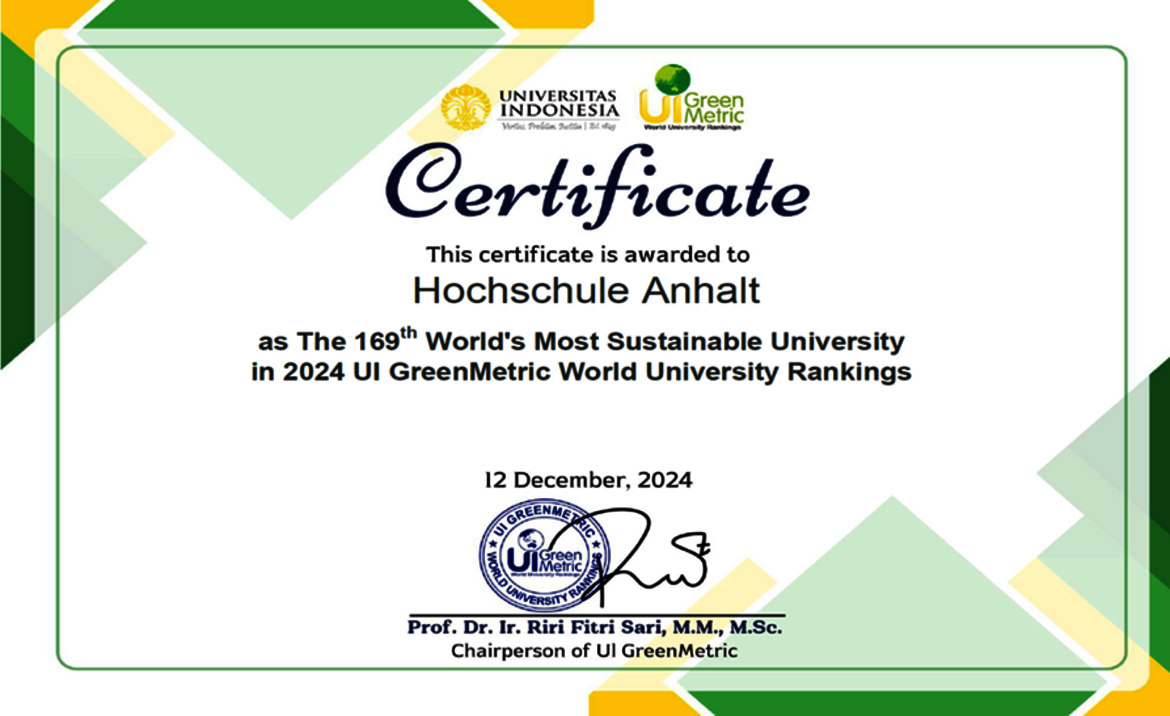 © Green Metric
