BATAWAY
-
 © FB 6, Ingo Chmielewski, all rights reserved
Development of a method for the targeted control of the spatial use behavior of bats towards wind turbines by means of species-specific ultrasonic sounds
Objective of the project
The basic aim of the project is to keep bats away from the rotating rotors of a wind turbine by emitting special ultrasonic sounds and to direct their flight paths into non-hazardous areas. In principle, these sounds should be emitted permanently in time windows of expected bat activity in order to actively keep the animals away. In areas with higher bat activity, this would result in a considerable increase in energy yields due to no longer necessary or shorter shutdown times of the wind turbines. Suitable components and test procedures are to be developed and tested for this purpose as part of the project. The scientific and technical foundations for the provision of such a technology are to be jointly developed here. The design and construction of a research demonstrator will also serve this purpose. The development and implementation of suitable examiner and test procedures that can prove the effectiveness of the technology are also the subject of the research and development work applied for.
Bat calls
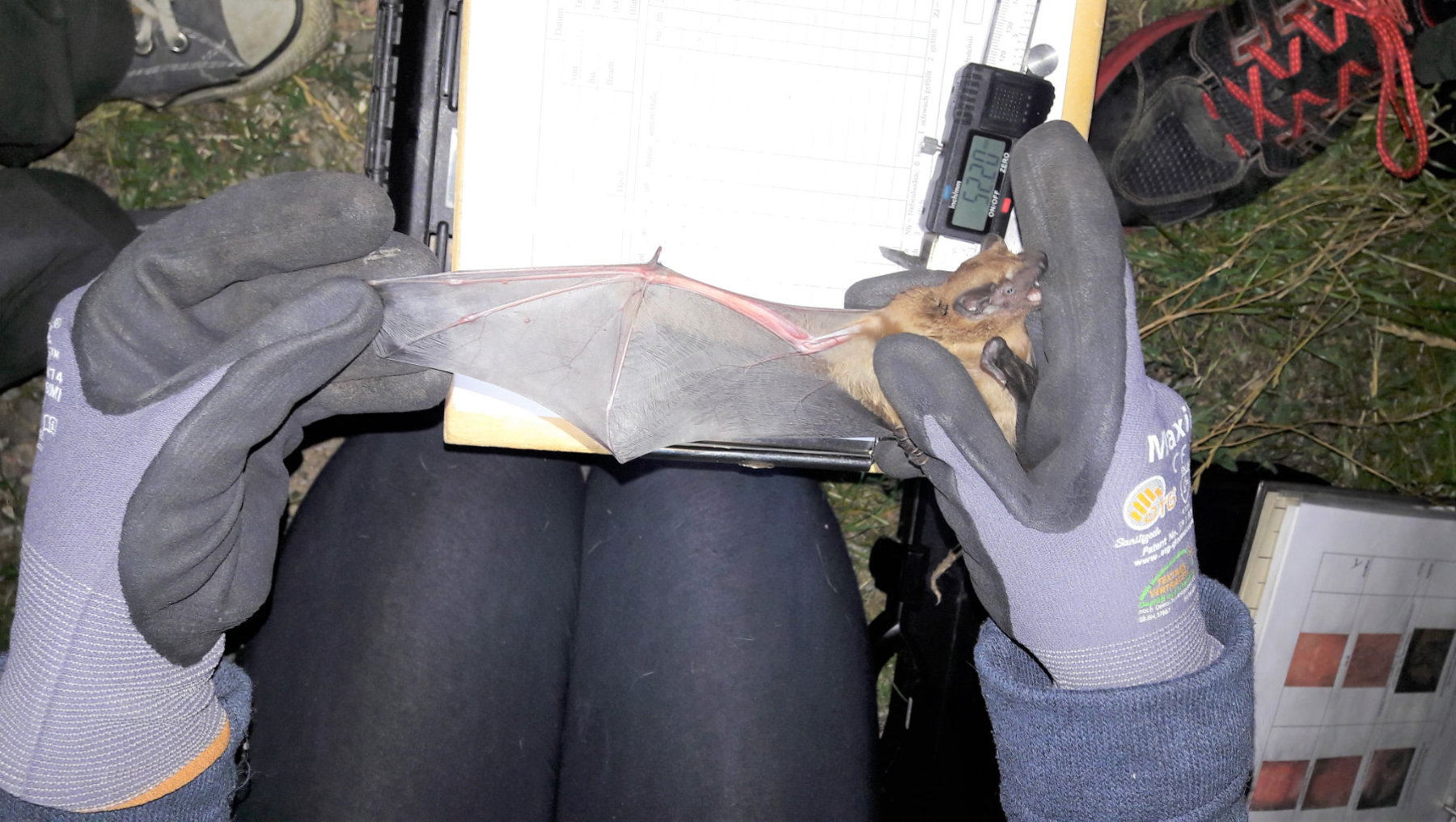
Specific social calls of the potentially affected bat species are to be used, namely warning and fear calls. For this purpose, individual animals (initially, common noctule bats and pipistrelle bats, both of which are particularly frequent victims of strikes, but are still relatively common and therefore at low risk, are planned as test species) must be captured and the corresponding sounds recorded in higher quality under captive conditions. The spectrum of corresponding social sounds of bats is relatively large, so that after recording the corresponding sounds, those that are particularly suitable for use must first be researched as planned. Two aspects are particularly relevant here:
- those sounds must be selected to which the animals react best by avoidance/escape and
- these sounds must be in the ultrasonic range so as not to be heard (by humans) in the vicinity of wind turbines (a number of social sounds in particular are also (partially) in the audible range below 20 KHz).
- The next step is to examine how and which of the identified suitable sounds of different species can be "mixed" (blended) with each other in order to be effective against different species at the same time.
Sound emitters and control
The sound emitters consist of powerful high-frequency loudspeaker arrays that are fed by a special power amplifier. The sound emitters must be designed to move in order to cover as large a spatial area as possible and to counteract the strong focusing of the loudspeakers at high frequencies. A power amplifier must be designed for this purpose. The design of the power amplifier is of particular importance for the system, as it must cover a wide frequency range (up to 100 kHz) and also be designed as an amplifier for very high power levels. The control of the amplifier is to be designed as a flexible microcomputer system that can not only generate mono-frequency signals, but can also function as a sweep generator and as a player for social sounds. The steering system will be embedded both in the wind turbine control system and in a central control center system. In addition, it is to be investigated whether the guidance systems can also be operated in a wind farm network and whether bats can be guided over a wide area around a wind farm (i.e. around a group of wind turbines).

Lorica Energiesysteme GmbH & Co. KG
Technikhaus Gündel GmbH
Leader
State of Saxony-Anhalt
