LTest – Packet-Level Network Measurement
Two network transfers can have the same average data rate and still behave very differently. One delivers packets steadily; the other pauses, loses packets or arrives in bursts. For a stream or a time-sensitive application, these differences can matter as much as the average.
LTest makes this behaviour easier to investigate. The Linux tool described by FILA combines traffic generation, distributed measurement and graphical analysis. An experiment can use a defined traffic profile and follow individual packets, connecting what was sent with what actually arrived.
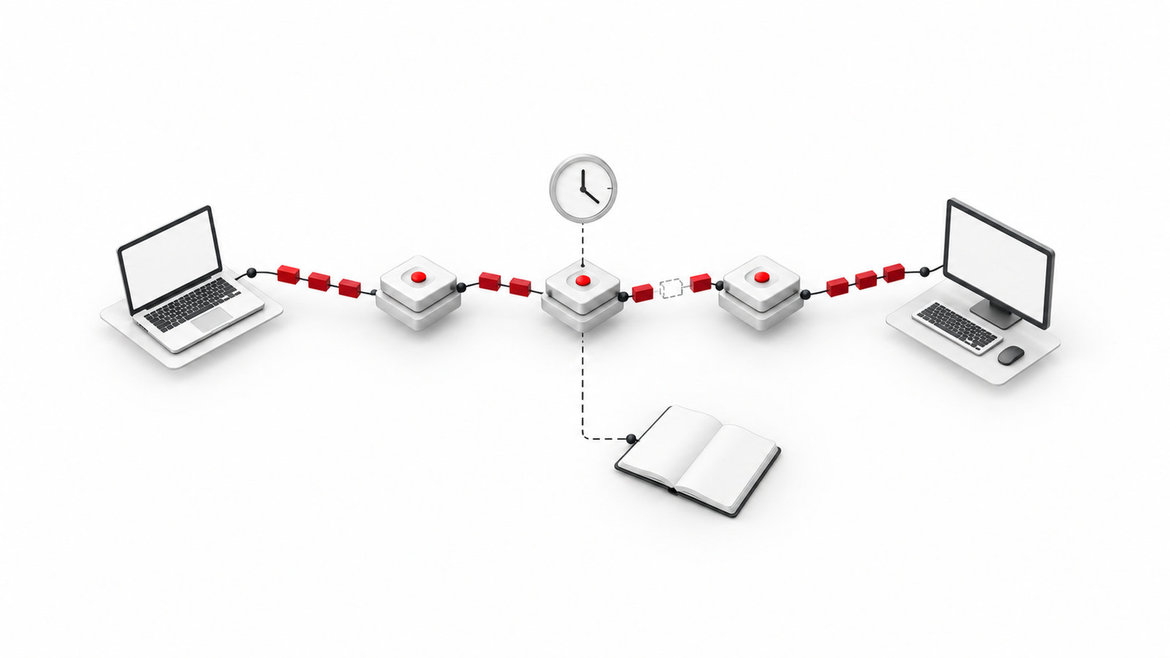 © FILA
Sender, test path and receiver form the experiment. Packet arrivals and missing packets make timing and loss open to inspection.
Looking at the packet sequence makes short disruptions visible. A traffic profile describes the load placed on the path; the resulting observations show when packets arrive and where delays or losses deserve a closer look. This helps connect an unusual interval in a plot with the conditions of the experiment.
The historical tool description includes constant-rate and Poisson-based traffic profiles and a graphical web interface. Different sending patterns can therefore be compared with the packet sequences observed at the receiver. Its clock-alignment method uses an improved Cristian approach with linear time interpolation; the quality of the time base remains part of the experimental setup.
Timing also needs careful interpretation. Measuring one-way delay requires comparable timestamps at the two endpoints. LTest describes an internal synchronisation method and the use of the HPTimer library, but a fine local time scale alone cannot establish that two hosts agree on the time.
System load, timestamp acquisition and virtualisation can affect the observations. Documenting these conditions makes a comparison useful to others. The selected papers below explain the timing foundations and execution context.
To use LTest in your own experiment, discuss the appropriate implementation and documentation with the FILA team. Include your target platform, measurement or transport scenario and required comparison data.
Selected publications
- Irina Fedotova, Eduard Siemens, Hao Hu (2013). A High-precision Time Handling Library. ICNS 2013: The Ninth International Conference on Networking and Services, 193–199 (IARIA).
- Veronika Kirova, Kirill Karpov, Eduard Siemens, Irina Zander, Oksana Vasylenko, Dmitry Kachan, Sergii Maksymov (2019). Impact of Modern Virtualization Methods on Timing Precision and Performance of High-Speed Applications. Future Internet, 11(8), article 179 (MDPI) DOI: 10.3390/fi11080179.

