RMDT – Reliable Multi-Destination Transport
A research dataset has to reach several laboratories. A video stream is needed at several locations at once. In both cases, sending the data is only part of the job: every receiver needs a complete, usable copy, even though its path through the network may differ from the others.
The Reliable Multi-Destination Transport Protocol (RMDT), developed at FILA, brings these deliveries together in one transport session. It uses UDP over existing IP connections and adds the mechanisms needed for reliable delivery and control of the sending rate. The research question is how to keep data moving when feedback arrives late, packets go missing and receivers have different network conditions.
 © FILA
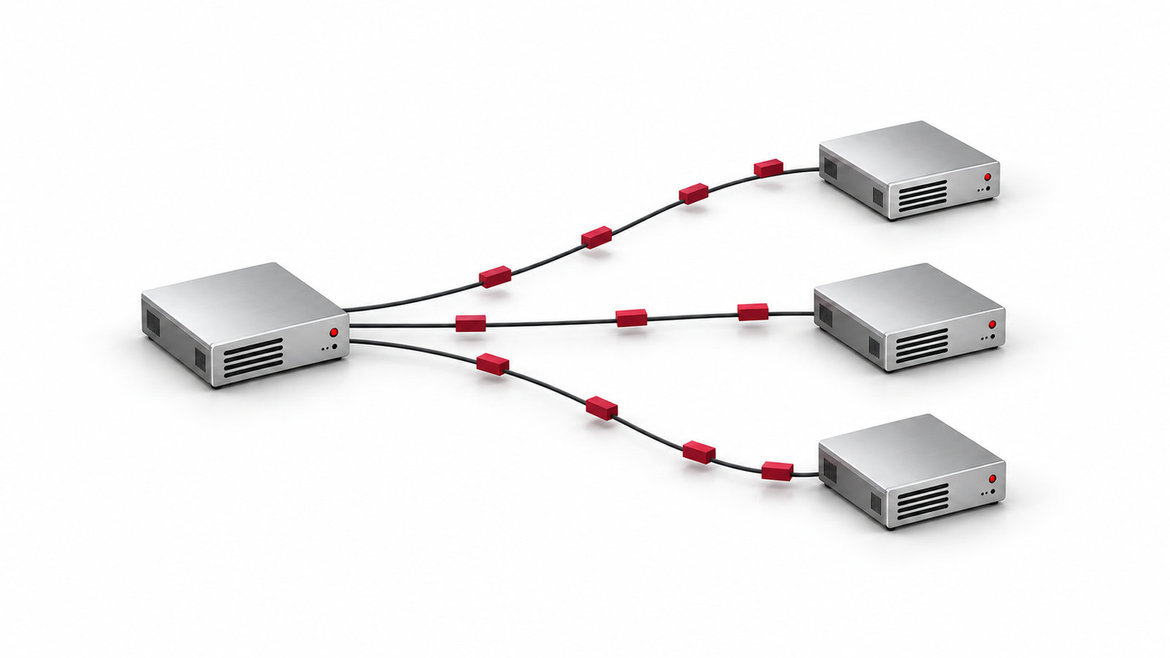
One sender supplies several receivers. Feedback and retransmission of missing packets support reliable distribution.
Receivers report what happens along their paths. This feedback helps the sender respond to missing data and adjust the sending rate. Several unicast streams can belong to the same session, so the approach does not depend on network-layer IP multicast being available between the sites.
A useful evaluation follows the data all the way to the receivers. Goodput—the rate of useful data delivered—is examined alongside loss recovery, delay and the processing and memory needed at the endpoints. A fast link alone does not establish that a complete dataset or a usable stream arrives in time.
Earlier RMDT research includes Bottleneck Queue Level (BQL), a delay-based congestion control approach. It combines use of available bandwidth with the aim of keeping bottleneck queues short. This complements loss recovery: retransmission repairs missing data, while sending-rate adaptation responds to available capacity.
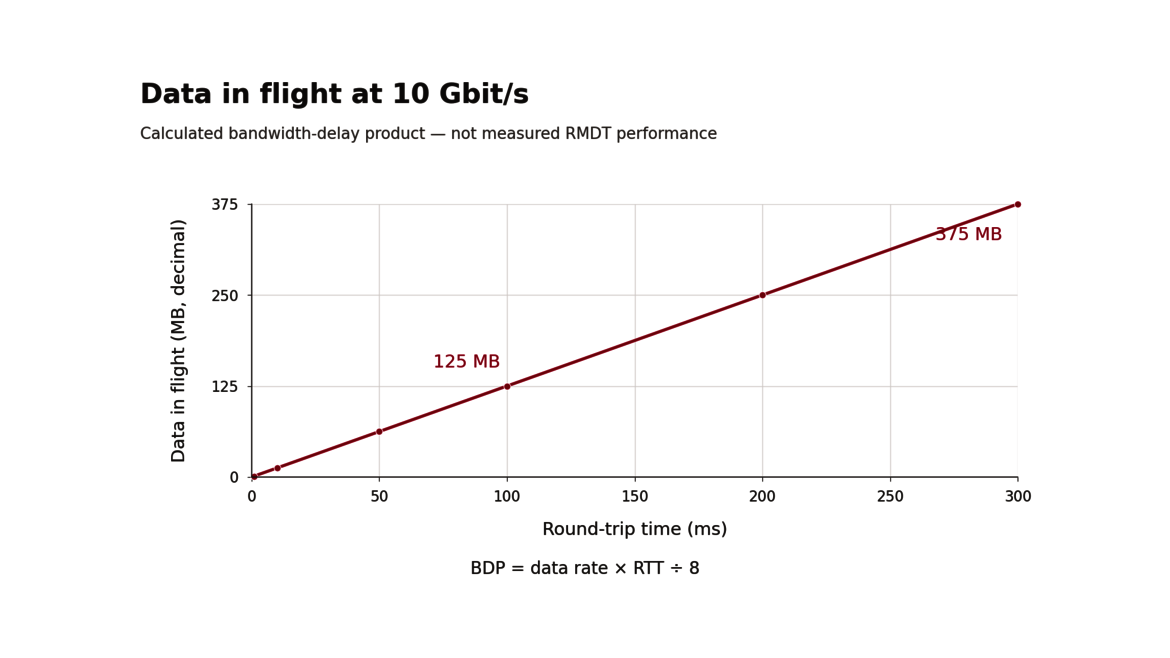
Distance adds another challenge. Time passes between sending data and receiving feedback. On a high-capacity connection, a large amount of data can already be in flight before the sender learns about a change. The bandwidth-delay product puts a number on that amount.
To use RMDT in your own experiment, discuss the appropriate implementation and documentation with the FILA team. Include your target platform, measurement or transport scenario and required comparison data.
 © FILA
A longer round-trip time means more data can be in flight: at 10 Gbit/s, 100 ms RTT corresponds to 125 MB and 300 ms to 375 MB. Calculation in decimal MB: BDP = data rate × RTT ÷ 8.
The calculation explains why feedback timing matters on long, fast paths. It gives a scale for data in flight; it does not measure the performance of RMDT. Protocol experiments need to state their receiver count, delay, packet loss and competing traffic before results can be compared.
For a larger receiver group, the next question is who forwards data to whom. Application-layer multicast chooses a distribution tree; RMDT provides the transport context. LTest helps examine packet behaviour, while HighPerTimer supports local timing operations. AI-RMDT extends this research towards learned transport control and related distribution and synchronisation methods.
Selected publications
- Nikolai Mareev, Dmitry Kachan, Eduard Siemens (2022). Multipoint Data Transmission Issues in High Bandwidth-Delay Product TCP/IP Networks. Progress in Advanced Information and Communication Technology and Systems, Lecture Notes in Networks and Systems 548, 277–295 (Springer) DOI: 10.1007/978-3-031-16368-5_14.
- Kirill Karpov, Dmitry Kachan, Veronika Kirova, Ali Ghermezian, Daria Koshutina, Eduard Siemens (2025). Tunable Multi-Objective Tree Synthesis for Application-Layer Multicast. Proceedings of the International Conference on Applied Innovations in IT (ICAIIT), 13(5), 69–74 DOI: 10.25673/122809.

