The Project
 © EduXBot
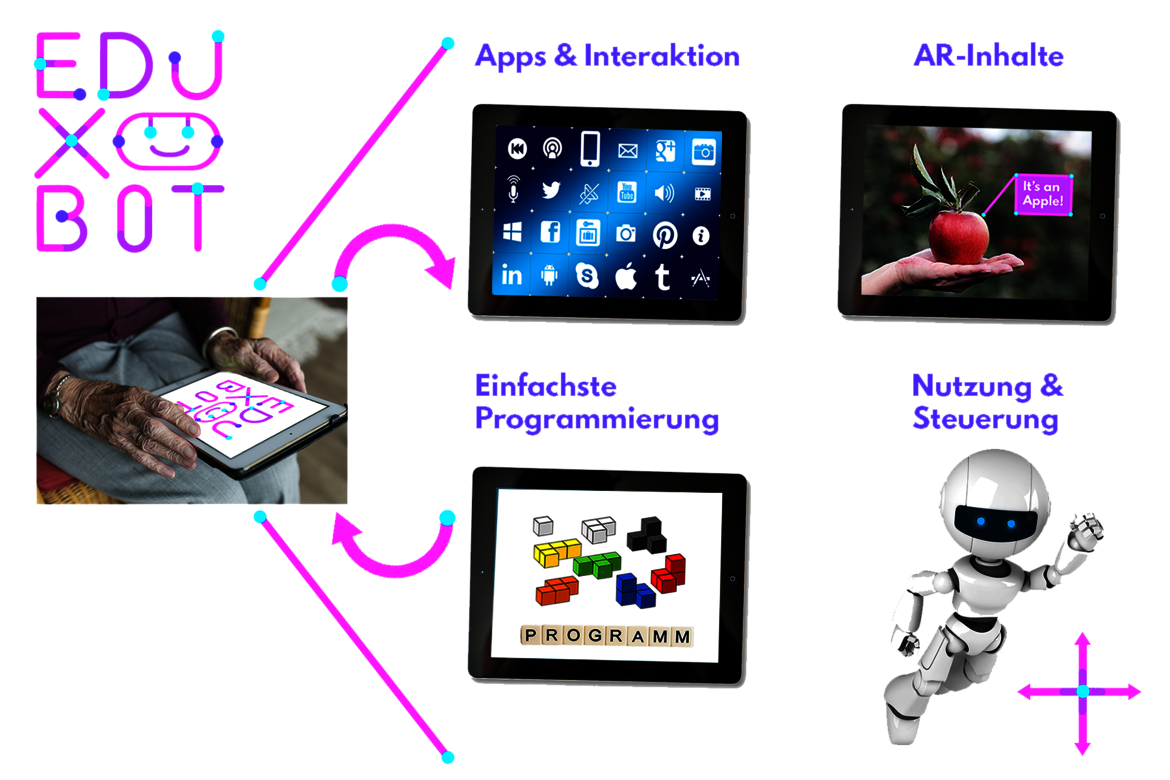
Co-creative development of an experience and learning platform for robotic interaction.
EduXBot was funded from January 2023 through December 2025 by the Federal Ministry of Research, Technology, and Space (BMFTR) (“FKZ 03WIR3118A”) as part of the WIR! program “Change Through Innovation in the Region” and was successfully completed in December 2025. The final reports for both subprojects have been publicly available since 2026 (see below). EduXBot was also an active partner and member of the TDG Alliance—Translation Region for Digital Healthcare. The project focused on participatory research and development with and for older adults and people with limited mobility, with the aim of supporting and motivating them to remain mentally and physically healthy.
By combining modern interactive media, a modular software architecture and robotics technologies, EduXBot aims to take the use of digital technologies to the next level in the care/support of people with disabilities/beginning care needs/forced isolation or restricted mobility due to various causes. EduXBot thus represents an "experience and learning platform based on a robot".
Due to the co-creative nature of the project, end users, developers from education and industry, care scientists and stakeholders are involved in every phase of the project from start to finish. This is to ensure that the project achieves its objectives in terms of user and consumer needs. For these reasons, the project includes a wide range of partners, including the Anhalt Köthen University of Applied Sciences, the AG Versorgungsforschung | Pflege im Krankenhaus (MLU) and IMSYS GmbH & Co. KG.
From Anhalt University of Applied Sciences in Köthen, experts in the fields of robotics, machine learning, automation and AR/VR are already equipped with the latest innovative technologies and developers to bring the vision of the project to life!
We would be delighted to hear from you, get in touch with us!
Project Completion and Outlook
 © HSA
© HSA
Project Successfully Completed
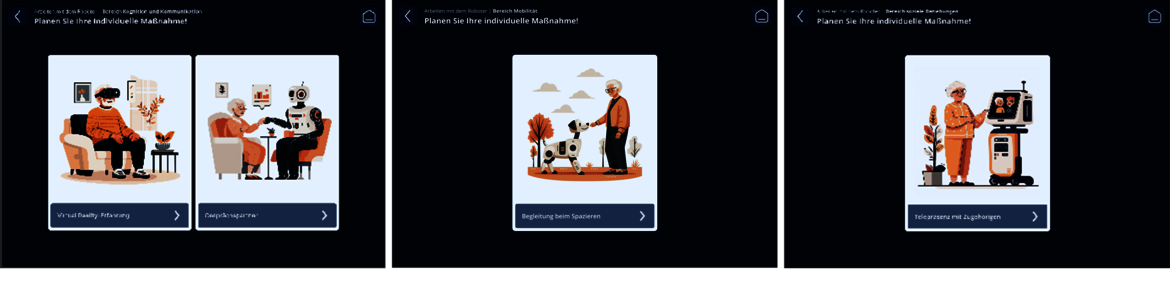
EduXBot was successfully completed in December 2025. The project resulted in a modular, co-creatively developed platform that combines robotics, augmented and virtual reality, and applications in elder care. The final proof of concept integrates three in-house solutions via a single user interface that can be operated by caregivers:
- Double3 robots—as self-learning conversation partners to promote mental fitness and as telepresence systems for intuitive remote visits.
- Unitree Go1 – A robotic dog designed to accompany users on walks both indoors and outdoors, featuring safety functions such as fall detection and alerts to caregivers.
- Pico 4 VR Headset – a biographical project involving the re-experiencing of recorded 360-degree memories.
Significant technical advances—including improved noise cancellation for reliable voice interaction in noisy communal areas and optimized mapping to reduce false identifications—overcame key limitations of existing platforms. The system achieved high levels of acceptance among professional caregivers at the Am Lutzepark Municipal Nursing Home in Köthen and at the Bitterfeld/Wolfen Health Center gGmbH.
We are looking for partners for a follow-up project
The project results provide a validated technical foundation for practical application. To continue development and integrate the prototypes into everyday nursing practice, applications for follow-up funding have been submitted. We are actively seeking partners from academia, industry, and the nursing field for a follow-up project—please feel free to contact us at: Stefan.Twieg@hs-anhalt.de
Final reports
 © HSA
© HSA
Sub-project: Anhalt University of Applied Sciences (FKZ 03WIR3118A)
Twieg, S.; Rajanayagam, S.: EduXBot – Educational Exploration Robot Application Platform. Part I: Brief report / Part II: Detailed account. Hannover: Technical Information Library, 27.02.2026. DOI: 10.34657/31030
→ View and download the report (PDF, 2,19 MB)
Sub-project: Martin Luther University Halle-Wittenberg (FKZ 03WIR3118B)
Müller, P.; Jahn, P.: EduXBot – Educational Exploration Robot Application Platform. Sachbericht. Hannover: Technical Information Library, 20.05.2026. DOI: 10.34657/36064
→ View and download the report (PDF, 1,07 MB)
Current publications
S. Rajanayagam, M. A. Ingrisch, P. Müller, P. Jahn, and S. Twieg, “Enhancing Voice Activity Detection for an Elderly-Centric Self-Learning Conversational Robot Partner in Noisy Environments,” Apr. 2025, doi: 10.25673/119209.
Menghani RV, Rajanayagam S, Twieg S. Optimized Indoor and Outdoor SLAM for a Quadruped-Based Robot Walking Partner to Safely Promote Elderly Mobility and Support Nursing Staff”. Irish Signals and Systems Conference (ISSC 2025). 9-10. Juni 2025 in Letterkenny (Irland) DOI: 10.1109/ISSC67739.2025.11291245
Kurumbaparambil, V.; Rajanayagam, S.; Twieg, S. Vision-Based Person-Following Algorithm for Assistive Elderly-Care Quadruped Robots. Sensors 2026, 26, 3263. doi.org/10.3390/s26103263
Kurumbaparambil, V.; Rajanayagam, S.; Twieg, S. Practical Integration of Open-Source Control Architectures on Custom Quadruped Robots: Simulation Validation and Hardware Interfacing. Sensors 2026, 26, 4730. doi.org/10.3390/s26154730
Müller P, Gali HKR, Rajanayagam S, Twieg S, Jahn P, Hofstetter S. Making Complex Technologies Accessible Through Simple Controllability: Initial Results of a Feasibility Study. Appl. Sci. 2025;15:1002. DOI: 10.3390/app15021002
Müller P, Jahn P. Cocreative Development of Robotic Interaction Systems for Health Care: Scoping Review. JMIR Hum Factors. 2024;11:e58046. DOI: 10.2196/58046
Müller P, Hofstetter S, Jahn P. Sustainable Implementation of Digital Assistive Technologies in Health Care Through a Simplified Interaction and Control Platform: Protocol for a Cocreative Feasibility Study. JMIR Res Protoc 2025;14:e63089. DOI: 10.2196/63089
Strategic Project Management and Employees




The BMBF promotes international cooperation in education, science, research and technology with European - and increasingly also Central and Eastern European - and non-European countries and within international organisations such as the EU, UNESCO and the Council of Europe.

The programme line "WIR! - Change through innovation in the region" provides the impetus for new regional alliances and sustainable innovation-based structural change in all structurally weak regions of Germany.

TDG stands for digitalised healthcare with a focus on nursing care and maintaining autonomy in old age.

The working group Care Research | Nursing in Hospitals is an interface for incorporating findings from care and nursing research into acute inpatient practice, particularly in the focal areas of oncology, cardiovascular diseases and geriatric medicine in Halle. This is unique in Germany for a professorship in nursing science, combining the tasks of teaching and research with patient care.

IMSYS has been one of the leading XR agencies for consulting, planning and project management of digital working environments for over 20 years. We specialise in well-coordinated media concepts, planning services, implementation and service solutions for virtual reality, augmented reality and mixed reality environments.
