Adaptive street lighting with wireless sensor networks
A cyclist approaches a dark section of a path. The lights should illuminate the route in time and reduce their output once nobody needs them. SmartLighting investigates this interaction between motion detection, wireless communication and distributed control.
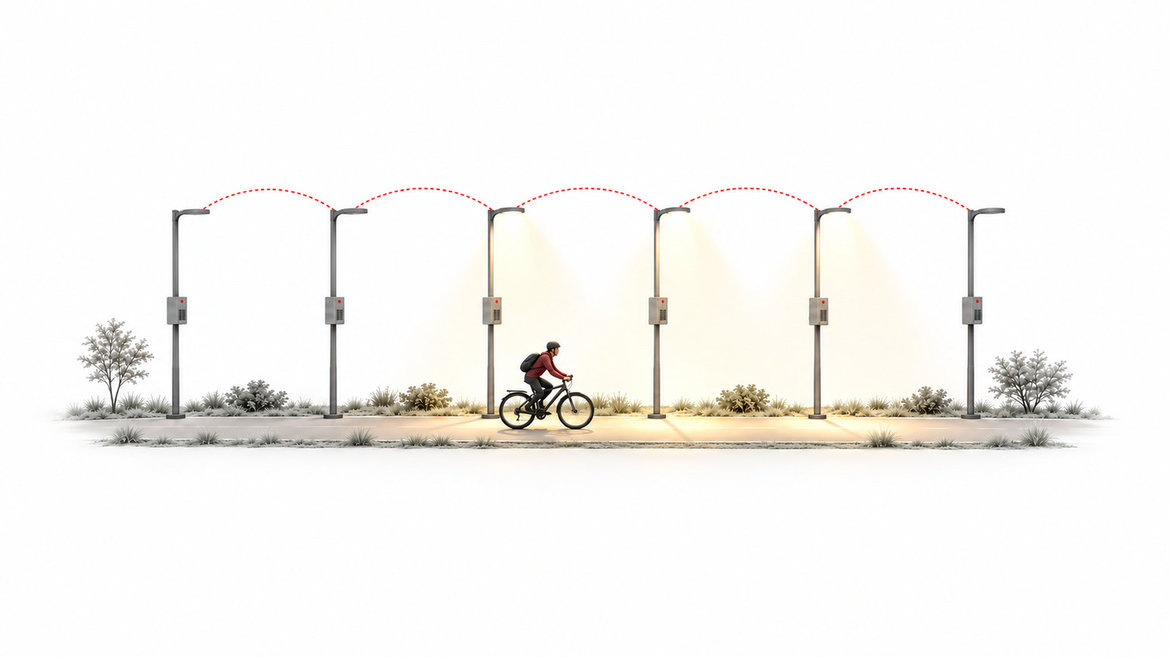
Lighting nodes exchange information with their neighbours rather than responding only to their own sensor. Detected movement becomes an illuminated zone along the route. Street lighting thus becomes an application of a sensor network: sensing, message exchange and the lamps' response have to work together.
Development progressed from a laboratory model to the Bernburg-Strenzfeld test installation and later to the SLBasis application with the city of Dessau-Roßlau. These activities connect practical lighting needs with research into detection, communication and system configuration.
 © FILA
An illuminated zone follows movement along the route. Neighbouring lamps coordinate their lighting through the network.
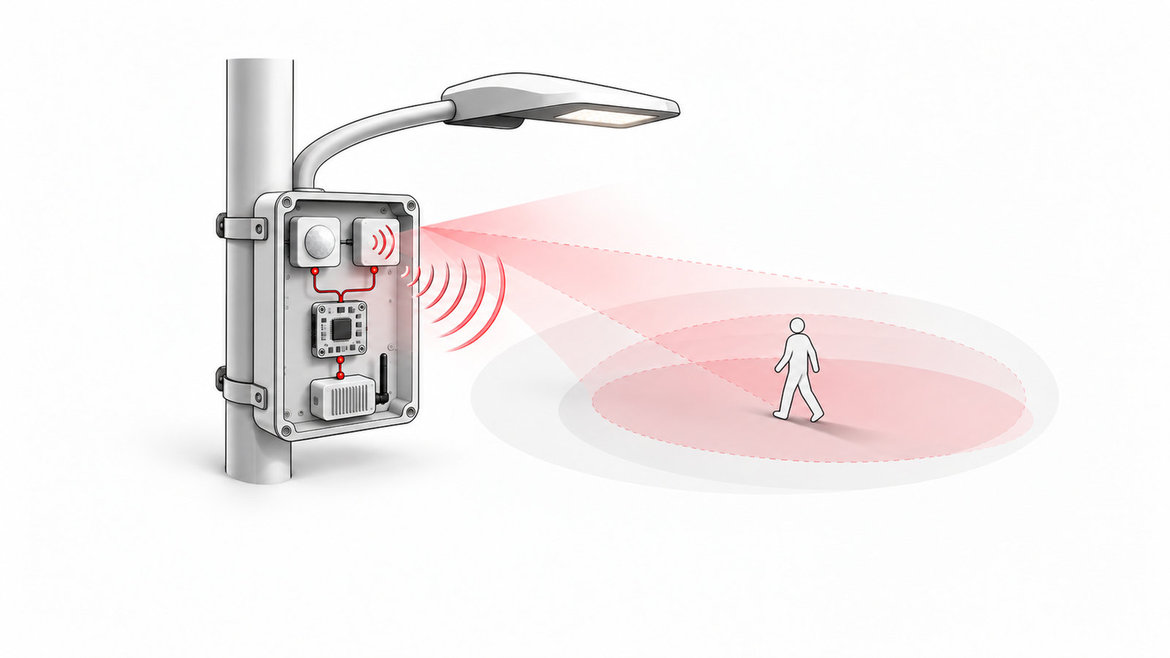
In the historical design, timestamps of motion events help determine a movement direction. A message describes the desired lighting zone ahead, behind and to either side. Neighbouring nodes use their position to decide how to forward that information and control their lamp. A local detection can thus influence illumination along a path.
Research topics
- Distributed control, sensor data fusion and motion vector recognition for predictive lighting strategies.
- Communication and routing methods for static ad hoc networks.
- Automatic configuration and localisation of distributed lighting nodes.
- Analysis of traffic and movement data for transport planning and infrastructure.
 © FILA
Sensors detect movement; processing in the lighting node connects these signals with communication to neighbouring lamps.
Laboratory prototype and test installation
The laboratory prototype connected 20 miniature lamps with ARM-based Linux controllers. Motion sensors and communication interfaces allowed detection and message exchange to be investigated in a manageable setup.
The Bernburg-Strenzfeld road installation comprised 19 SmartLighting subsystems in late 2017, using PIR sensors and WLAN components. Photovoltaic panels and batteries supplied the lamps; two subsystems had mobile internet connections.


Publications and project history
SLBasis Dessau
SLBasis Dessau developed SmartLighting for an urban application. Anhalt University and the city of Dessau-Roßlau worked from 1 November 2019 to 31 October 2022 to install, commission and optimise motion-sensitive lighting. The project was funded by ERDF and the state of Saxony-Anhalt.
Institutional project overview (PDF, p. 14)
Selected publications
- Ivan Matveev, Eduard Siemens, Dmitri Dugaev, Aleksey Yurchenko (2017). Development of the Detection Module for a SmartLighting System. Proceedings of the 5th International Conference on Applied Innovations in IT (ICAIIT), 5(1), 87–94 DOI: 10.13142/KT10005.34.
