Multimodal AI for location and route prediction
A GPS history records where a vehicle has travelled. A conversation can add context about a destination or planned journey. AURORA investigates how movement histories and speech information can be combined to predict possible locations and routes.
The approach brings together machine learning and deep learning with speech recognition, speaker identification and semantic analysis. Named Entity Recognition can, for example, extract relevant place references from speech. The research question is how these clues can be analysed alongside movement patterns in time and space, including when only short histories are available.
Related FILA research studies this combination in GTA-NarrativeTraj, a dataset linking coordinates and dialogue from a simulated game world. These controlled data support investigation of language context and temporal alignment; evaluation for real mobility requires suitable data and experimental conditions. Read the published dataset study.
AURORA-GPS is funded through the Central Innovation Programme for SMEs (ZIM), funding reference KK5004811MA4. The approved project period runs from 1 January 2025 to 31 December 2027.
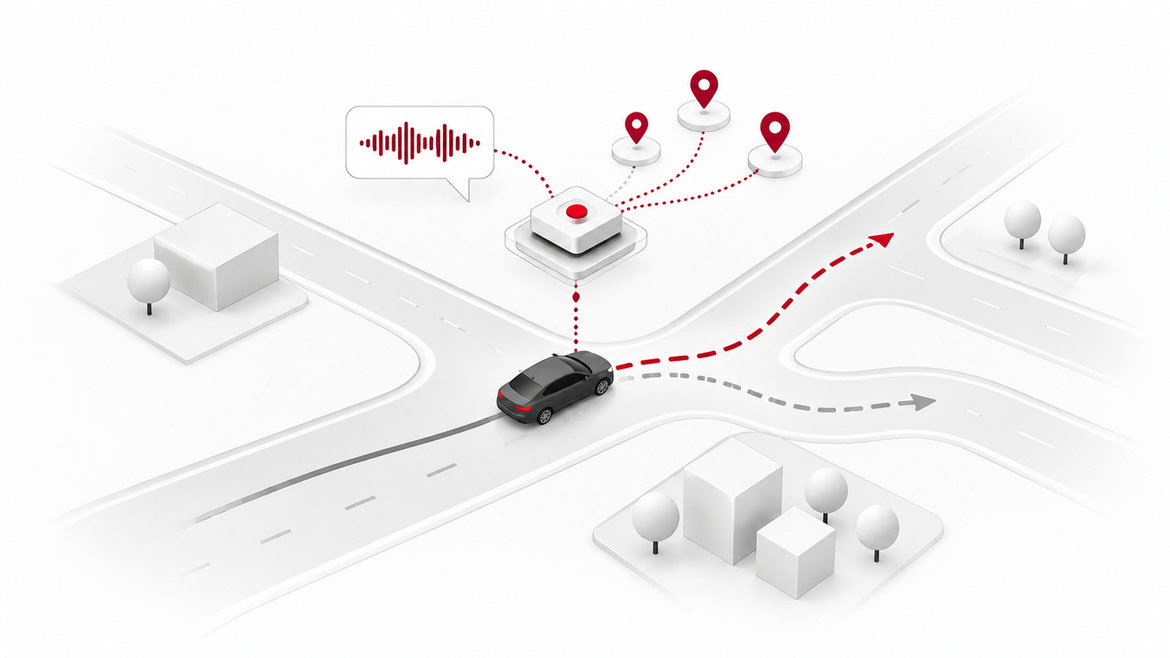 © FILA
A movement history describes past routes. Speech context adds clues that are investigated when predicting possible routes ahead.
Research topics
- ML- and DL-based methods for location and route prediction from GPS data.
- Semantic analysis of speech context and its integration into prediction models.
- Multimodal learning methods for combining different data sources.
- Analysis of prediction accuracy, robustness and the trustworthiness of AI models.

