Evaluating ML Models Against Physical Predictions for PV Energy Production in Malta
-
 © Brodina Kravchuk Melnyk
Accurate forecasting of photovoltaic (PV) energy production is a key challenge in modern renewable energy systems, especially in regions with highly variable weather conditions such as Malta. This project investigates how advanced machine learning (ML) models compare to traditional physics-based approaches in predicting short-term solar energy output.
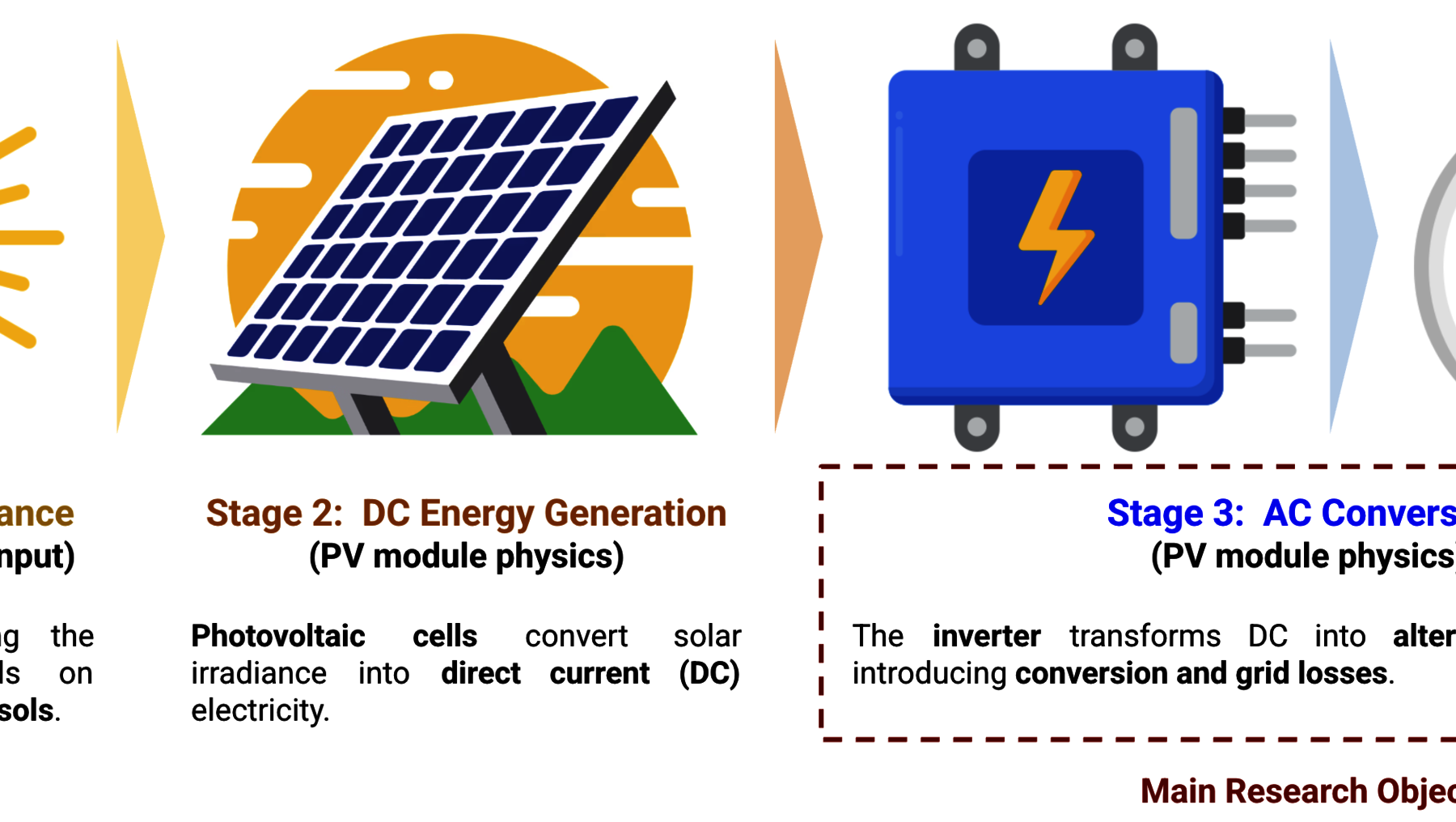
The study focuses on the full PV production pipeline, including solar irradiance, DC energy generation, and AC conversion. Using data from six measurement stations, the dataset consists of multivariate time-series observations, including environmental variables (irradiance, temperature, wind speed) and electrical outputs (DC and AC power).
The project compares several state-of-the-art approaches for time-series forecasting, including LSTM with attention mechanisms, Temporal Fusion Transformers (TFT), and PatchTST architectures. Results show that transformer-based models outperform traditional recurrent approaches, achieving the lowest prediction error and demonstrating superior capability in capturing long-range temporal dependencies.
A key challenge identified in the study is the impact of cloud cover, which introduces high variability and limits prediction accuracy. To address this, the project proposes integrating additional data sources such as fisheye sky cameras and optimized pyranometer networks.
Overall, the project highlights the potential of combining data-driven and physics-informed approaches to improve renewable energy forecasting and support more efficient energy management systems.

