Forest Road Segmentation and Anomaly Detection
-
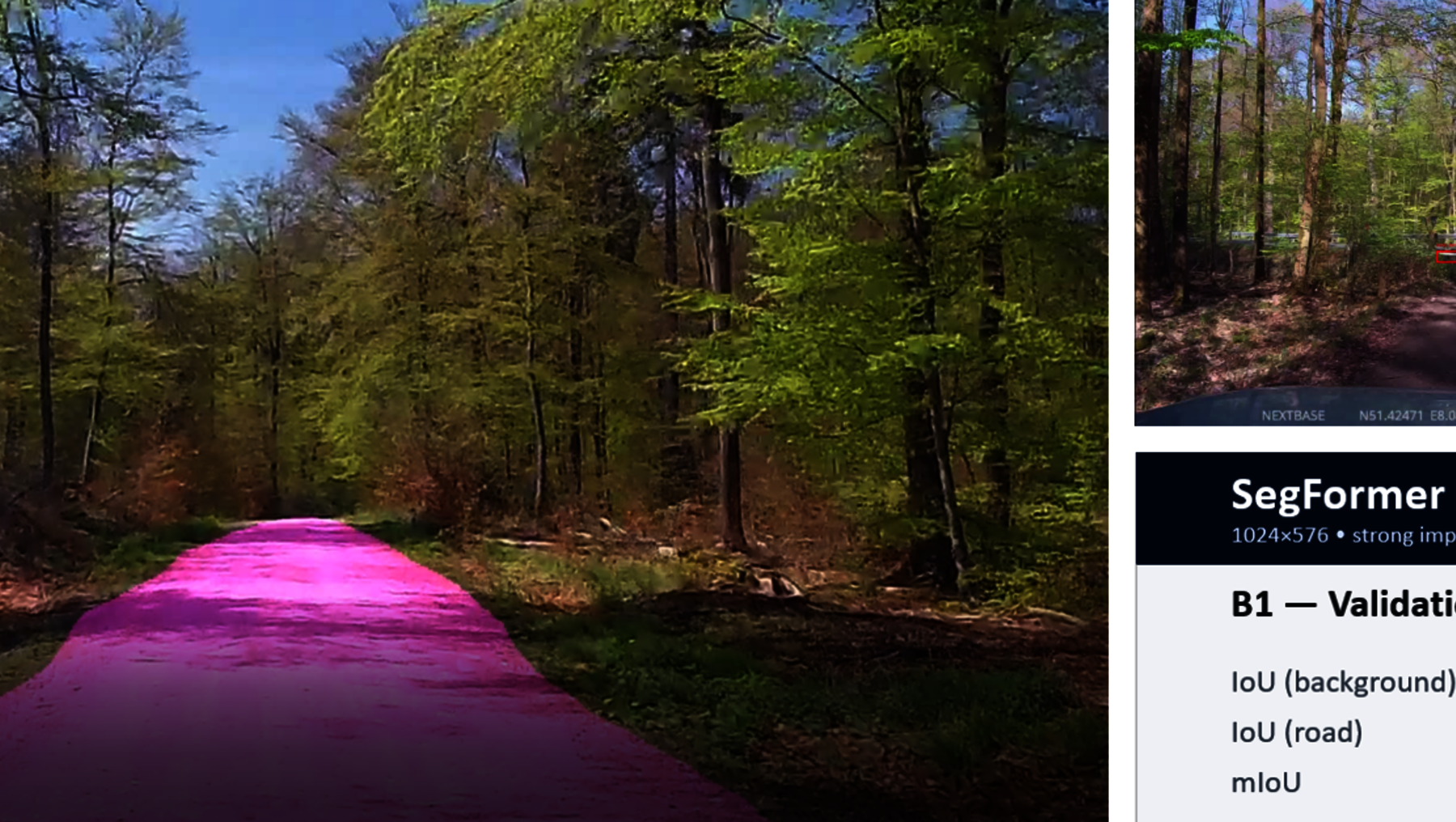 © Chuzhda Matushevskyi
1. Problem Description
Monitoring forest roads is a critical task for environmental management, infrastructure maintenance, and safety.
However, automating this process using dashcam video data is challenging due to several factors:
- Variable lighting: strong illumination changes and deep shadows from trees
- Image artifacts: motion blur and partial occlusions
- Complex textures: low contrast between the road and the surrounding environment
2. Methodology: Two-Stage Approach
To address this problem, a structured two-stage pipeline was developed.
Stage I: Region of Interest (ROI) Extraction
The main goal is to separate the road from the background and restrict further analysis to relevant areas.
- Model: SegFormer B1 for binary segmentation
- Data: dataset of 644 labeled frames
- Result: a stable road mask that serves as the foundation for subsequent processing
Stage II: Anomaly Detection and Road Condition Analysis
The road mask allows the system to ignore irrelevant regions (forest, sky) and focus only on the road surface.
- Functionality: segmentation of problematic areas (potholes, obstacles, surface damage) directly on top of the road mask
- Advantage: significant reduction of false positives outside the road region
3. Results and Metrics
The Stage I model demonstrates strong segmentation performance even under challenging conditions (shadows, complex textures):
Metric Value
IoU (Intersection over Union) 86.35%
F1-score 92.68%
4. Conclusion
The results confirm that accurate road segmentation is a critical foundation for building a reliable road monitoring system.
As shown in the examples, problematic road regions can be successfully segmented directly on top of the base road mask. This hierarchical approach enables efficient transformation of raw video data into structured information and ensures robust detection of anomalies and obstacles, even in complex and dynamic forest environments.

