Unsymbols: AI-Driven Creation of Symbols That Never Existed
-
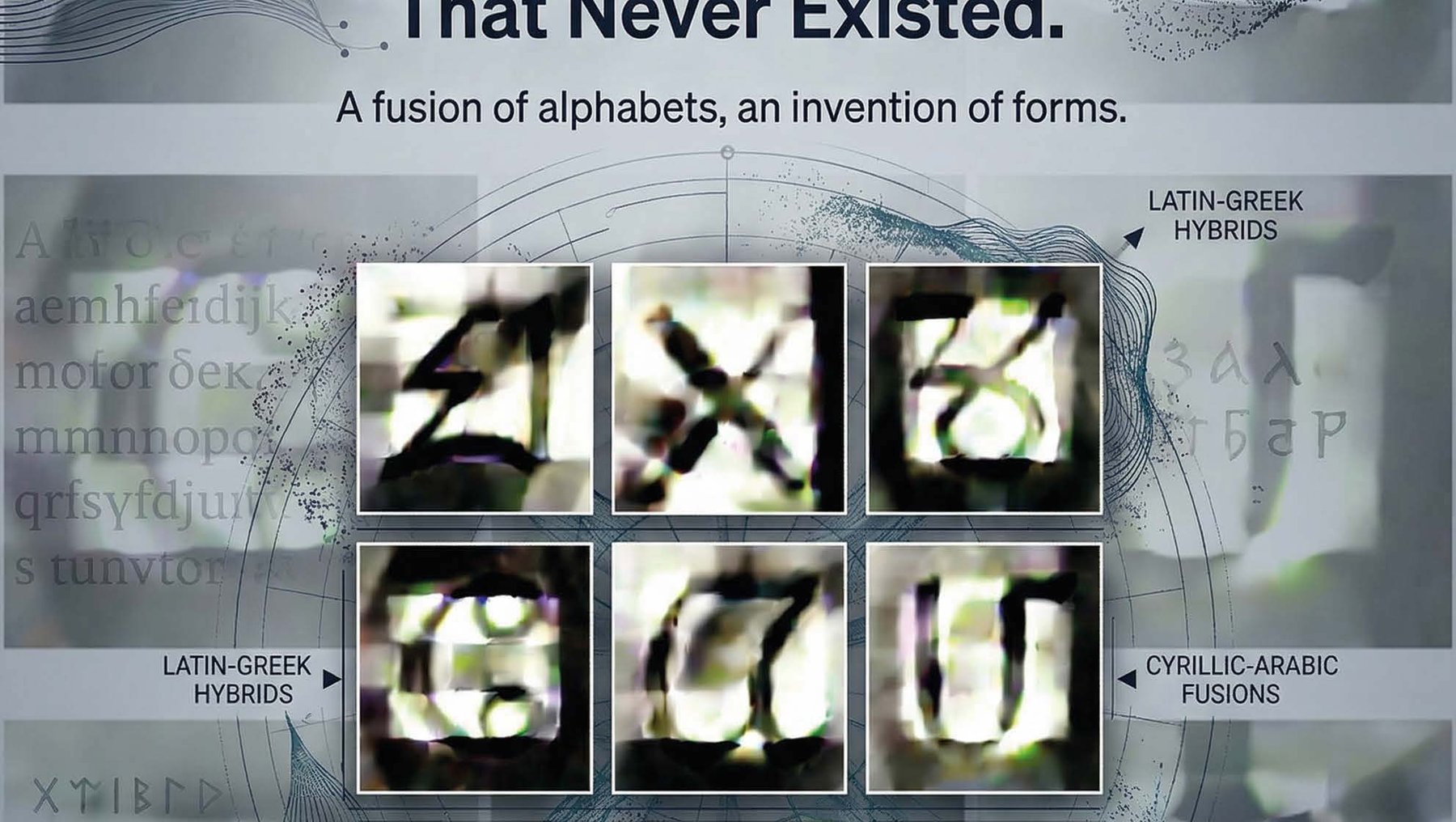 © Dmytro Khar, Maksym Namchuk, Ihor Vitenko
Can artificial intelligence invent symbols that have never existed in any writing system? The Unsymbols project explores this question by using generative deep learning to produce entirely novel characters that blend visual properties of two real alphabets – without belonging to either.
The approach is based on Conditional Flow Matching, a generative modelling technique that learns a continuous vector field to transform one probability distribution into another. As source and target distributions, we selected two visually distinct symbol sets: NotoSansLimbu, a Limbu Unicode script with organic, curved strokes, and Aurebeth, the fictional Star Wars alphabet characterised by geometric, angular shapes. Both were converted to 512×512 pixel images and encoded into a compact latent representation using the pre-trained Stable Diffusion XL Variational Autoencoder (VAE), reducing the dimensionality from over 260,000 to approximately 16,000 values per symbol.
A time-conditioned multilayer perceptron (VectorFieldNet) was trained on pairs of source and target latents to predict the velocity field along straight-line interpolation paths. At inference time, starting from a Limbu latent with a small amount of added Gaussian noise, the learned velocity field is integrated forward using 25 Euler steps. The resulting latent is then decoded back into a pixel image through the VAE decoder, producing a novel symbol.
The generated outputs exhibit clear symbol-like structures with a mix of angular and curvilinear features, confirming that the model has learned a meaningful transformation rather than simply memorising training data. A t-SNE visualisation of the latent space shows that the generated symbols form a distinct cluster, separate from both source alphabets.
Technologies used: Python, PyTorch, Stable Diffusion XL VAE, scikit-learn, Git.

