The Residence Act
Your residence in Germany depends on various factors. These are regulated in the Residence Act.
There are different residence titles with different provisions for different residence purposes.
1. §16 b Residence for the purpose of education-study
 © Foto: Daniel Karmann/dpa +++ dpa-Bildfunk +++ | Verwendung weltweit
moz.de
© Foto: Daniel Karmann/dpa +++ dpa-Bildfunk +++ | Verwendung weltweit
moz.de
The residence permit according to § 16b AufenthG is issued for the purpose of full-time programs andalso includes preparatory study measures and the completion of compulsory internships. This regulation enables students to prepare for their studies by taking part in language courses or attending a preparatory college if this is required for admission to the course.
A residence permit in accordance with § 16b is issued if the student has been admitted to a full-time program by a state or state-recognized university. This permit is generally limited to two years, but can be extended if the conditions are still met and the progress of the studies justifies this.
Admission requirements to be fulfilled
You must have been admitted to a full-time program by a state-recognized university or comparable educational institution in Germany. Your academic prerequisites include:
- Full-time program: Your studies must be full-time
- Study preparation measures: Including attendance of language courses and preparatory courses if these are required for your admission.
- Language skills: You must demonstrate sufficient knowledge of the language of instruction, unless this has already been examined as part of the admission decision
(For English courses usually C1/IELTS 6.5; for German courses C1/TestDaF 4x4 - see course website for details).
Financial proof
In order to obtain a residence permit, you must be able to prove your financial independence during your stay in Germany. Required proofs include:
- a blocked account (from October 2024) with the amount of €11,904.00 and a monthly disposal of €992.00 as well as annual renewal
- Proof of a declaration of commitment according to § 68 Residence Act from a foreigners authority (guarantor must have German citizenship or settlement permit & prove financial resilience to the ABH by providing proof of salary. Please note! The original remains with the ABH when the application is submitted, i.e. a new/current declaration of commitment must be submitted with each subsequent application).
- Scholarships (in the amount of the monthly blocked account amount)
- Costs and fees: There are certain fees for the initial issue and extension of the residence permit approx. 100€ per application
- Proof of salary from part-time jobs MAY (but does not have to) also be accepted as a (partial) replacement for the blocked account. However, this is at the discretion of the case officer. Make sure that the sum of your salary statements also plausibly corresponds to the maximum permitted annual working days (see 1c)
The opportunity to work while studying is an essential part of the residence permit under Section 16b AufenthG, offering both financial independence and valuable work experience for international students in Germany. From March 1, 2024, there will be a significant change that will offer students more flexibility in their work options.
The key points are:
- You are allowed to work up to 140 full working days (8h) or 280 half days (4h) per year - The limits were raised with the March 24 reform
- During the semester, the weekly working time may not exceed 20 hours
- During the semester break, you may work without restriction (i.e. up to the legal maximum of 40h/week)
- Student part-time jobs (i.e. employment as a student assistant at your university) are not counted towards the weekly or annual limits
- Please note that self-employed activities (freelance work) are generally excluded by the immigration authorities. Please read the ancillary provisions of your residence permit (green slip) to see whether you can find the statement "self-employed activity not permitted" there.
- In the case of a lab placement, it depends on whether it is a compulsory internship (a fixed part of the study/module regulations) or a voluntary internship. If the lab is part of your degree course (and therefore compulsory), the working hours do not count towards your annual limit, as you are supposed to gain specific work experience as part of your degree course. If it is a voluntary lab or thesis that you want to do on your own initiative, e.g. to expand your experience and thus your job opportunities, then the working days will count towards your annual limit.
In many cases, however, it is possible to get an extension of the annual working days approved afterconsultation with the immigration authority(if the remaining days are no longer sufficient for the internship) - as long as the internship is relevant to the course content.
Please note: The minimum wage regulation does not apply to compulsory internships, which is why they are usually unpaid (the "experience" is considered as payment in this case).
Family reunification for people who have a residence permit in accordance with Section 16b of the Residence Act (AufenthG) is subject to strict conditions. The limited duration of your residence permit also complicates the long-term security required for family reunification.
One critical point is the duration of the residence permit, which is normally only issued for two years. This calls into question the long-term security for your livelihood and creates uncertainty about the future extension of the title.
- In addition, the applicant must justify why family reunification is essential for them. This may be the case for family, humanitarian or professional reasons
- Please note that only direct first-degree relatives are eligible for family reunification, i.e. underage children or spouses
- Please note that you must provide evidence of sufficient living space in Germany (on average: kitchen, bathroom, toilet + 12m² per person) for successful family reunification
- The operator (Studentenwerk Halle) does not allow double occupancy of your room (e.g. with your spouse). You must therefore apply for a suitably large apartment/relocation in good time.
The process of family reunification starts with the part of the family remaining in the home country at the local embassy. There you will also receive a list with all the detailed prerequisites and documents to be submitted.
- The residence permit must be applied for before your visa or visa-free stay or your current residence permit expires. We recommend at least 8 weeks before expiry!
- Find out whether your immigration office allows you to apply online or has a special application form.
- If the application can only be submitted in person, make an appointment at the immigration office. If you apply online, the immigration office will contact you after receiving your application to arrange an appointment.
- During the appointment, your identity and documents will be checked (please bring your documents to the appointment, in the original if possible).
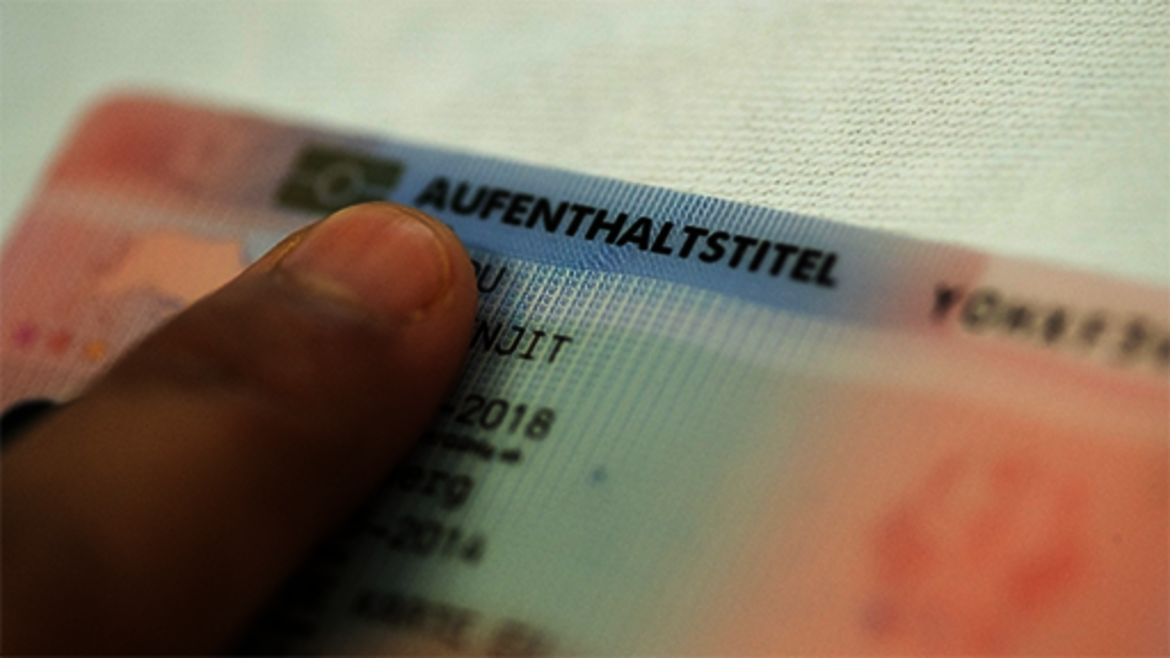
- If your application is approved, your fingerprints will be taken to produce your residence permit in the form of an electronic residence permit (eAT card). You must also provide a signature.
- The Foreigners' Registration Office will commission the Bundesdruckerei to produce the eAT card. After completion, you will receive information and can collect the eAT card from the relevant office. You must always collect your card in person. Until your card is delivered (approx. 4-6 weeks), you will receive a provisional certificate confirming that you have been granted a residence permit (paper, A4). You must carry this with you until you receive your eAT card.
- If your application is rejected, you will receive a notice of rejection.
Grading documents required
- Recognized and valid identity document (e.g. passport or passport substitute)
- Current biometric photo in passport format (45 x 35 mm)
- Visa, if required for entry
- Proof of means of subsistence (e.g. equity capital, scholarship certificate, declaration of commitment, blocked account at a bank, proof of parents' income or similar)
- Tenancy agreement (landlord's certificate)
- Proof of health insurance cover (membership certificate)
- Letter of admission from the educational institution (enrollment certificate)
- If applicable, proof of the required language skills, for example through suitable language certificates such as language tests from the ALTE-certified examination providers Goethe-Institut, telc GmbH, ÖSD, TestDAF, but also DSH, DSD, TOEFL, IELTS
- For participation in study preparation measures: Proof of admission to the preparatory college or a preparatory language course
1.2 §20 Job search following a stay in Germany
 © fiverr.com
The residence permit enables the person concerned to look for suitable employment for a period of up to 18 months. Securing a livelihood is a prerequisite for this. There is an entitlement to this:
- Following successful completion of a course of study in Germany (§16b)
- Following the completion of research work in Germany (§18d)
- Proof of your qualification - This usually includes a certificate of your degree - in the case of an HS-Anhalt degree, the question of recognition is automatically given, as it is a domestic educational qualification
- Proof of livelihood - you must provide papers proving that you are financially secure. This can be salary statements, bank statements or an employment contract. IMPORTANT! During the 18-month job search period, you can accept any job (regardless of the conditions for a work/residence permit) to secure your livelihood
- Valid passport - Your passport should be valid for the entire duration of your planned stay
- Proof of health insurance - Proof of valid health insurance is mandatory
Securing your livelihood is one of the central prerequisites for obtaining a residence permit in accordance with § 20 AufenthG. You must prove that your livelihood is secured for the entire duration of the residence permit.
This includes
- Rent and ancillary costs
- Health insurance and other insurances
- Living expenses such as food, transportation and personal expenses
Particularly important: If you receive financial support from relatives during your job search, this evidence must also be fully and comprehensibly documented. This is the only way to ensure that your application is approved.
The residence permit according to § 20 AufenthG is issued for a period of up to 18 months.
You can use this period to
- take upqualified employment in the professional field you have learned
- acquirefurther qualifications or recognitions, if still necessary
- and to orient yourself on the German labor market
Important: It is advisable to look for suitable job offers as early as possible so that you have enough time to write applications and attend job interviews. If you are accepted for a permanent position within the first few months, it is possible to adjust your residence status immediately and stay in Germany long-term.
With an eAT (electronic residence permit) and possession of § 20 AufenthG, you can also go to work. This allows you to secure your livelihood while you are looking for a permanent job, which you can then use to change your residence title. There are no restrictions on qualifications or maximum working days per year.
2. §18 b /18 g Skilled workers with academic training/ EU Blue Card
 © fstop123
§18b: Qualified employment
A skilled worker who has an academic degree can obtain a residence permit to pursue any qualified employment in Germany.
- Concrete job offer
- Recognized, equivalent foreign university degree, German university degree if applicable (your degree from the HSA automatically fulfills this requirement)
- In the first 12 months after initial issue, any change of job must be reported to the immigration authority; the authority can suspend the change and reject it if necessary
- 4 years or limited to the duration of the employment contract plus 3 months, when issued for the first time
- Extension possible if the conditions for granting continue to be met
- Yes, for academic specialists according to § 18b any qualified employment
- The spouse and minor children must be granted a residence permit
- The residence permit entitles family members to pursue gainful employment
There is no fixed, generally applicable income limit for a skilled worker with an academic qualification (Section 18b AufenthG). The rule is that they must be able to support themselves in the region without drawing on public funds. The income limit is therefore the responsibility of the respective immigration authority (in cooperation with the employment agency).
As an approximate guide , 55% of the income threshold is assumed in many cases.
- 55,700 € per year (2026)
- 4,647.50 per month (2026)
Please note: the income limits are updated annually, are therefore subject to fluctuations and always refer to the gross salary.
§18 g: EU Blue Card
Both residence titles are basically work permit-related titles, but with different prerequisites and advantages. In general, it can be expected that the application for the "EU Blue Card" will take significantly longer and be more workload than the work permit according to §18b
- Concrete job offer
- Recognized, equivalent foreign university degree OR German university degree
- Minimum income
- see k)
Both types entitle the holder to carry out an activity.
For §18b: any qualified employment is permitted
- i.e. as long as the requirements profile corresponds to the level of the university degree, the sector/direction is irrelevant (e.g. electrical engineers may work as financial experts)
For §18g: only employment appropriate to the qualification is permitted
- i.e. the job must correspond to the requirements profile AND the specialization of the university degree (e.g. electrical engineers may only work as electrical engineers)
In the first 12 months after initial issue, any change of job must be reported to the Foreigners' Registration Office, which can suspend the change and reject it if necessary.
Residence permits are issued to the spouse and minor children.
- According to the required conditions - proof of livelihood (in this case income of the working partner or blocked account) - sufficient living space
- A settlement permit can be issued after 27 months (prerequisites: 27 months of compulsory social security contributions have been paid)
- If you have sufficient German language skills (B2), the period is reduced to 21 months
- Holders of an EU Blue Card can travel to another EU member state with their family members without a visa after 12 months and apply for an EU Blue Card there
For regular Blue Card:
- Per year €50,700 (2026)
- Per month € 4,225 (2026)
- This corresponds to 50% of the contribution assessment ceiling for general pension insurance
For shortage occupations (doctors/academic medical professions, IT, engineers such as electrical engineering, scientists in STEM fields)
- Per year € 45,934.20 (2026)
- Per month 3,827.85 (2026)
- This corresponds to 45.3% of the contribution assessment ceiling for general pension insurance
Please note: the income limits are updated annually, are therefore subject to fluctuations and always refer to the gross salary.
3. §18 d Residence permit as a researcher / for research projects
 © null, © Colourbox
For persons who wish to carry out a research project at a recognized research institution (university/institute).
If applicable, also for doctoral candidates IF the doctorate is completed within the framework of an employment contract with the university (e.g. as a research assistant)
- No minimum income (a 50% contract at a university is common and usually sufficient)
- Recognition of the research institution by the BAMF (automatically given in the case of universities/colleges)
- Hosting agreement between the researcher and the research institution (defines the conditions of the research work, technical equipment and workplace conditions)
- Employment contract OR declaration of assumption of costs
- Limited to at least 1 year (extension possible thereafter if research continues)
- If necessary also shorter than 1 year - then according to the duration of the research stay
- Important! After completion of the research project - entitlement to an 18-month residence permit to look for a job corresponding to the qualification
Residence permits are issued to the spouse and minor children.
- According to the required conditions - proof of livelihood (in this case income of the working partner or blocked account) - sufficient living space
- Freedom to travel for up to 90 days within a period of 180 days in the Schengen area
- A research stay of up to 180 days within a period of 360 days in another EU Member State is generally possible
