Medieval Construction Sites. The crane of the Braunschweig Cathedral
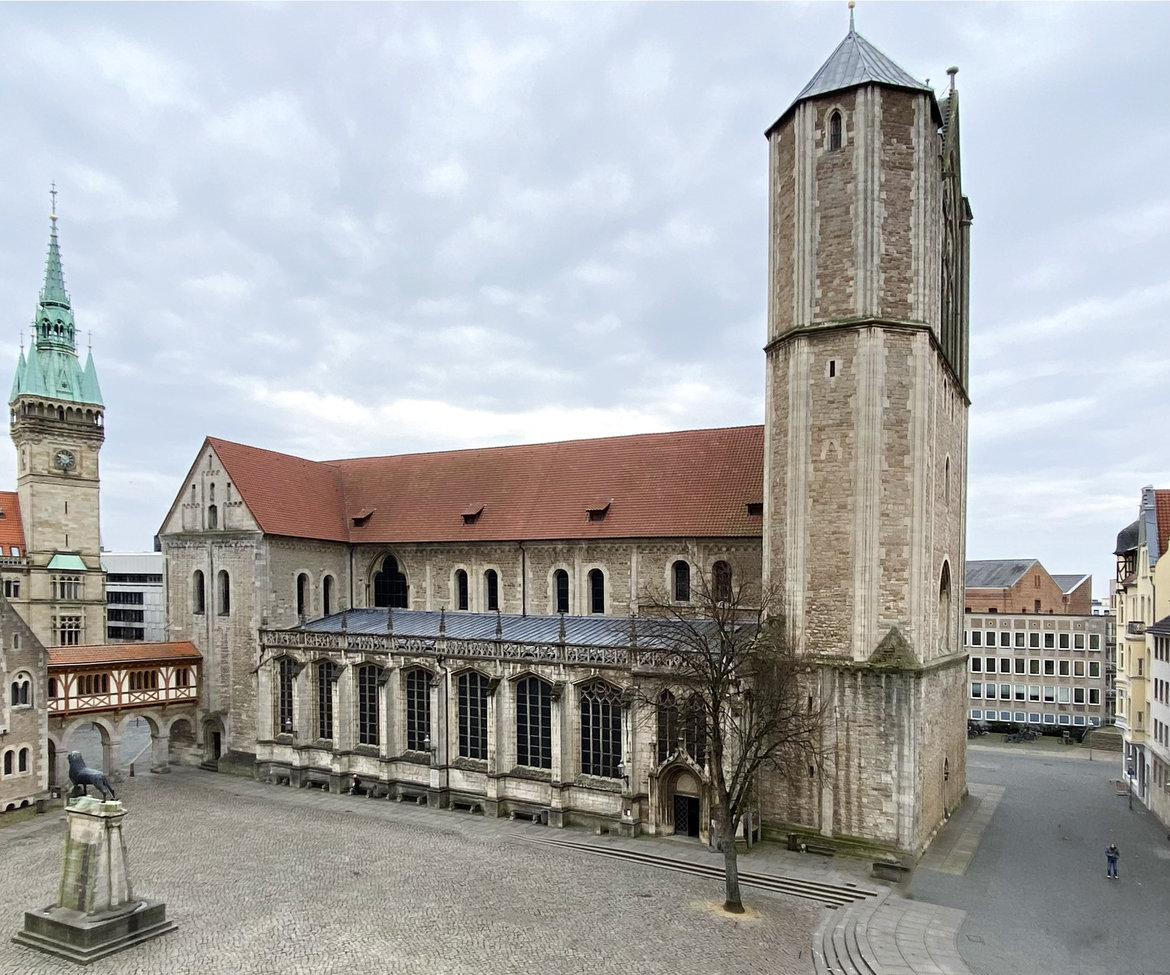 © Gunnar Schulz-Lehnfeld
Background
How did a construction site look like in the Middle Ages? When dealing with Medieval architecture, questions concerning the construction site and process bear interesting insights into the historical process of making architecture. The construction process had a great influence on the appearance of the building and its construction, but examining the building process and its organization also provides us with insights into the social and technological history from the period when the building was erected: how did building technologies develop? How was the construction site organized? How long did the construction site exist?
Machines, especially cranes, played a major role during the construction of grand medieval buildings as they were needed to move bulky and heavy building parts across the construction site to their intended places. Nowadays, traces of these machines are exceptionally rare due to the fact that they were dismantled right after the construction was finished – they were simply not needed anymore. Fortunately, parts of a Medieval crane are still standing today in the Brunswick Cathedral. Dating back to the 13th century, the crane is known to be the only Medieval crane still existing today. The research project aims at examining the crane in depth to learn more about the history of the Cathedral, the Medieval construction site and, first of all, the crane itself.
Aim of the Project
The team, consisting of scientists from the Anhalt University of Applied Sciences, Technische Universität Braunschweig and BTU Cottbus-Senftenberg, plans to pursue different approaches analyzing the construction and mode of operation of the crane. To achieve a better understanding, a building survey will be conducted focusing not only on the crane itself but also studying the context of the tower in which it is situated. The survey will help to retrace the erection of the crane, its further use and the dismantling of different parts of the machine. Furthermore, a digital and physical model of the crane and its surrounding structures will be created to further comprehend how the building process took place in this part of the cathedral. This way, scholarly established building phases can be verified and – where necessary – re-evaluated.
The research on the cathedral crane will not only serve to deepen the knowledge of Brunswick Cathedral and its construction site but also serve to explore Medieval construction techniques in general.
Contact
Prof. Dr.-Ing. Gunnar Schulz-Lehnfeld
In Cooperation with
Prof. Dr. Ulrike Fauerbach, Institut für Baugeschichte, TU Braunschweig
Prof. Dr.-Ing. David Wendland, Fachgebiet Bautechnikgeschichte, BTU Cottbus-Senfentberg
