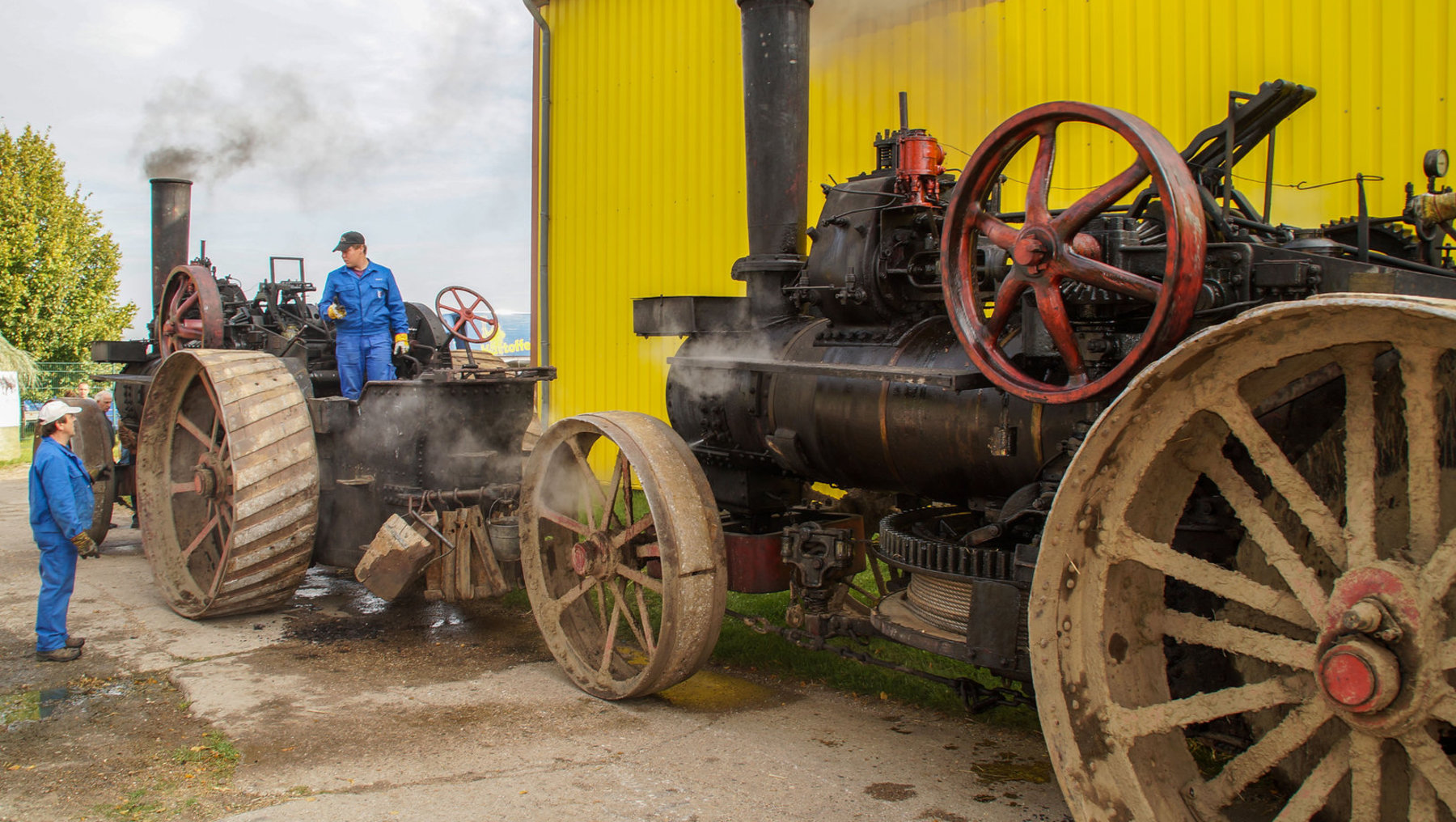
For the 30th Historic Harvest Festival in Bernburg-Strenzfeld, an extraordinary piece of agricultural machinery will take to the field: A historic steam plow set from Hohenheim will be demonstrated in Strenzfeld again after about ten years. Christoph Gajda from the Welding Research and Training Institute in Halle has been volunteering at the Historic Harvest Festival for about 20 years. In this interview, he explains why such demonstrations are a rarity today and the workload involved.
"It smokes, it hisses, it's big"
-
 © Hochschule Anhalt/Renate Geue
Mr. Gajda, you’ve been involved with the Historic Harvest Festival for about 20 years. Have you ever experienced steam plowing in Strenzfeld yourself?
Yes, I’ve been part of the Harvest Festival for almost exactly 20 years. Back then, I was 16 and somehow ended up joining the group of people who volunteered to take care of the old tractors. I stuck with it, and today I work with other volunteers at the tractor collection in Strenzfeld to keep everything running as smoothly as possible. I’ve also experienced the steam plow here as a participant. The last time must have been around 2015 or 2016.
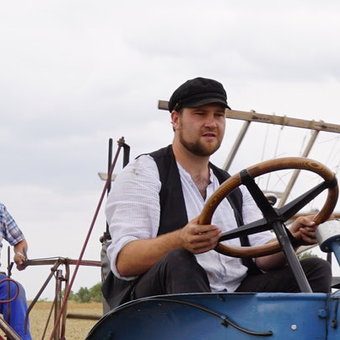
"The Hohenheimers don't usually take their steam plow set on trips. That's why it's truly something special that we get to see it again in Strenzfeld after about ten years."
Christoph Gajda
What makes this year's demonstration so special?
For a long time, there were three steam plow sets throughout Germany: one in Landshut-Schönbrunn, one in Hohenheim, and one in Kirchheim unter Teck. Now, only the one from Hohenheim is still operational. The others are no longer operational. Steam technology involves high costs; TÜV inspections and maintenance are expensive, and specially trained personnel are required.
The Hohenheim team doesn’t usually take their steam plow set on the road either. They demonstrate it right there in Hohenheim. That’s why it’s truly something special that we can see it again in Strenzfeld after about ten years.
-
 © Christoph Gajda
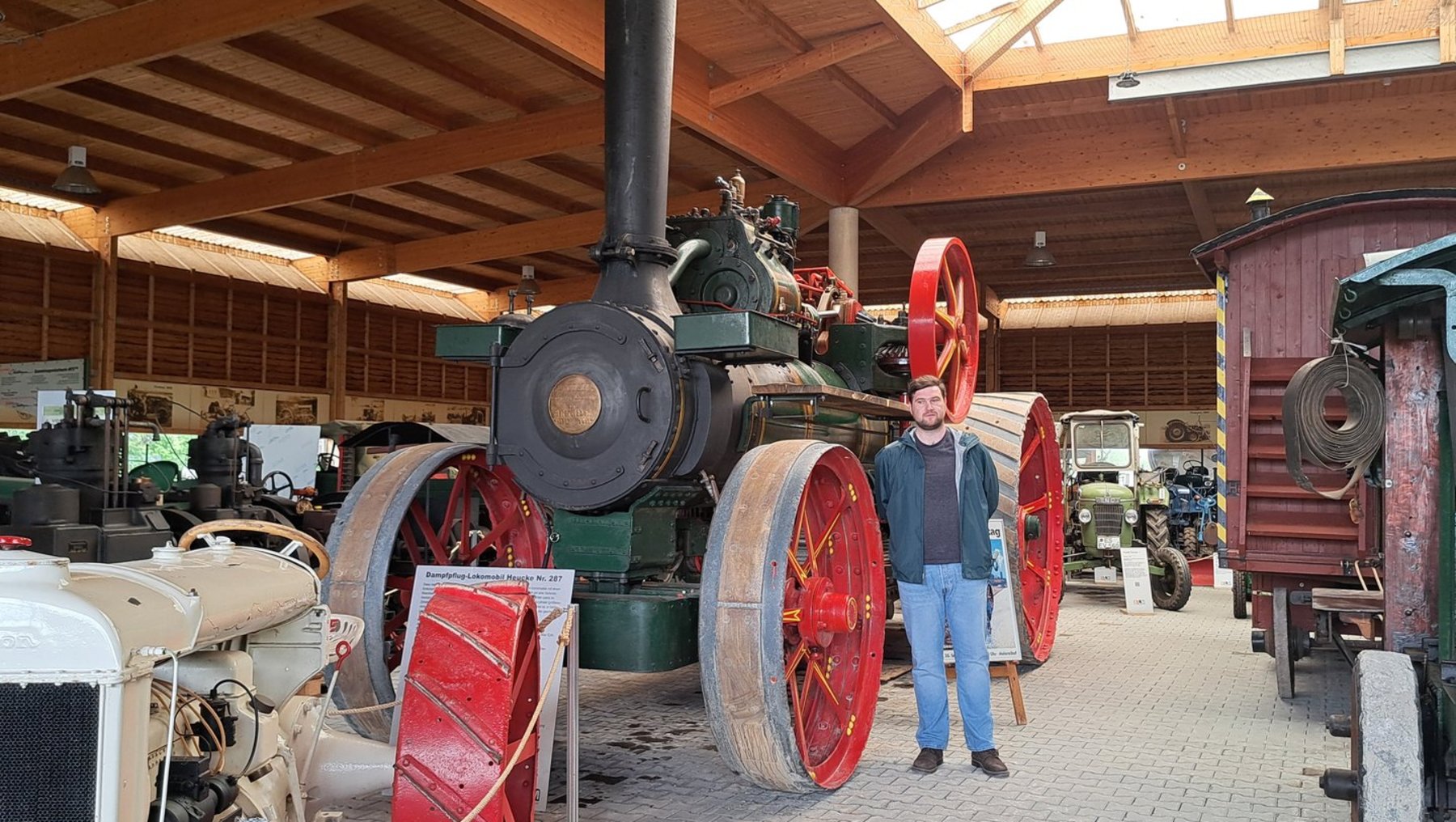
Christoph Gajda vor einem historischen Dampfplug -
 © Hochschule Anhalt / Renate Geue
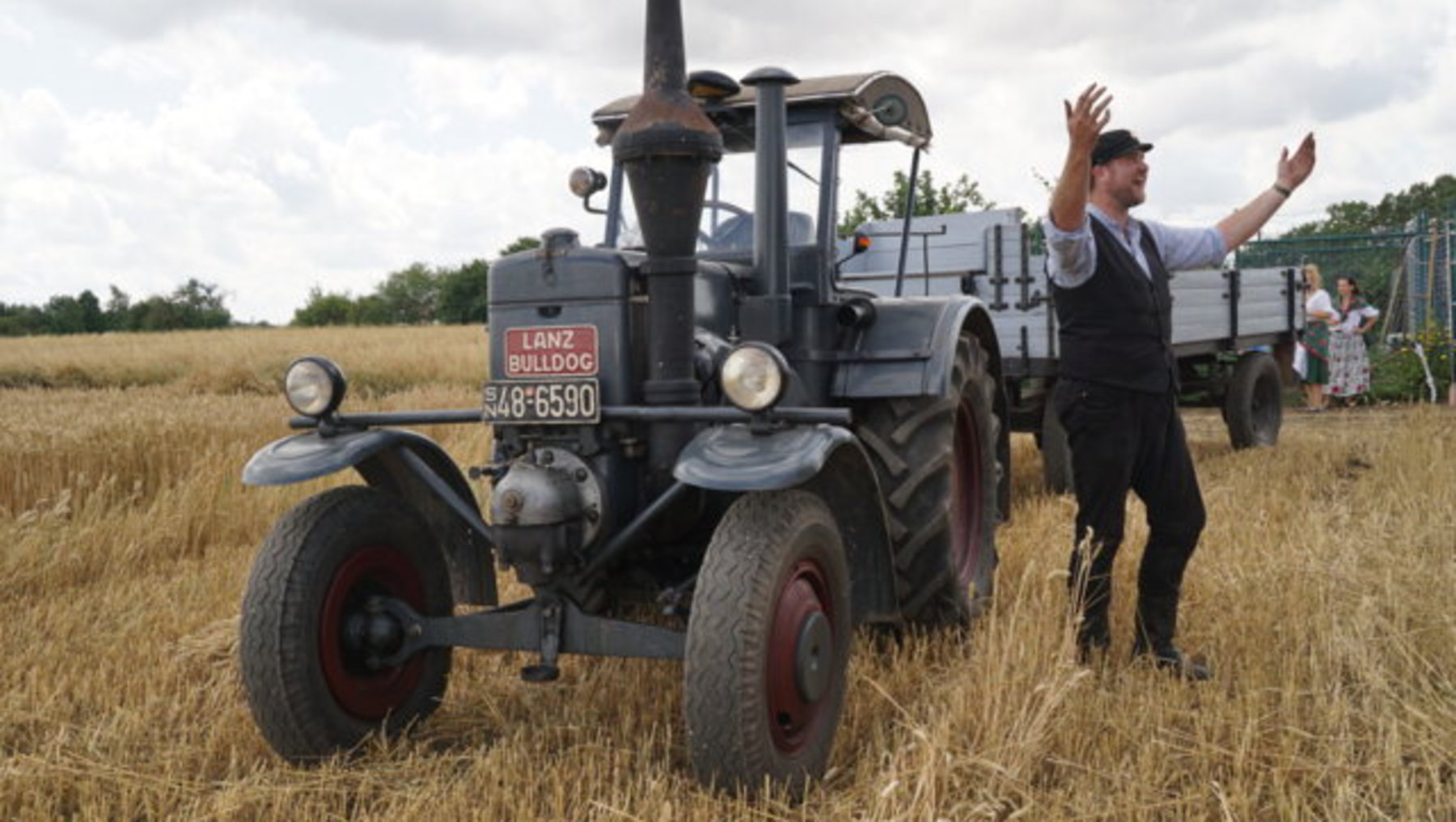
Der alte Lanz Bulldog von Christoph Gajda beim Mähbindern
How does steam plowing actually work?
It’s what’s known as the cable-pull method. At each end of the field stands a locomobile—it looks like a giant steam locomotive, only on wheels. In between, a plow is pulled back and forth by a cable. A locomobile weighs about 20 metric tons.
The method has two major advantages: It’s gentle on the soil because the machines don’t exert any pressure on the ground. And it allowed farmers to work the land even in the rain and, above all, on large areas.
What was the historical significance of this technology?
The steam plow was the first industrial-scale method of tilling the soil. In the 19th century, industrialization took hold, fields grew larger, and Agriculture had to evolve. Tractors didn’t exist yet. At the time, the steam plow was the first real means of practicing Agriculture on a large scale. It was a technology that was ubiquitous back then and made so much possible. And you can still experience it up close today at the Harvest Festival.
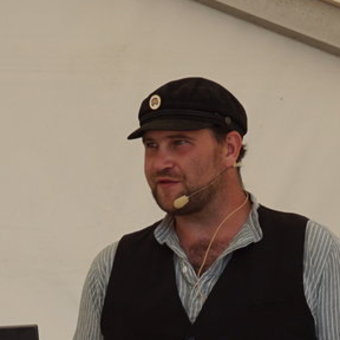
"Steam plowing will be on display all day alongside the main program."
Christoph Gajda
The demonstration looks spectacular. What workload goes into it before the first plow is pulled across the field?
A great deal. The machines are transported to Strenzfeld by a specialized freight company using three trucks—specifically, three flatbed trucks. The team from Hohenheim arrives with a crew of nine people. You can’t just operate something like this. It requires various qualifications and examinations.
On the day of the harvest festival, the team gets up early in the morning to fire up the machines. It takes a while for enough steam to build up so the machines can be operated. We plan to head out to the field for the opening ceremony. Steam plowing will be on display all day alongside the rest of the program.
Is this workload worth it? How do visitors react to the steam plow?
It’s something very special—and it always has been. People actually come from near and far. We’ve already had people sign up from Schleswig-Holstein, Lower Saxony, and southern Germany who are coming specifically to see the steam plow. They say: “It’ll be a once-in-a-lifetime experience to see something like this here.” Some are even booking a hotel room just for this.
People who are into agricultural machinery definitely know that this is something very special. And for everyone else, it’s simply an attraction: it smokes, it hisses, and it’s huge.
Kontakt
Bettina Kranhold
RedaktionVeronika Rivera
Historical Harvest FestivalColorful, lively, and traditional:
The Historic Harvest Festival takes place at the estate of the DLG’s International Center for Crop Production in Bernburg-Strenzfeld. The festival begins at 10:00 a.m. with the traditional harvest parade, which showcases the evolution of Agriculture. Anhalt University of Applied Sciences and the Saxony-Anhalt State Institute for Agriculture and Horticulture are organizing the Harvest Festival, which is being held for the 30th time this year.
August 29, 2026, starting at 10:00 a.m.
Bernburg-Strenzfeld Estate, 06406 Bernburg (Saale)
We look forward to seeing you there!
