The loss of plant, insect, and bird species was reversed in the Oranienbaumer Heide. In a multi-year project, a network of dedicated stakeholders, under the scientific direction of Anhalt University of Applied Sciences, significantly increased biodiversity. This has had far-reaching consequences for the environment, people, Economics, and the climate. This article on Anhalt University of Applied Sciences’ climate blog explains, through text and images, what steps were taken to achieve this and how the former military training area in the Wittenberg district has changed step by step.
The Oranienbaumer Heide Pastoral Landscape: From a Military Training Area to a Biodiversity Hotspot
-
 © Heiner Hensen | HS Anhalt
How the Biodiversity of the Oranienbaum Heath Was Lost
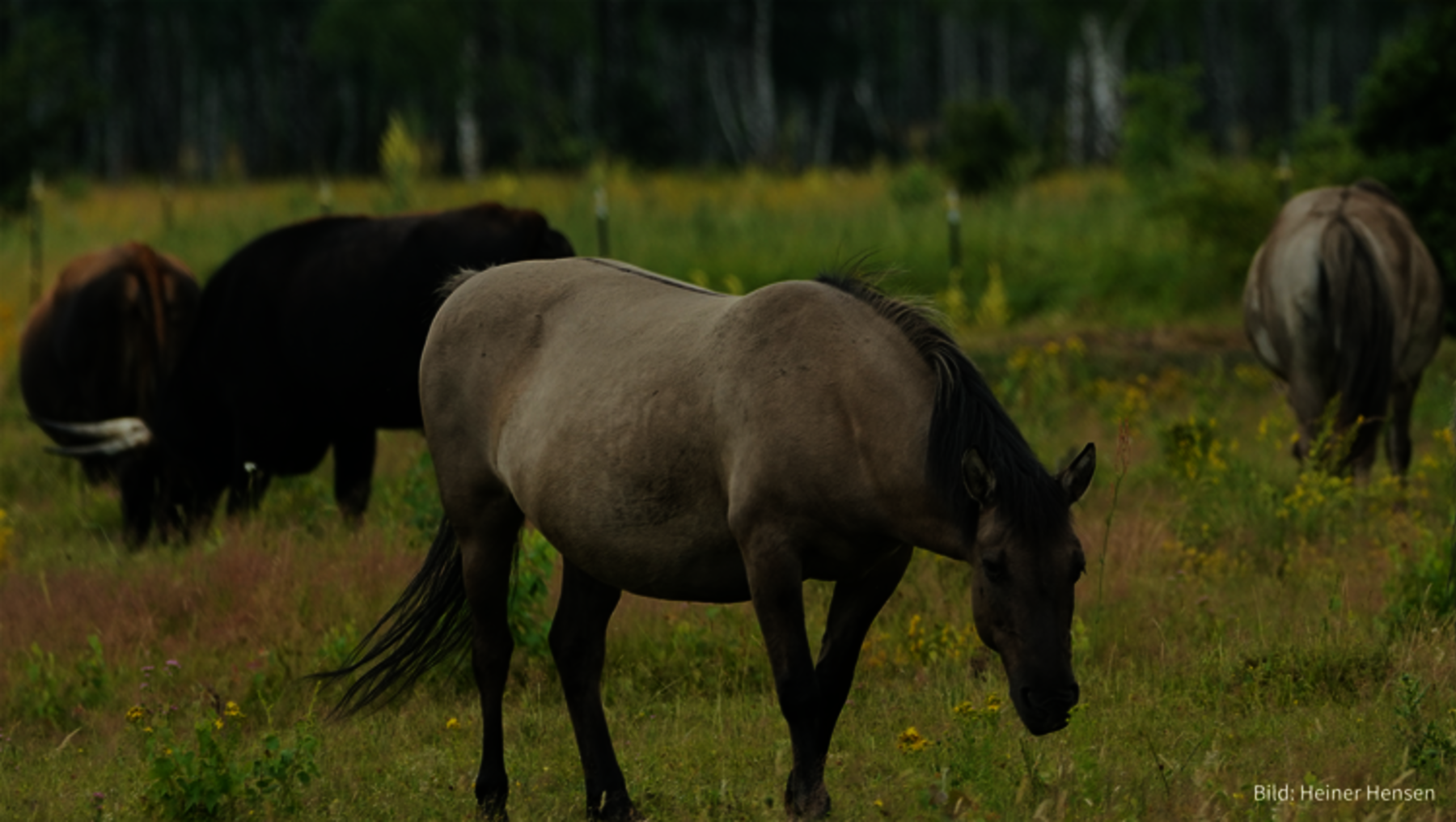
For decades, tanks have dominated the landscape here. A natural treasure remains hidden: Although the approximately 800-hectare Oranienbaumer Heide near Dessau consists of rather dry, nutrient-poor soils, it is nonetheless a habitat for many species. So-called nutrient-poor grasslands, sandy grasslands, and heathlands are now even considered natural areas worthy of protection. Historical maps reveal what the area looked like before its military use: parts of it were grazed by sheep and cattle. Even before human settlement, herds of aurochs and wild horses most likely roamed here.
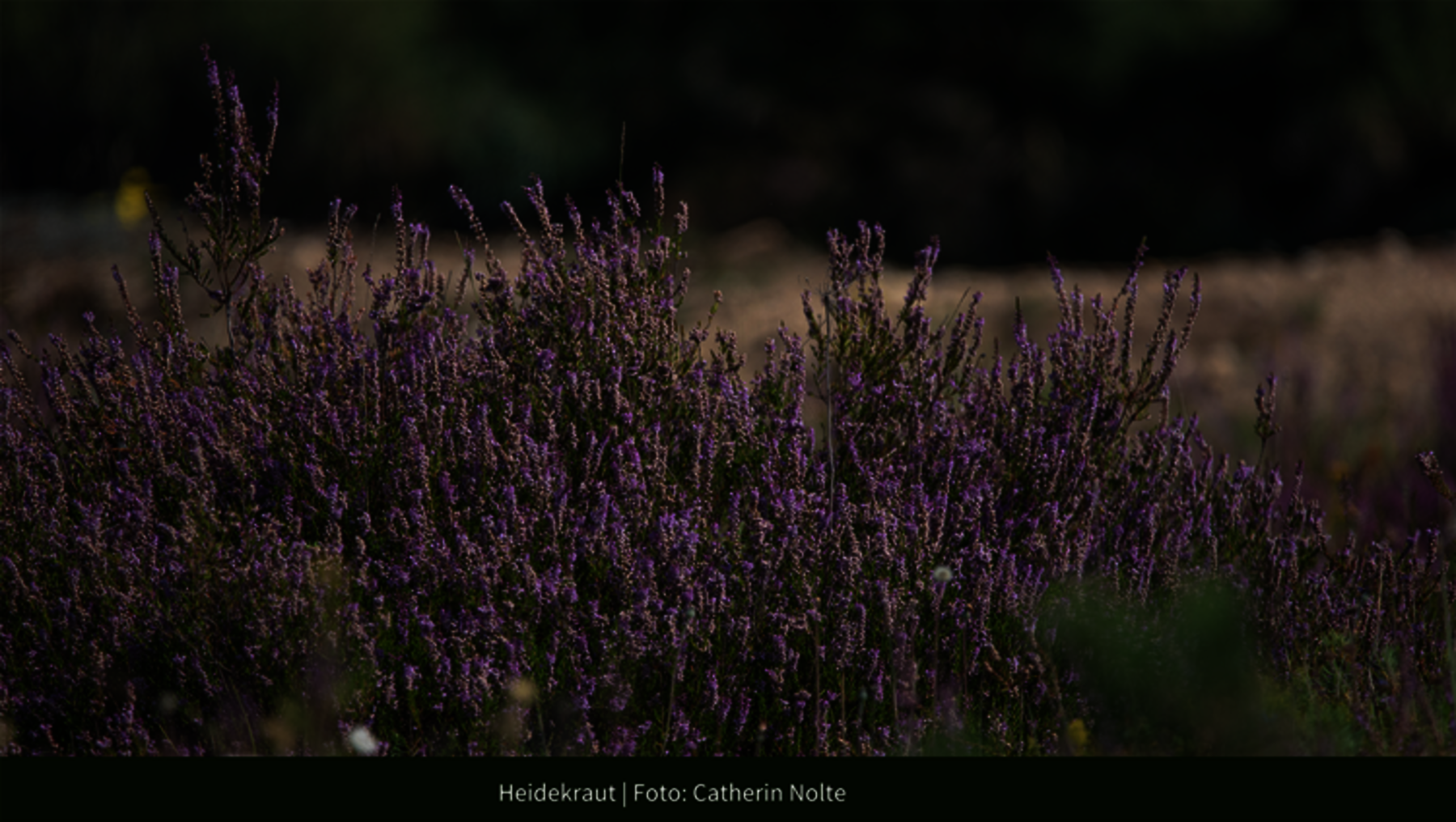
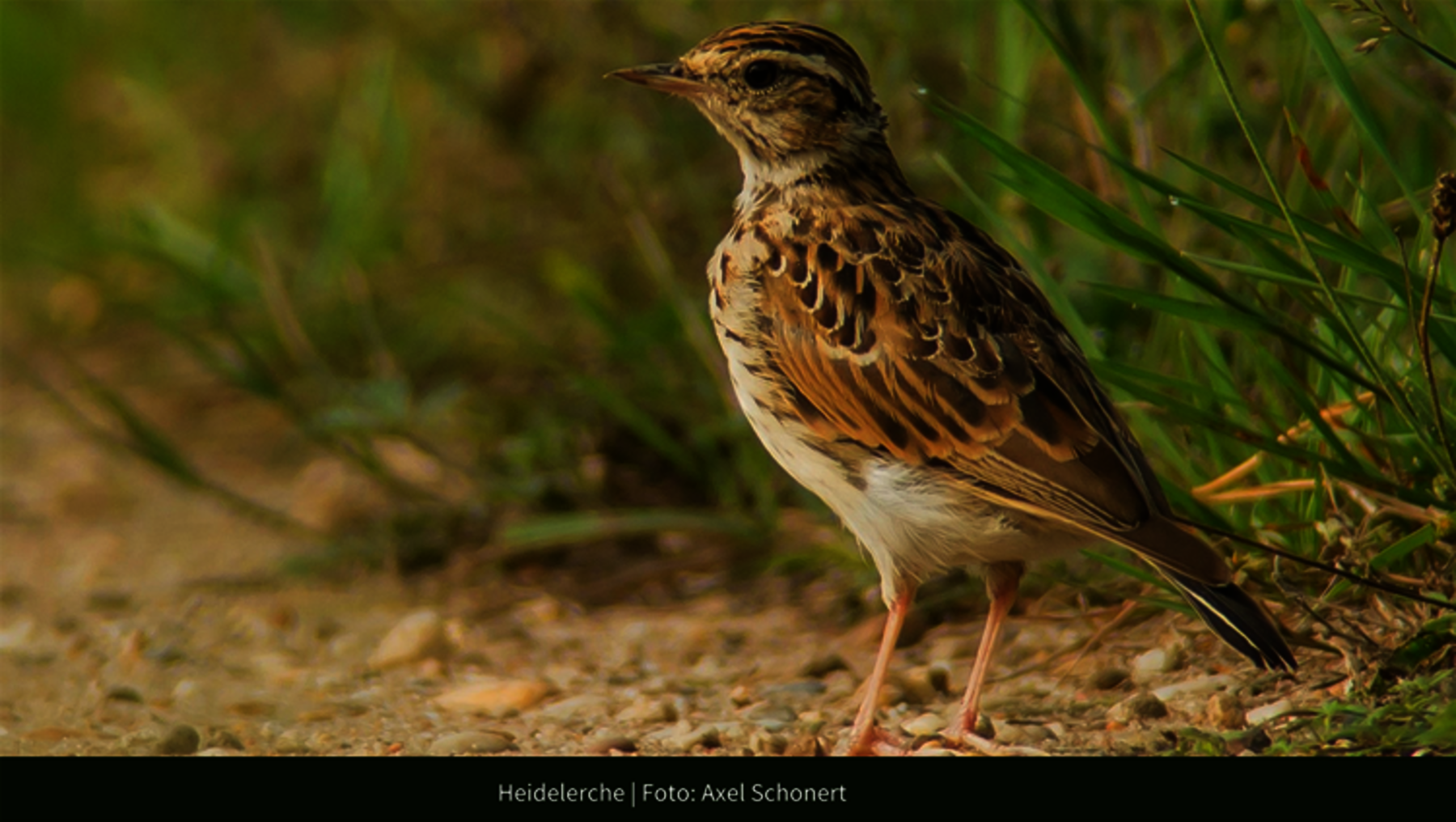
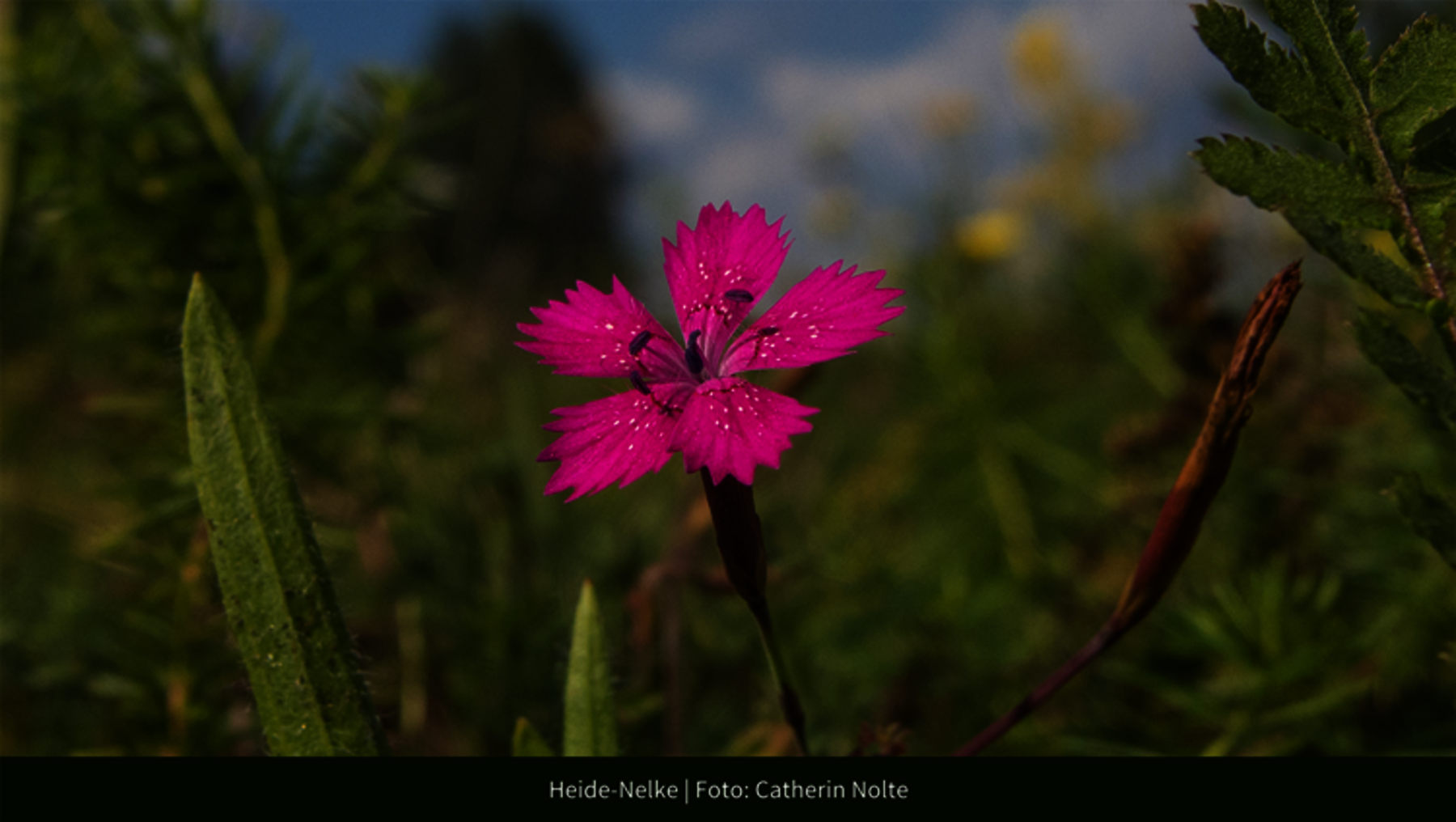
When the former military training area was transferred to civilian use in the early 1990s, the area began to become overgrown with grass and shrubs. Many species that require open habitats are now threatened: they lack sufficient light, food, or suitable breeding sites. Many insect species, plants such as the heath carnation, and birds such as the nightjar and the heath lark now exist only in small populations in the Oranienbaum Heath. Still, they are still there, as mapping conducted by researchers from Anhalt University of Applied Sciences in 2007 shows.
Therefore, the prospects for reviving the Oranienbaumer Heath as a semi-open grassland landscape with high biological diversity are good. However, it will take a major effort before the abandoned military training area becomes one of the most species-rich areas in Saxony-Anhalt. It began in 2008...
2008: A network combining practical experience and research for biodiversity is established
 © Claudia Aldinger | HS Anhalt
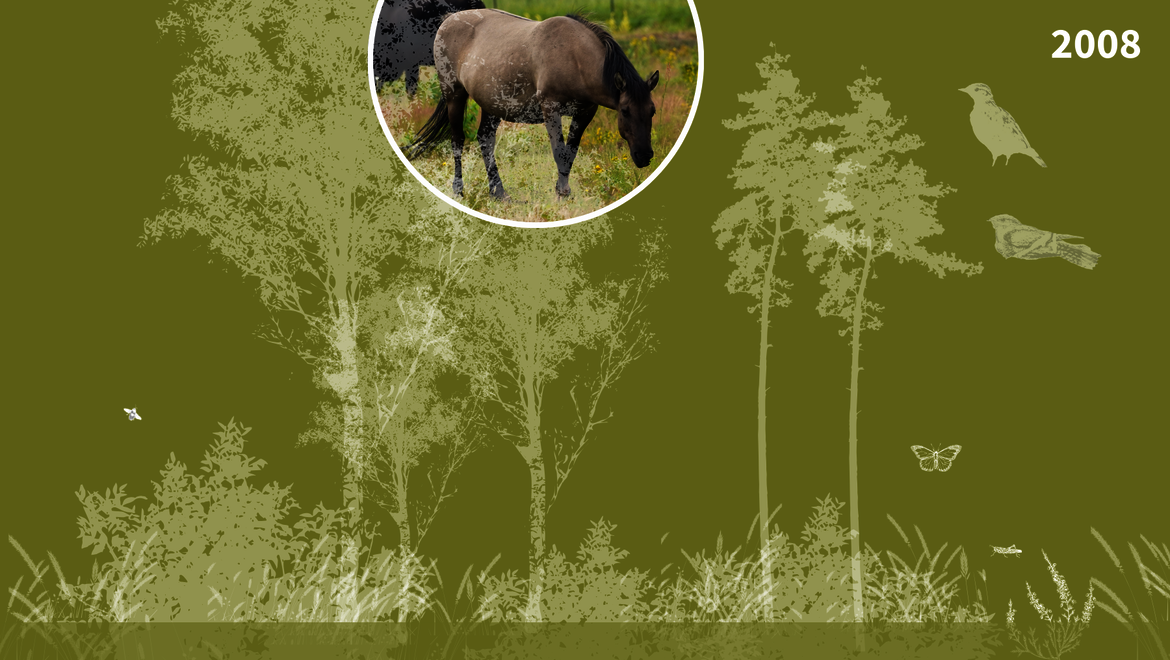
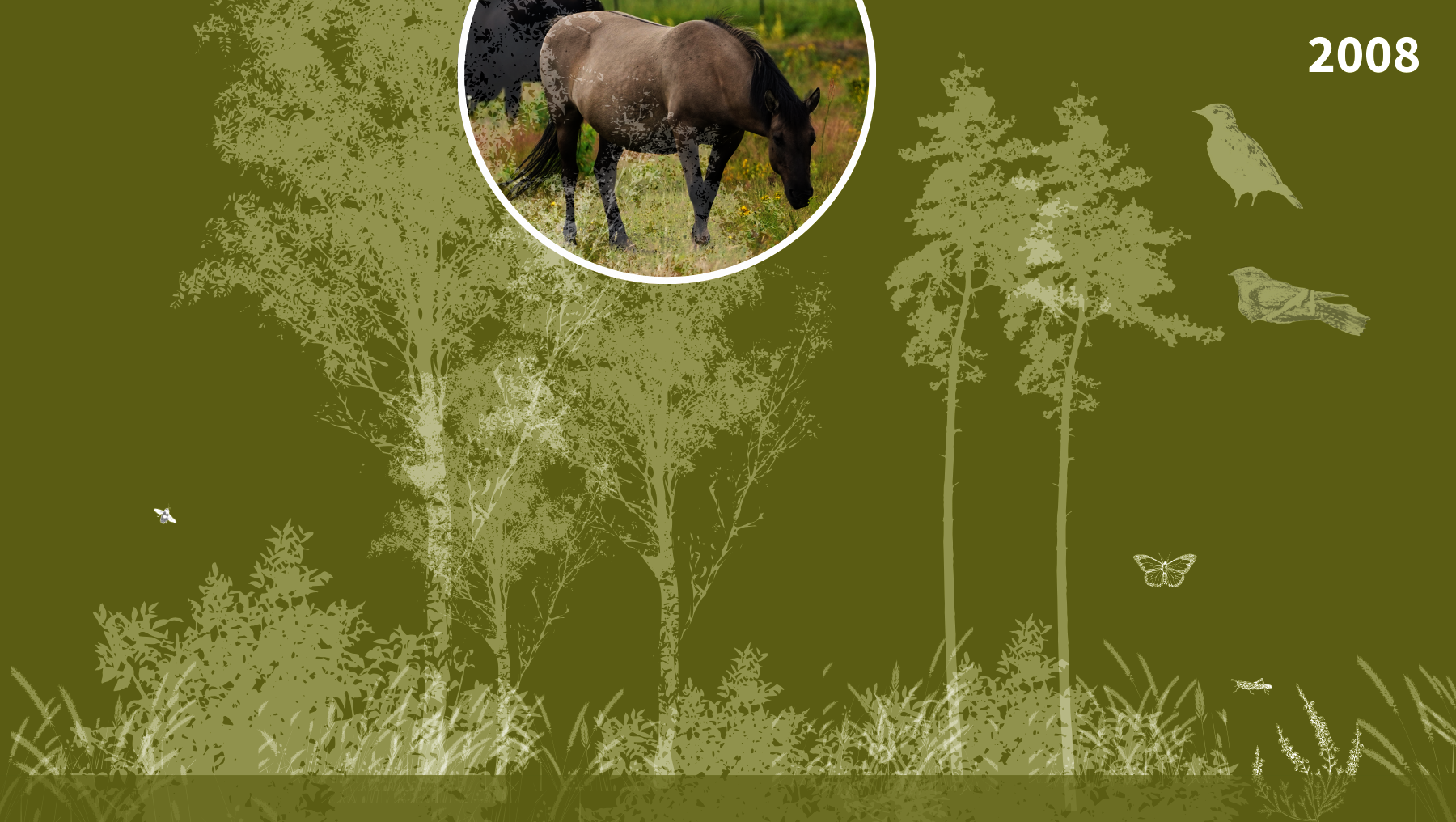
In 2008, the former Oranienbaumer Heide military training area was transferred to DBU Naturerbe GmbH, a nonprofit subsidiary of the German Federal Environmental Foundation (DBU). At that time, the area around Dessau was already part of the UNESCO Middle Elbe Biosphere Reserve and the National Natural Heritage. The area is dedicated to nature conservation, but the biodiversity in the heathlands and sandy areas—that is, valuable open-land habitats—is severely threatened. In 2008, the Oranienbaum Heath was characterized by:
- increasing scrub encroachment caused by growing pioneer tree and shrub species such as birch, pine, and late-blooming bird cherry
- the spread of undesirable dominant stands of certain species, such as meadow foxtail
- few species and small populations of plants and animals typical of open landscapes
Initiated by the Biosphere Reserve, Anhalt University of Applied Sciences and Primigenius gGmbH, as the managers of the area, are taking countermeasures. To this end, they are enlisting numerous supporters and partners, including the German Federal Environmental Foundation, the European Agricultural Fund for Rural Development in Saxony-Anhalt, and the Saxony-Anhalt Foundation for Environmental, Nature, and Climate Protection to finance the project.
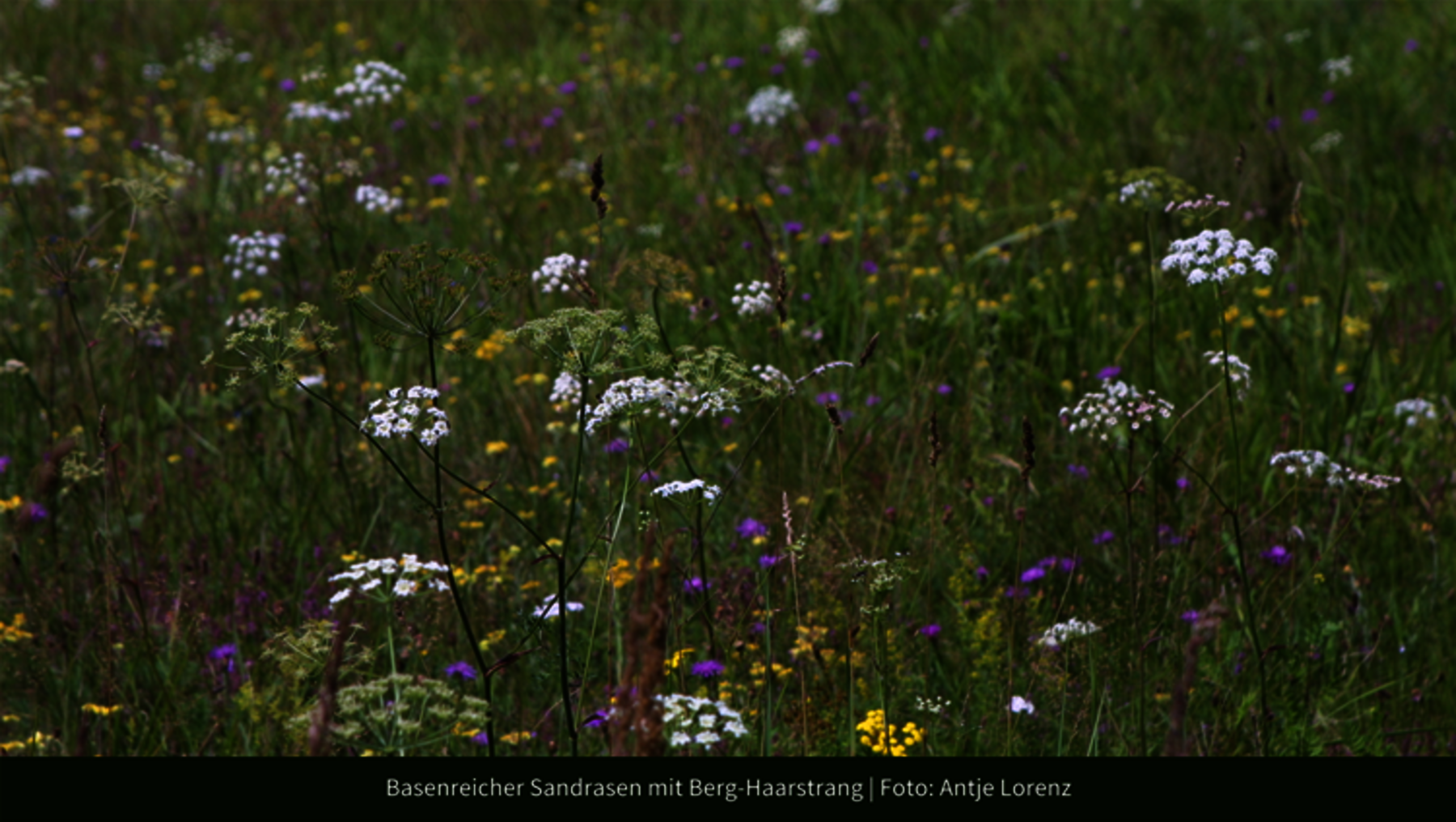
Fundamentally, the scientific team led by Prof. Sabine Tischew sees exceptional potential in the Oranienbaumer Heide for a species-rich area. The close interconnection of heathlands, base-rich sandy grasslands, and other nutrient-poor open-land, edge, and pioneer forest habitats provides a good foundation for this.
2008–2009: Extensive grazing is introduced to promote biodiversity
-
 © Claudia Aldinger | HS Anhalt
-
 © Claudia Aldinger | HS Anhalt
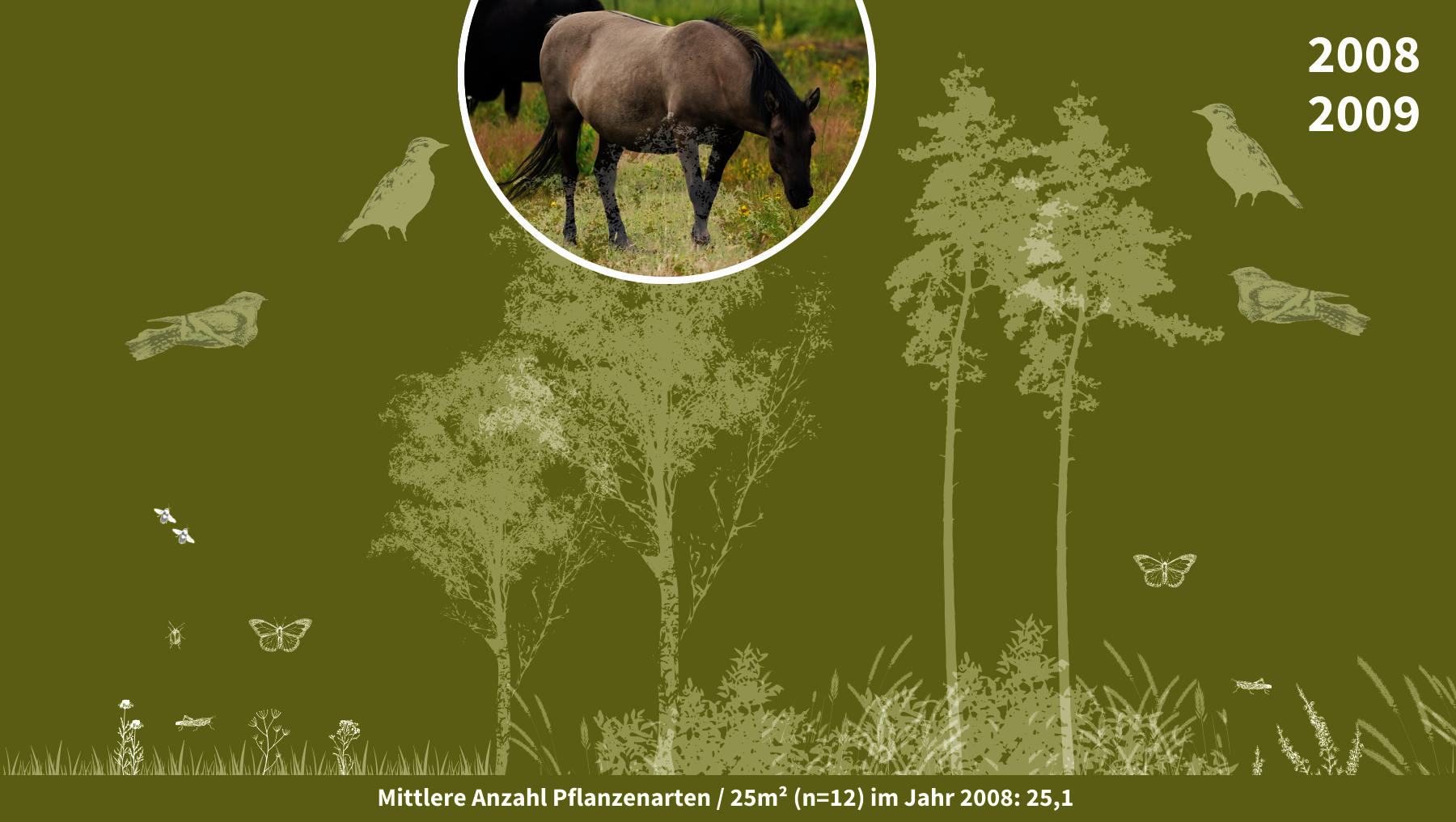
Without support, many plant, insect, and bird species have little chance of establishing themselves in the Oranienbaumer Heide. There is a lack of habitat and food sources. For this reason, the project partners have decided to establish an extensive year-round pasture with Heck cattle and Konik horses in the southern part of the area, initially covering about 305 ha. Extensive scrub clearance measures are being carried out, which means removing trees and shrubs from 225 ha. In the interest of sustainability, the wood is recycled in the form of wood chips. This is made possible with the help of regional companies as well as state and EU funding. The process of clearing the invasive late-blooming bird cherry begins: regrowing shoots are good grazing for the grazing animals. The first successes were already documented between 2008 and 2009:
- The widespread creeping bentgrass and the invasive black cherry are being pushed back. Grazing contributes significantly to this.
- The decisive effect, however, lies in the areas of open ground that have been created: in these open spaces, the species typical of so-called nutrient-poor grasslands now have room to grow again.
- The heather, which had become overmature over large areas due to the hiatus in land use, is already visibly recovering: grazing by livestock is rejuvenating it.
To better manage the development of the Oranienbaumer Heath, a comprehensive scientific monitoring program and nature conservation-focused performance evaluation are being designed and implemented.
2010–2011: Open-ground areas provide habitat for species
-
 © Claudia Aldinger | HS Anhalt
-
© Claudia Aldinger | HS Anhalt
-
© Claudia Aldinger | HS Anhalt
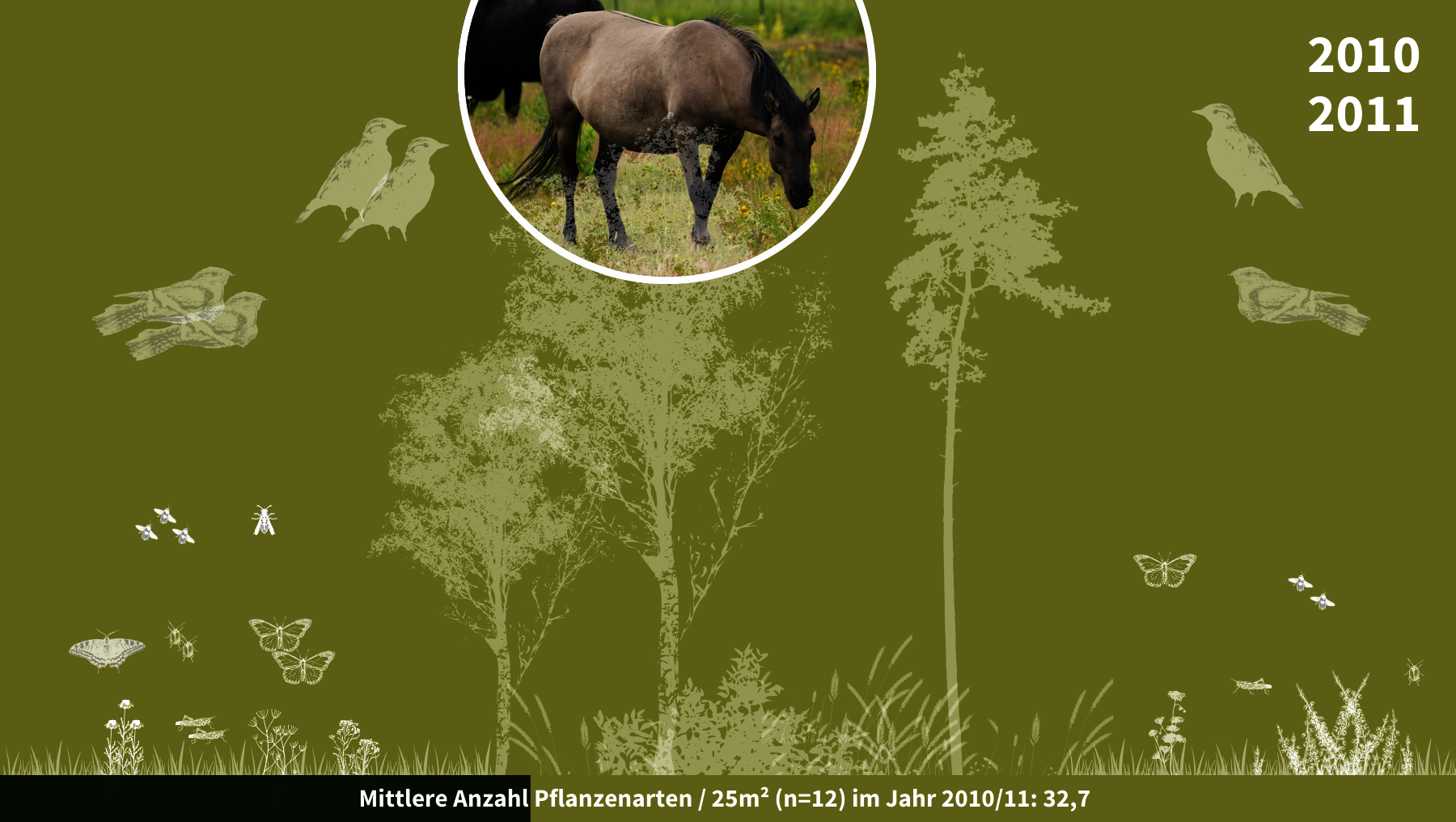
Between 2010 and 2011, the research team documented the following in its progress reports:
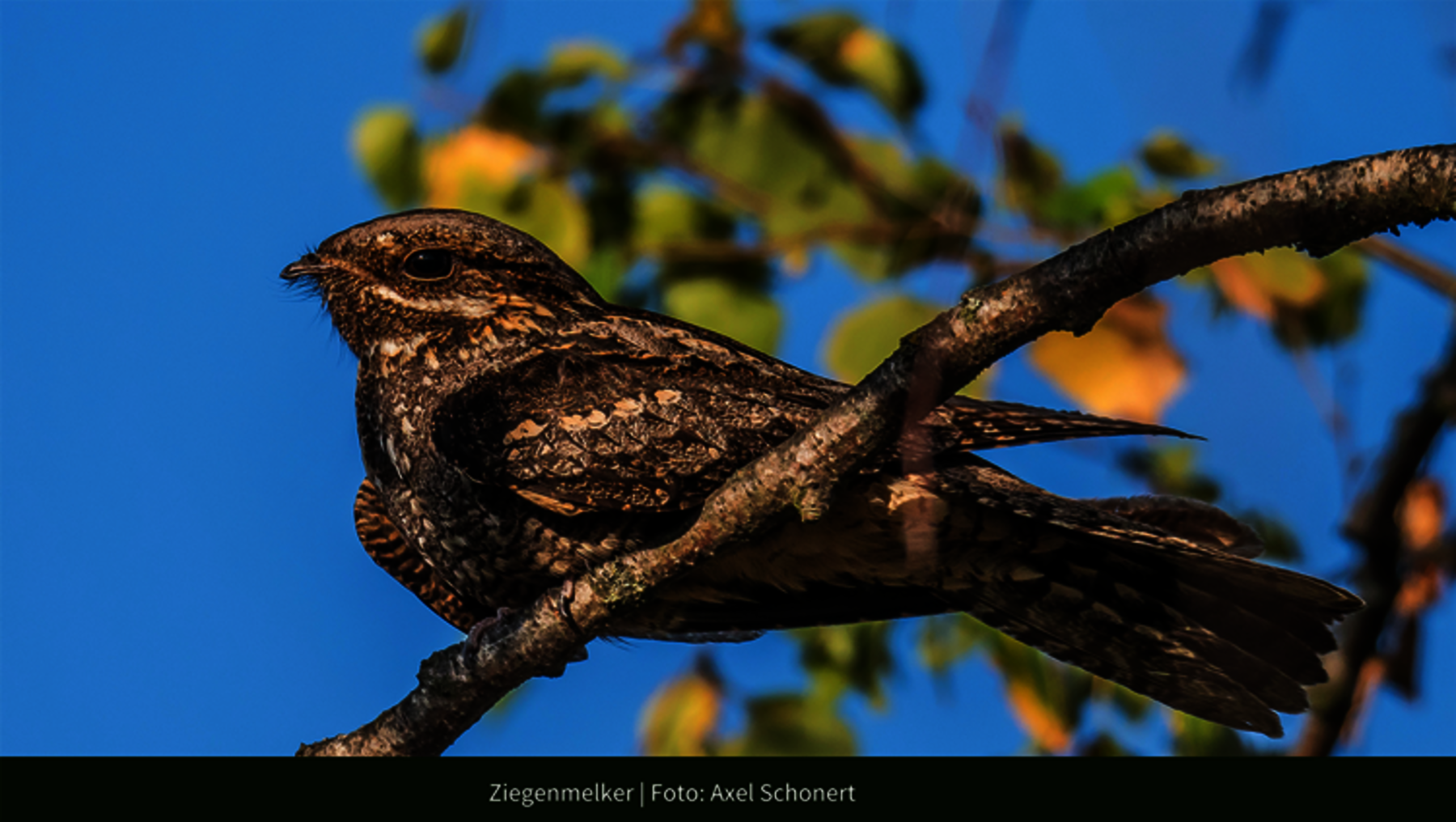
- larger populations of existing plant and insect species. Birds such as the woodlark and the nightjar are also expanding their ranges.
- Many rare species: plants such as the mountain hairgrass and the heath carnation.
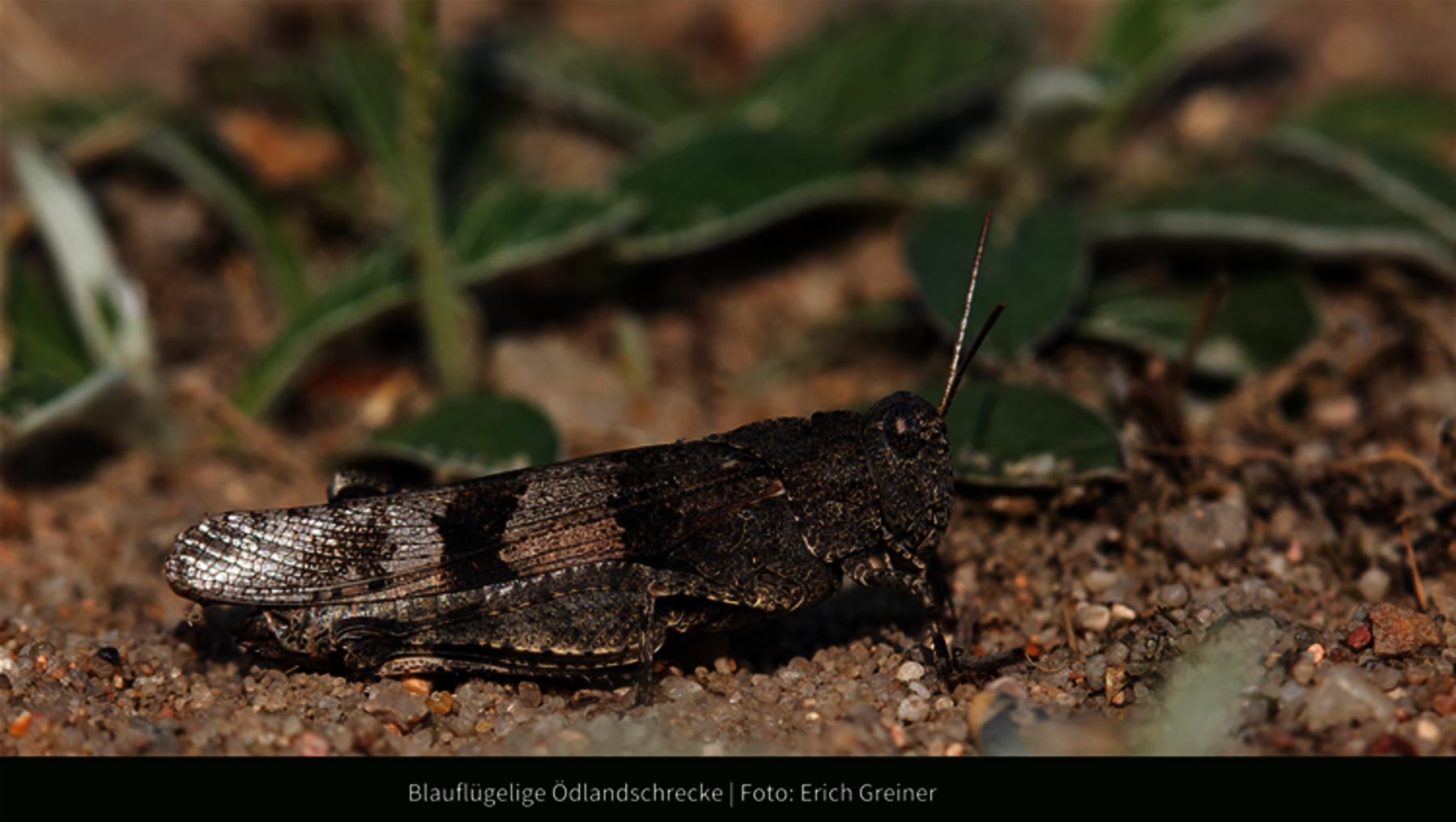
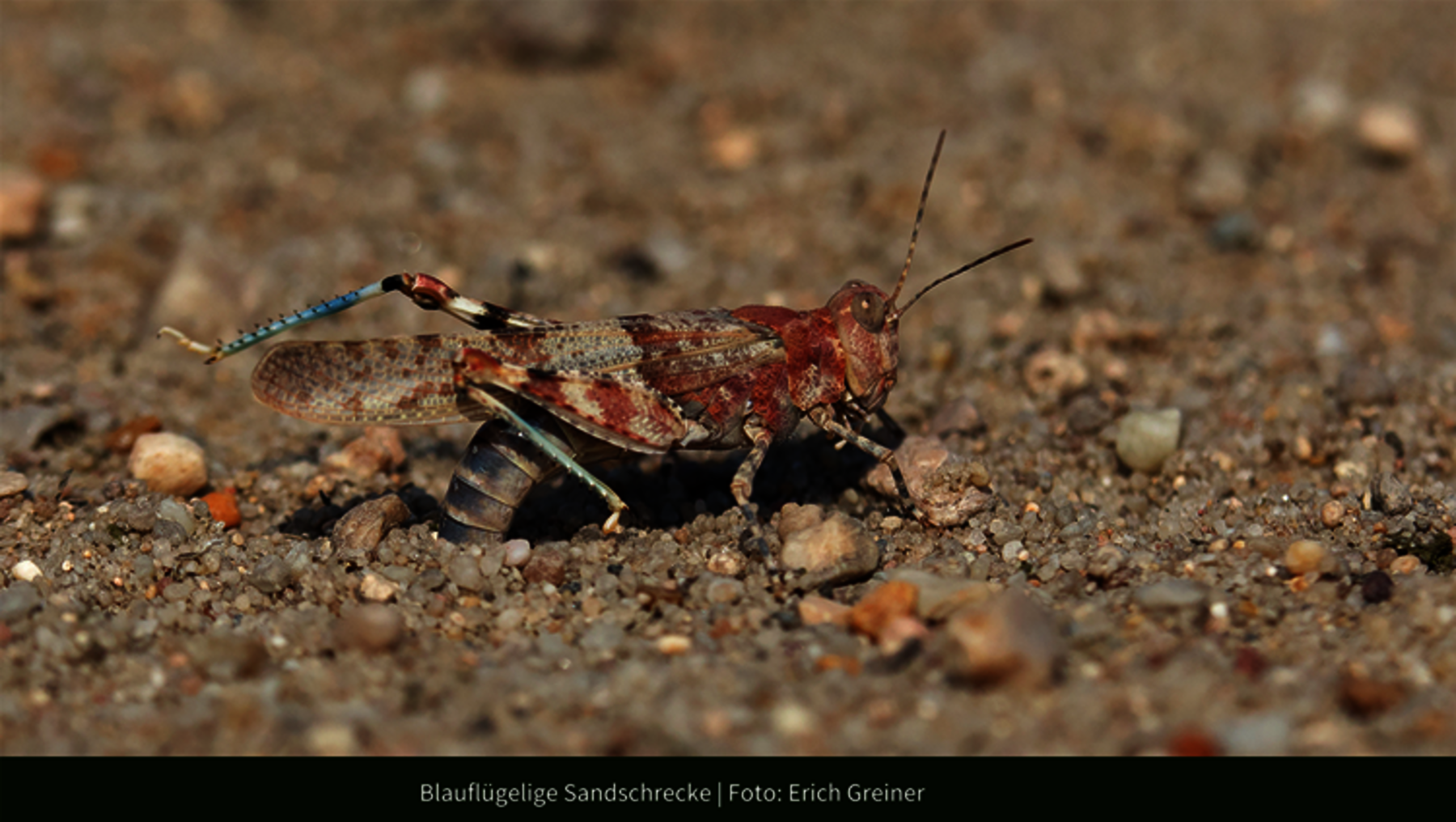
- Insects such as the blue-winged sand grasshopper.
Following the positive effects observed during the first two years of the project, the two key measures were expanded: Heck cattle and Konik horses can now graze on an area of 480 ha. The Mittelelbe Federal Forestry Office is responsible for the brush clearing and is expanding the removal of trees and shrubs by approximately 105 ha. This will allow additional areas of valuable open-land habitats to be restored. Grazing increases the proportion of open ground, which is important for plants, insects, and birds alike—for example, for ground-nesting bees or as breeding grounds for various bird species. Biodiversity in the Oranienbaumer Heide is recovering thanks to the restoration of these habitats.
2012–2015: Plants, Insects, and Bird Species Reclaim Their Habitats
-
 © Claudia Aldinger | HS Anhalt
-
© Claudia Aldinger | HS Anhalt
-
© Claudia Aldinger | HS Anhalt
-
© Claudia Aldinger | HS Anhalt
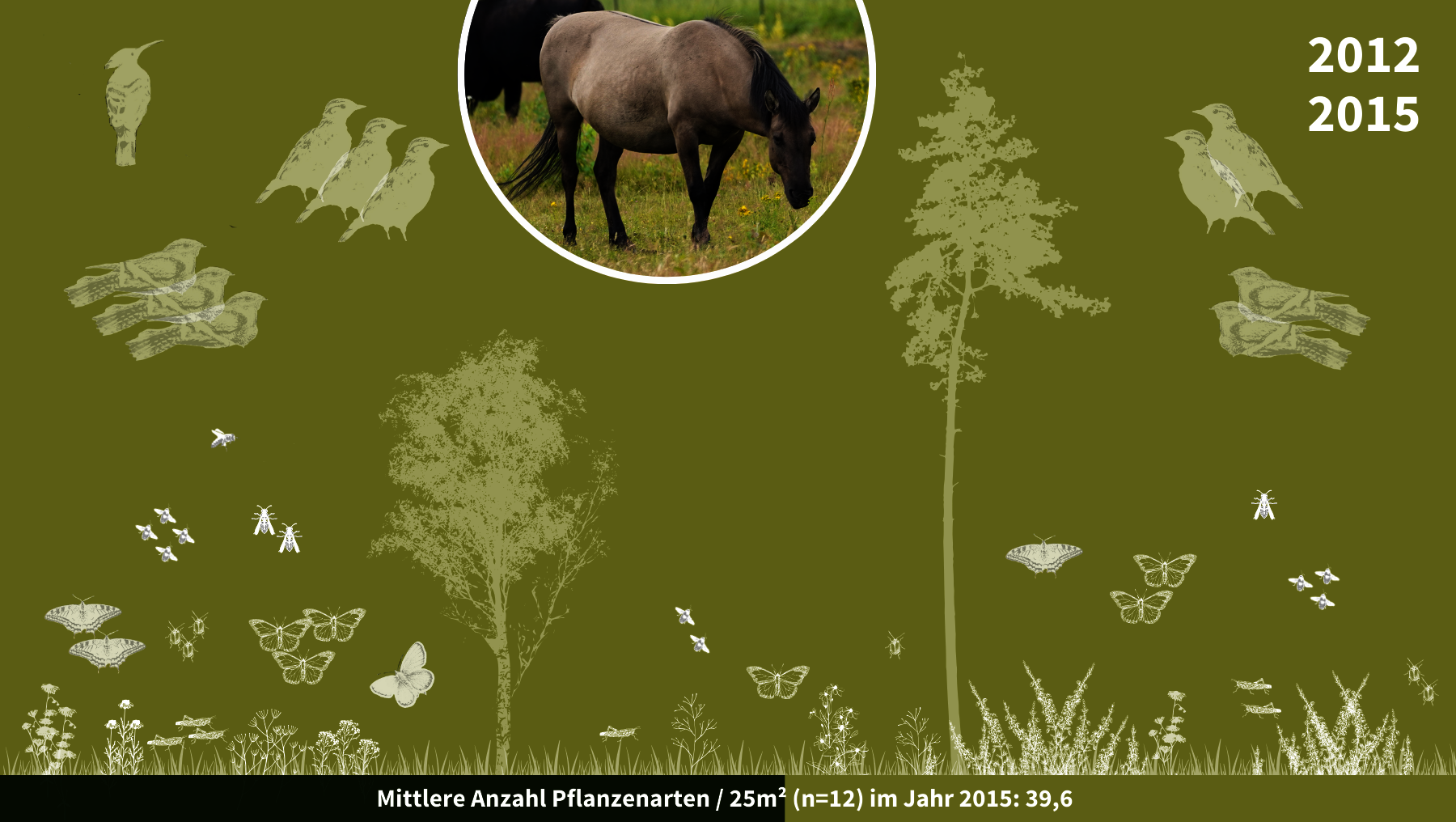
The grazing area is being expanded to its maximum extent: Heck cattle and Konik horses graze on a total of 800 hectares. The Mittelelbe Federal Forestry Office is removing additional trees and shrubs from 225 ha, and through this clearing, is creating open spaces to preserve the valuable open-land habitats. With support from the Mittelelbe Federal Forestry Office, Primigenius gGmbH is carrying out supplementary measures, such as one-time mowing or mulching of overmature heathland stands.
- Seven years after the project began, not only have the number of plant species and the abundance of flowers in the heathlands and nutrient-poor grasslands increased significantly in the Oranienbaumer Heath.
- The diverse structure, the medication-free manure—including its fauna—and suitable breeding sites in the open areas have also enhanced habitats for insects such as butterflies, grasshoppers, and wild bees.
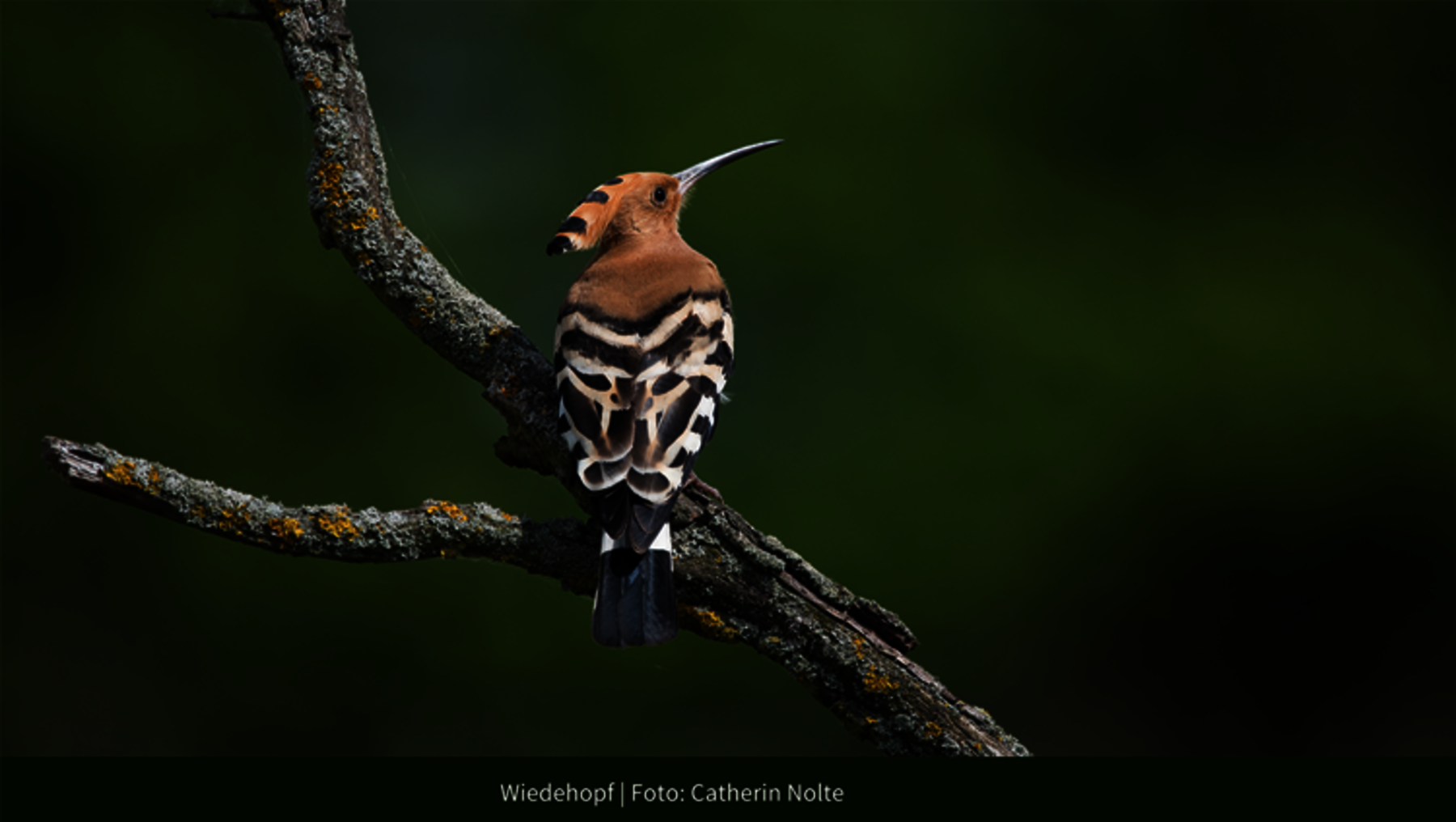
- These—along with the structurally rich semi-open landscapes—are, in turn, a key reason why bird populations are recovering and new ones are settling in: The hoopoe is particularly noteworthy here: additional nesting aids are being installed for it, and five territories were documented for the first time in 2012.
- Bird species such as the woodlark (45) and the nightjar (69) are expanding their territories.
- Also noteworthy is the increase in insect species.
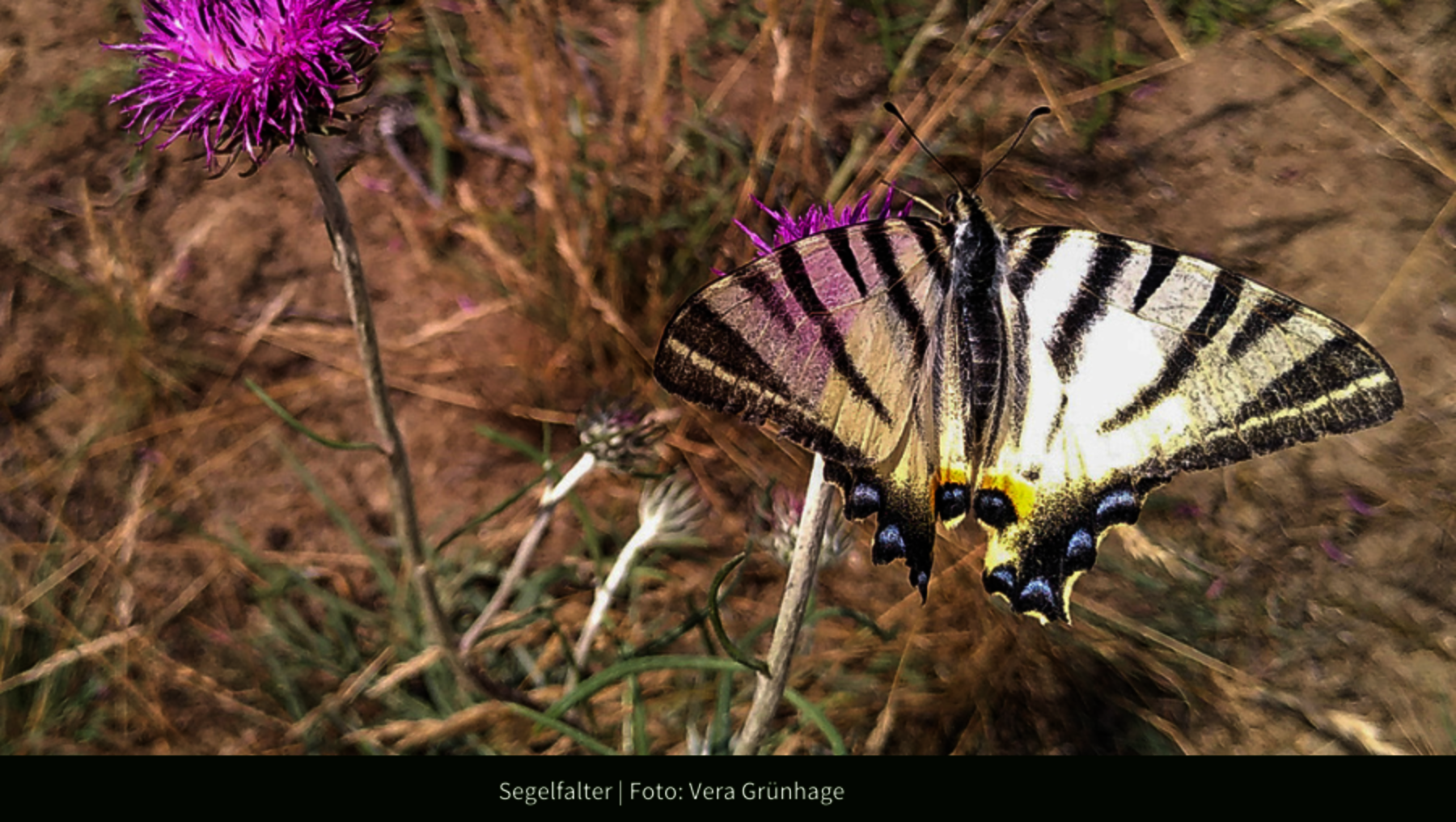
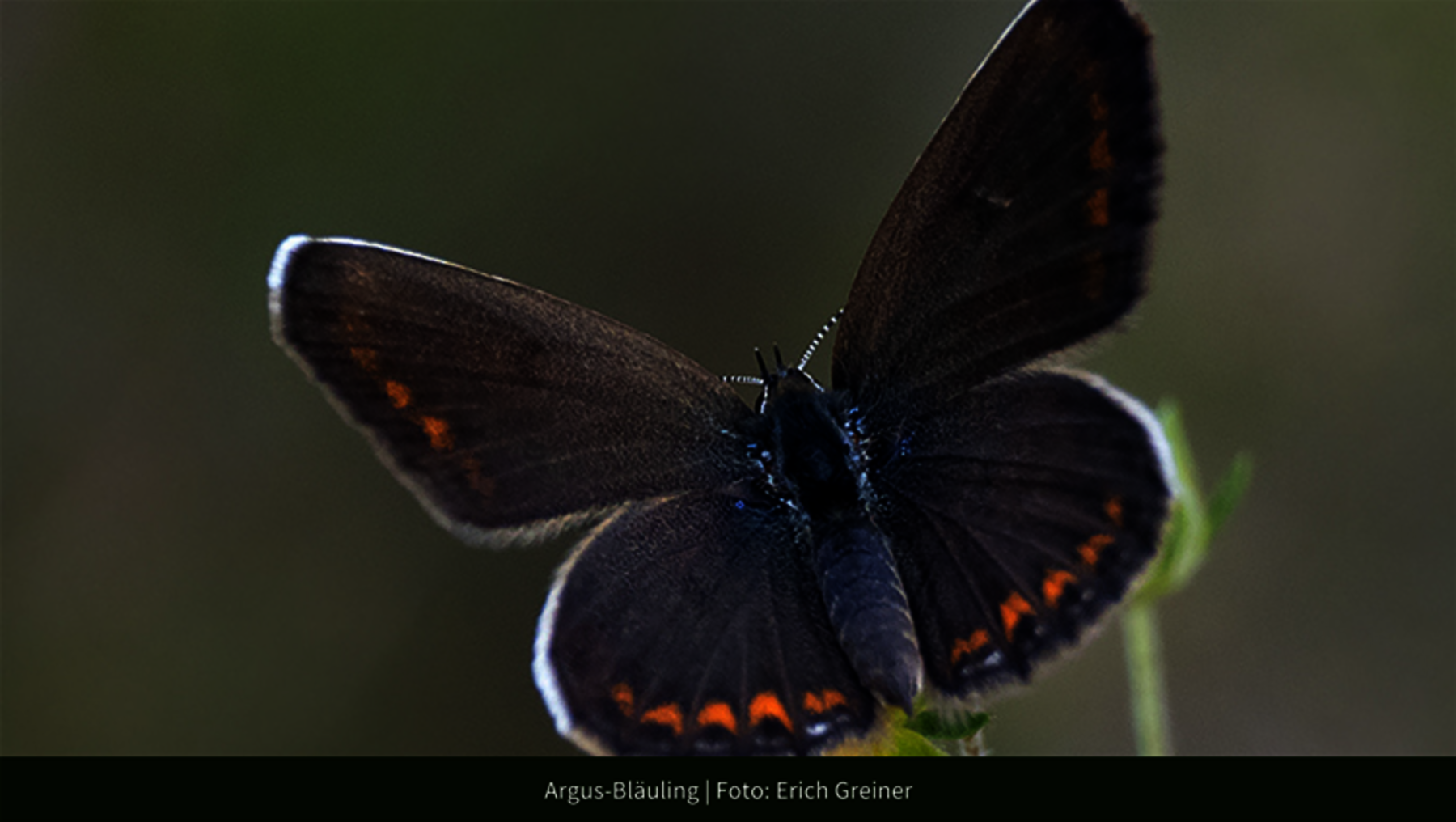
- During this period, an important butterfly species was added to the list: the Argus blue.
2023: From a Herculean effort to one of the most successful initiatives of the UN Decade
-
 © Claudia Aldinger | HS Anhalt
-
© Claudia Aldinger | HS Anhalt
-
© Claudia Aldinger | HS Anhalt
-
© Claudia Aldinger | HS Anhalt
-
© Claudia Aldinger | HS Anhalt
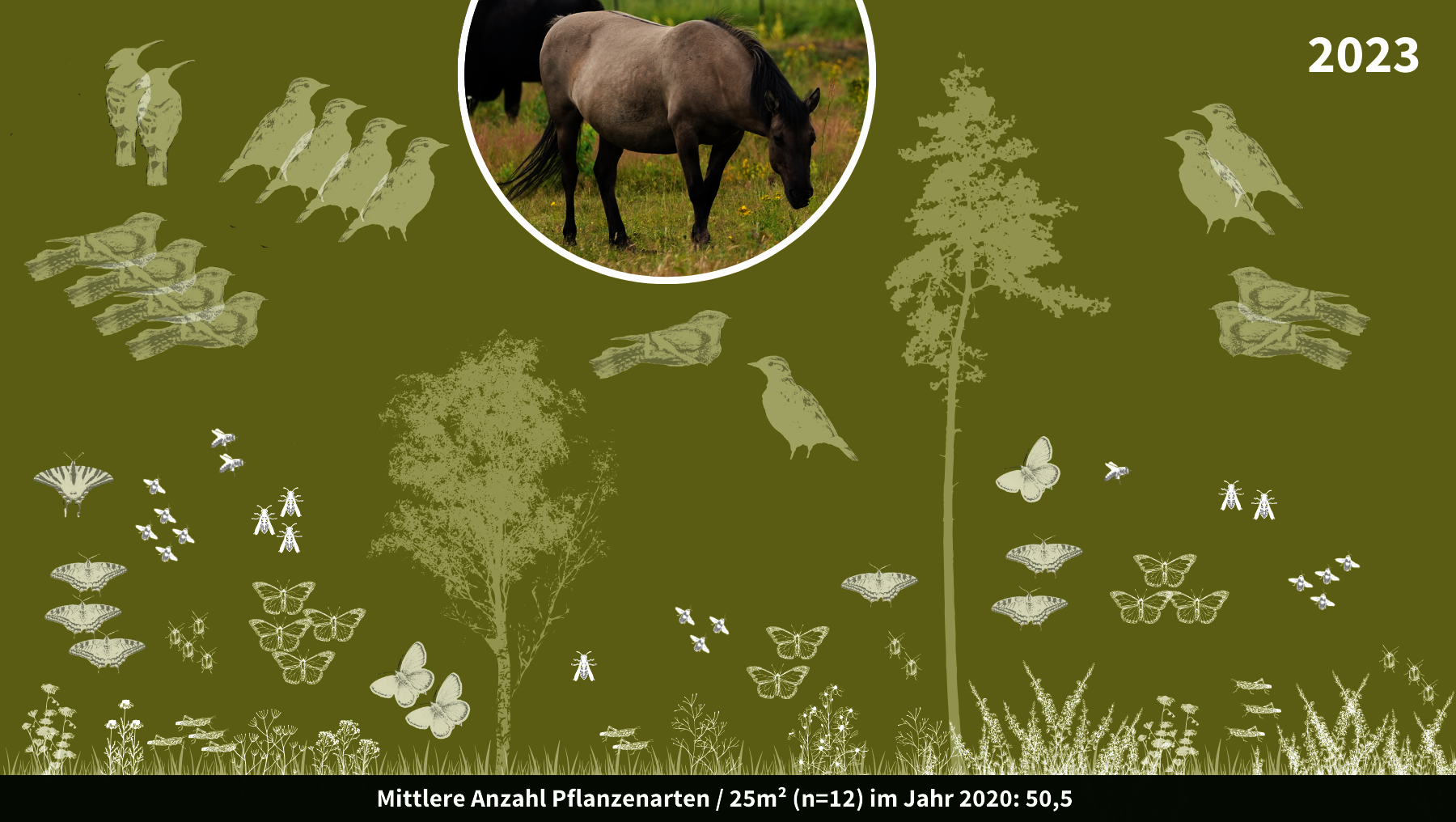
Biodiversity in the Oranienbaumer Heide had fully recovered by 2023. There are now:
- about 800 plant species (nearly one-third of all species found in Saxony-Anhalt)
- 73 breeding bird species, including 7 listed under the EU Birds Directive, and 20 species with protected or endangered status
- about 600 butterfly species, including 12 butterfly species for which the Oranienbaumer Heide is a key area of distribution, and 2,021 swallowtail butterflies (2 species listed in the Habitats Directive)
- 39 grasshopper species, representing 63% of the species found in Saxony-Anhalt
- 105 bee species and 118 wasp species (including 65 RL D and 71 RL ST), with four previously thought-to-be-extinct species rediscovered in Saxony-Anhalt in 2021 (RL 0)
In February 2023, Federal Environment Minister Steffi Lemke presented Anhalt University of Applied Sciences and Primigenius gGmbH of the NABU Regional Association Köthen e. V. with an award recognizing them as one of the most successful initiatives of the UN Decade on Ecosystem Restoration in Germany.
The project also receives enough votes in an online poll to be named the UN Decade Project of the Year for 2023. Ultimately, this award also reflects how good the stakeholders' roots are in the region. The idea of the Oranienbaumer Heide as a site of biological diversity has had a wide-ranging impact. DBU Naturerbe GmbH, as the landowner, and Primigenius gGmbH, as the manager, are continuing to pursue this path.
How did the military training area become the Oranienbaumer Heide pastureland?
 © Heiner Hensen
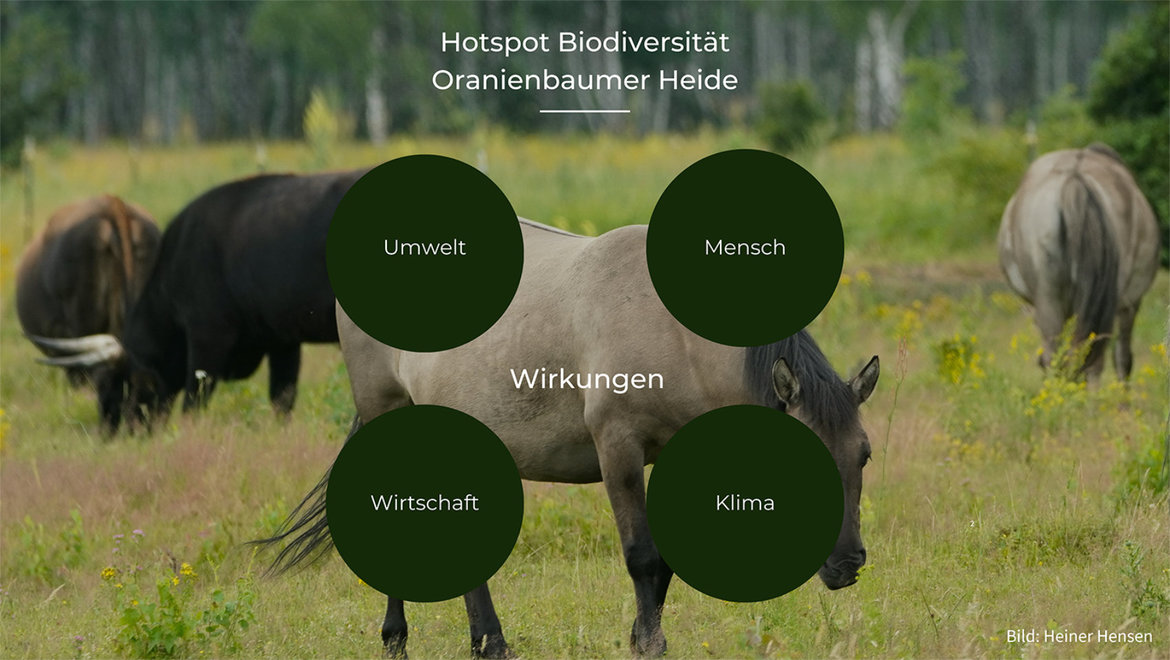
Grazing, landscape conservation, impact assessments: From the very beginning, the plan to restore biodiversity in the Oranienbaumer Heide was designed to have a multifaceted impact. The environment, people, Economics, and the climate were all considered together.
Environment
Plants and insects were the first to benefit from the measures, followed eventually by bird species. The controlled, sustainable use of the grasslands and landscape conservation measures restored space for the species-rich, flower-filled nutrient-poor grasslands and heathlands. With a foundation of food and nesting opportunities, the populations of other animal species were able to recover. Some, such as the hoopoe, even established new colonies.
People
The Oranienbaumer Heath is firmly rooted in the region thanks to its value: as a popular local recreation area that is now known beyond the region—especially among nature lovers. At the start of the project, the trails were intentionally opened to the public, a process that initially required measures to clear the area of unexploded ordnance. The nature trail, designed in collaboration with the Middle Elbe Biosphere Reserve, was implemented and has been used extensively.
Since no conventional fertilizers or pesticides are used in the Oranienbaumer Heide, the clean groundwater beneath the heathland is preserved.
Economics
The Oranienbaumer Heide is managed with sought-after animal species. Primigenius gGbmH, as the manager, markets the high-quality meat produced through landscape management. The source populations of insects are important for maintaining and strengthening repopulation in neighboring areas—such as beneficial insects like pollinators or natural predators of pests.
Climate
The protection of biodiversity is also becoming increasingly important in light of climate change: for sequestering CO₂ in the soil, protecting against heat-induced erosion, and absorbing and storing water.
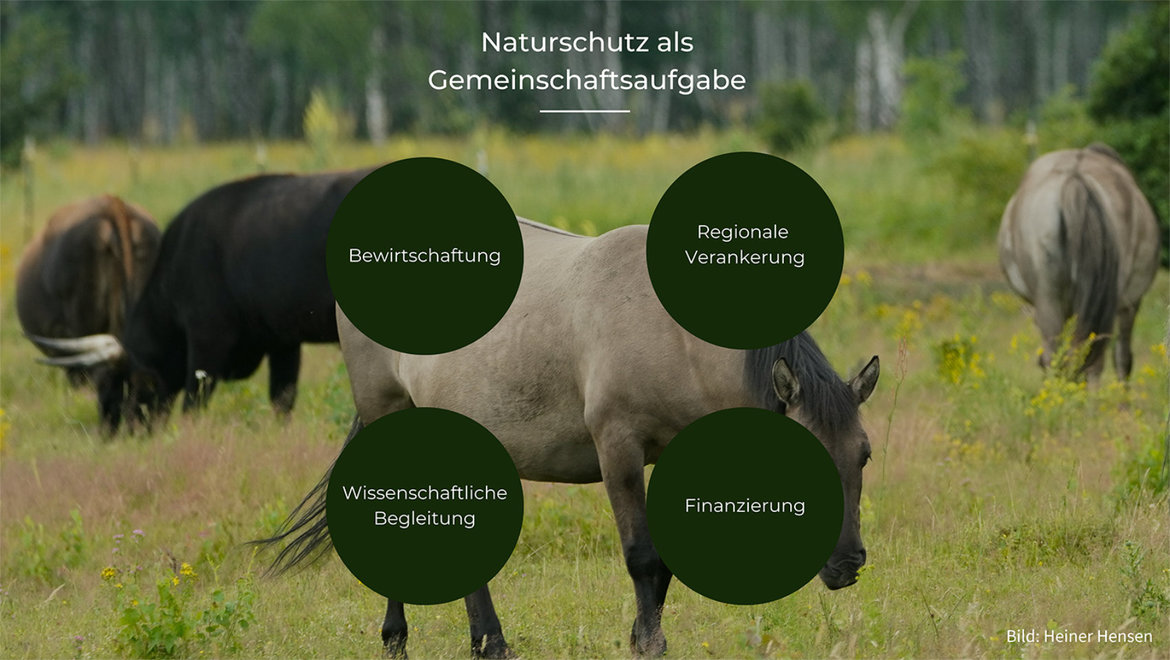
Who Was and Is Important to Our Success
 © Heiner Hensen
The close cooperation among all partners—both regional and national—was crucial to reversing the trend from biodiversity loss to biodiversity restoration in the Oranienbaumer Heide. Key to this effort was the development of a shared vision for the Oranienbaumer Heide and its designation as a nature reserve, as well as the joint funding of the measures by the State of Saxony-Anhalt, the EU’s EAFRD, and the German Federal Environmental Foundation. The following institutions were particularly involved in the project’s core components:
- Anhalt University of Applied Sciences
- Primigenius gGmbH
- Owner: DBU Naturerbe gGmbH
- Federal Forestry Office Mittelelbe
- Mittelelbe Biosphere Reserve
- Surrounding Municipalities
- Nature Conservation Authorities and the Ministry of the Environment of the State of Saxony-Anhalt
Research at Anhalt University of Applied Sciences and Biodiversity: From Knowledge to Action
The lessons learned from restoring biodiversity in the Oranienbaumer Heide are now being applied in other areas as well. Researchers at Anhalt University of Applied Sciences are working on numerous projects focused on the sustainable use, restoration, or creation of open-land habitats, as well as their monitoring—always with a focus on nature conservation and landscape management. For more information and to request contact details, please visit the website https://www.offenlandinfo.de.
Details about the Oranienbaumer Heide, specific project objectives, scientific publications, a practical guide, and contact information are available at this link: https://www.offenlandinfo.de/projekte/aktuelle-projekte/halboffene-weidelandschaft-oranienbaumer-heide-wiederherstellung-von-ffh-offenlandlebensraeumen-1
Information about the project’s designation as a UN Decade Project can be found here: https://www.undekade-restoration.de/projekte/halboffene-weidelandschaft-oranienbaumer-heide/
If you’re interested in a relevant degree program on this topic, search our program pages using the keyword “Nature & Environment”: https://www.hs-anhalt.de/studieren/orientierung/studienangebot.html
Anhalt University of Applied Sciences is committed to sustainability in many ways. The pages on the university’s sustainability strategy provide information about its overall commitment.
Additional articles about the research group on Anhalt University of Applied Sciences’ Climate Blog:
Biodiversity: How do we shape cultures of coexistence?
Plants, Insects, and Bird Species in the Oranienbaumer Heide
-
 © Catherin Nolte
-
 © Axel Schonert
-
 © Erich Greiner
-
 © Erich Greiner
-
 © Vera Grünhage
-
 © Catherin Nolte
-
 © Axel Schonert
-
 © Erich Greiner
-
 © Antje Lorenz
-
 © Catherin Nolte
Redaktion
Many thanks to Prof. Sabine Tischew and Heiner Hensen: They proofread the story and provided important details and images.
This article was written (in part) as a tribute to a special honor bestowed about a year ago: On January 30, 2023, Federal Environment Minister Steffi Lemke recognized the grazing project “Semi-Open Pasture Landscape of Oranienbaumer Heide” as a UN Decade project. Read the press release.
Additional explanatory websites and contacts are linked in the article.
