Discover more. Achieve more. Get more out of your studies.
Studying means more than just acquiring specialized knowledge. The challenges of our time call for people who can think outside the box, take on responsibility, and collaborate successfully in diverse teams.
Through the studium generale, Anhalt University of Applied Sciences offers all students the opportunity to develop precisely these skills. Discover new areas of interest, broaden your horizons, and tailor your academic experience even more to your individual needs.
Whether it’s sustainability, personal development, career planning, social engagement, or interdisciplinary learning—the studium generale provides space for new perspectives, exciting experiences, and personal growth.
Broaden your horizons, strengthen key skills, and shape your future—beyond your degree program.
To do so, please contact your respective examinations committee.

Why is the studium generale worth it?
Today, college is about more than just specialized knowledge. In a complex professional world, interdisciplinary skills are crucial. The studium generale program supports you in this—with a practical, diverse, and forward-looking approach.
 © HSA
© HSA
Six subject areas—a wide range of possibilities
Here's how it works
Five easy steps to earning your credits in the studium generale.
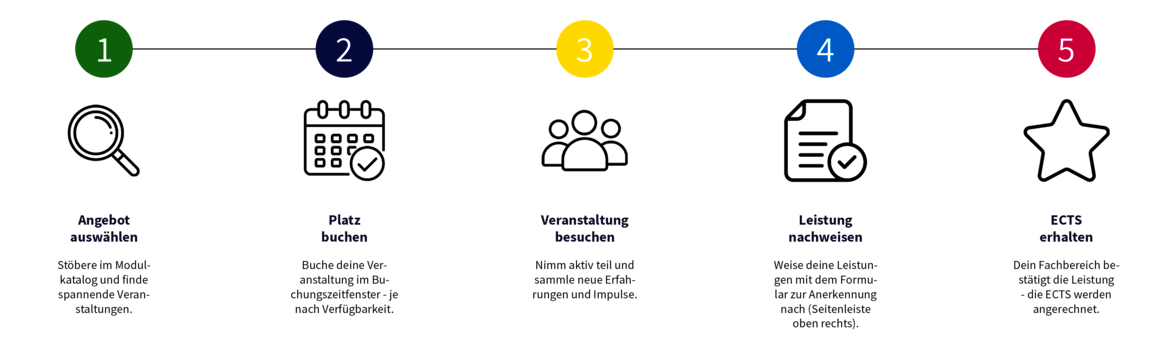 © Hochschule Anhalt
FAQ
General Information
Studium generale is a new university-wide, interdisciplinary program offered by Anhalt University of Applied Sciences. It will launch in this format for the first time in the 2026–27 winter semester. Through this program, you can explore new topics beyond the content of your own degree program and develop interdisciplinary skills—for example, in the areas of personal development, civic engagement, sustainability, career development, or interdisciplinary learning.
The studium generale is generally open to all students at Anhalt University of Applied Sciences—starting as early as the first regular semester. Depending on the degree program, it may be part of the curriculum as a required or elective module, or it may be completed in addition to the regular coursework.
That depends on your degree program. If the studium generale is listed as a compulsory module in the curriculum, you must take it. Modules for the studium generale are also offered as part of your degree program. Ask your Degree Program Advisor or the examinations committee about the modules.
Yes. In fact, cross-departmental and cross-campus exchange is a key part of the studium generale program. In general, you can also take courses at another campus of the university, provided you meet the respective prerequisites and it fits into your class schedule.
Yes. The studium generale includes relevant classes from other departments. You can see which classes are open to students in other degree programs in the current course catalog.
The eligibility requirements are generally listed in the module descriptions. There is one important restriction here: Only master’s students are eligible to take exams in the master’s modules of the degree programs.
No. No other form of compensation may be provided for courses taken as part of the studium generale program. Furthermore, courses that are already being taken, for example, as a lab or as part of a paid position, cannot be credited additionally as part of the studium generale program.
If you have questions about how the studium generale can be credited toward your specific degree program, please contact the examinations committee in your Department. For general questions about the studium generale, please contact the person listed in the sidebar.
For the studium generale, you can only receive credit for as many credits as specified in your examination and degree program regulations. However, you may register for and attend additional modules and have your attendance and, if applicable, your performance documented by the instructor on a separate certificate.
Yes, these programs are free for students at Anhalt University of Applied Sciences.
Yes, this opportunity is open to all students. Their performance will then be documented in the "Certificate of Achievement."
Registration / Booking
Registration for courses in the 2026–27 winter semester will open on September 21, 2026. The number of spots for some courses is very limited, so it’s a good idea to register early.
For courses that typically begin at the start of the semester, registration is open until the end of the first week of classes. Courses that begin later in the semester—such as intensive courses—can be registered for at a later date as well.
Yes. For courses that start at the beginning of the semester, you can drop them by the end of the first week of classes.
On this website, you'll find the link to the booking page. All available options are listed there. If there is still space available in the module, you can book a spot; if it's already full, you can have your name added to the waiting list.
Once you make your booking, your spot is reserved. However, you can still cancel your registration until the end of the first week of classes.
Seats are assigned on a first-come, first-served basis. Booking early ensures you get the good selection.
You can initially sign up for classes worth 5 credits. If you'd like to attend additional classes, you'll need to join the waiting list.
Yes, there is a waiting list. By the end of the first week of classes at the latest, the waiting list will be processed, and you will receive reregistration notification if you can participate in the module.
When choosing modules, you should make sure they fit into your class schedule and, if necessary, take into account any changes in location and travel time.
Services
Your program’s academic regulations specify how many credits are required for the studium generale in your degree program. Credits can be earned over the course of several semesters and across various subject areas.
No. Credits for the studium generale can be earned over the course of several semesters and combined with one another.
Each credit requires a workload of 25 to a maximum of 30 hours per week (depending on the course). This may include in-class time, online instruction, and time spent independently studying.
Generally, courses in the studium generale are not graded. For certain courses, however, it is possible to take a graded examination and have the instructors document this on a separate certificate (in the right-hand sidebar).
No. A compulsory module or an elective module that you have already selected as part of your own degree program cannot also be used as astudium generale credit. It is not possible to receive credit twice for the same course.
Under certain prerequisites, yes. Volunteer work performed at Anhalt University of Applied Sciences is generally eligible for approval. For volunteer activities outside the university, you must first discuss the matter with the chair of your examinations committee and obtain their approval.
In some studium generale modules, taking the examination is mandatory, even though your performance will be recorded in your academic transcript without a grade. Registration for the examination is not done through the HIS system. Send your examiner the completed form for credit recognition and the certificate documenting your achievements 5 days before the examination.
That is possible. A course can only be certified if it awards credits. If the required credits for the studium generale are earned through multiple courses, you may apply for recognition.
Proof
The courses listed in the official catalog are already approved as eligible studium generale courses and are generally accepted by the examinations committees. Formal confirmation of the completed coursework and credits is provided by the examinations committee of the respective Department.
No. Only coursework completed during the current academic program can be taken into account.
The “studium generale certification” form is provided for this purpose. The workload must be documented; the form includes a time sheet for this purpose, specifying the date, start time, end time, time spent, and type of activity.
The examiner will certify that you have completed the module by issuing a certificate of achievement. You must submit this certificate, along with the “Proof of Recognition” form, to the examinations committee. The committee will decide on the recognition and forward the document to the examination office. If recognition is denied, the examinations committee will notify you.
