The technical advances that are now possible are currently well illustrated by generative artificial intelligence, such as that used by ChatGPT. The voice assistant creates texts, concepts for campaigns, scripts for films or website codes. At a simple voice command, without a fee and now used millions of times over. Entire professional groups see their copyrights violated and at the same time have to ask themselves: are we still needed? Arne Berger teaches and researches the consequences of technologies like these. At the same time, the Professor of Human-Computer Interaction asks: How can we design information technologies in such a way that they benefit rather than harm people, society and nature?
Professor Berger, you recently brought two research projects to the university: "bitplush" and "Simplications". What are they about?
Both are looking at the opportunities and risks of so-called simple sensor data, such as that collected by door-opening or temperature sensors on the fridge or the front door. In "Simplications ", we are developing teaching and learning materials in collaboration with Chemnitz University of Technology, the KF Education agency and the Saxony Consumer Advice Center on how dangerous such sensors can be in terms of surveillance and invasion of privacy. With "bitplush", we ask the other way around: What great things can I do with it? Can I use such simple sensor data in a privacy-friendly way to communicate with other people?
How did you come up with the ideas for the projects?
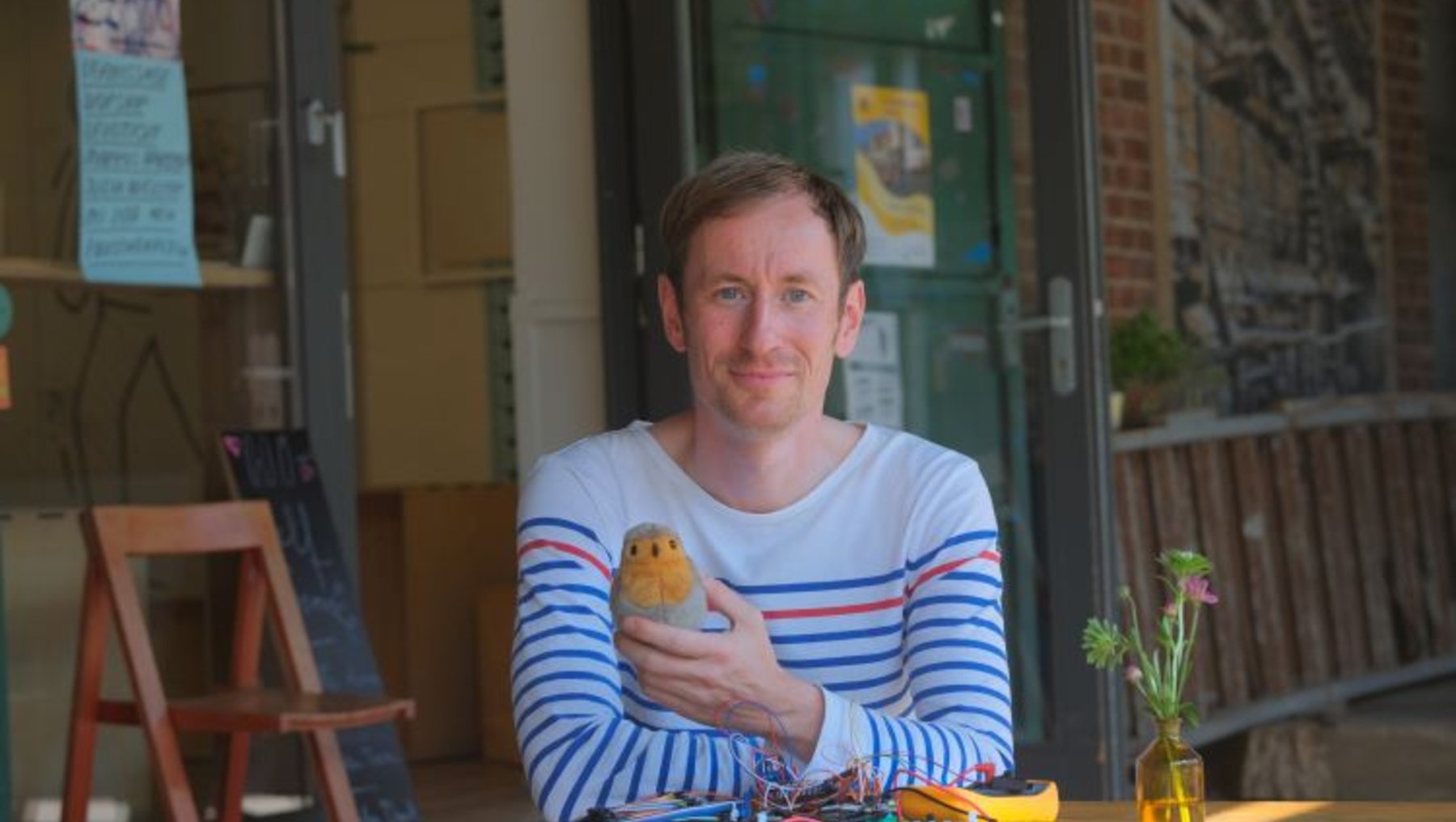
The ideas and ultimately the contact with the cooperation partners basically go back to my postdoc project "Together" from 2014 to 2022. Together with computer scientists, designers and sociologists from Chemnitz University of Technology and funded by the German Federal Ministry of Education and Research (BMBF), we investigated how we can uncover the opportunities and risks of smart homes in a participatory way, i.e. together with future users. We are now applying one of the methods developed in "Simplications". And in one of the workshops, the "Whether Bird" was developed in collaboration with blind schoolgirls to help assess whether it has rained and the road is still wet. Although the idea for this assistant in the form of a small bird was not implemented, it was ultimately the basis for "bitplush". We are now focusing on the development of smart soft toys, which are developed in consultation with potential users. Our industrial partners, the Kösener Spielzeug Manufaktur with its long tradition and high quality standards, and the Thüringen-Vogtland Textile Research Institute, with its expertise in smart textiles, are also hoping to gain new impetus from this approach.
What impetus do you hope to gain for teaching?
Basically, of course, new, practical experience from participatory approaches to human-computer interaction. We still talk too much about technical advances and too little about people's needs on the one hand and the effects of technologies on the other. About the right of those who are affected by future technologies to have a say. I also say this as spokesperson for the Participation section of the German Informatics Society. Regardless of whether it's about sensor data or artificial intelligence: Our students should talk to people first and then design technologies and put them to use. This can be quite challenging for budding computer scientists.
Is your approach sufficiently heard? Offerings based on generative artificial intelligence have become part of our everyday and working lives within just a few months.
In fact, parts of computer science are propagating questionable future narratives without paying sufficient attention to the current problems of these technologies. I see this again in the discussion about artificial intelligence. In general, too little is said about how the systems are trained: with texts and images that belong to others. Or how training data is classified: often by humans, some of whom are subjected to severe stress because they have to decide whether to watch a brutal act of violence or a cat video. There is also too little discussion of the impact that algorithmic bias - i.e. distorted representation - already has on the lives of already marginalized population groups on a daily basis.
How can we do better?
I think that other voices are being heard, especially in Europe. I am active in the BMBF-funded Integrated Research Network, where I work with colleagues from the fields of ethics, sociology and law to advise technology development projects on how ethical discussions can be promoted alongside technological development. This in turn gives rise to funding such as the "bitplush" project, which aims to develop smart technology based on values such as sustainability or privacy. There are also good examples of how researchers have been heard by industry on the topic of ethics in the Internet of Things with a focus on the smart home. For example, through the global initiative "ThingsCon", in which I am also active.
In October, you will be going on a research semester. What will you be working on during this time?
I will be working on a topic called "More than human design". There will finally be more discussion about this. Up to now, everything we've done, whether computer science or design, has focused on people. Unfortunately, this has gone hand in hand with the exploitation of nature and other species. During my research semester, I want to collect international examples of what "more than human design" can look like in applied teaching. I want to present the results at conferences, but also incorporate them into teaching in the form of a new interdisciplinary teaching module.
Professor Berger, thank you very much for talking to us.
