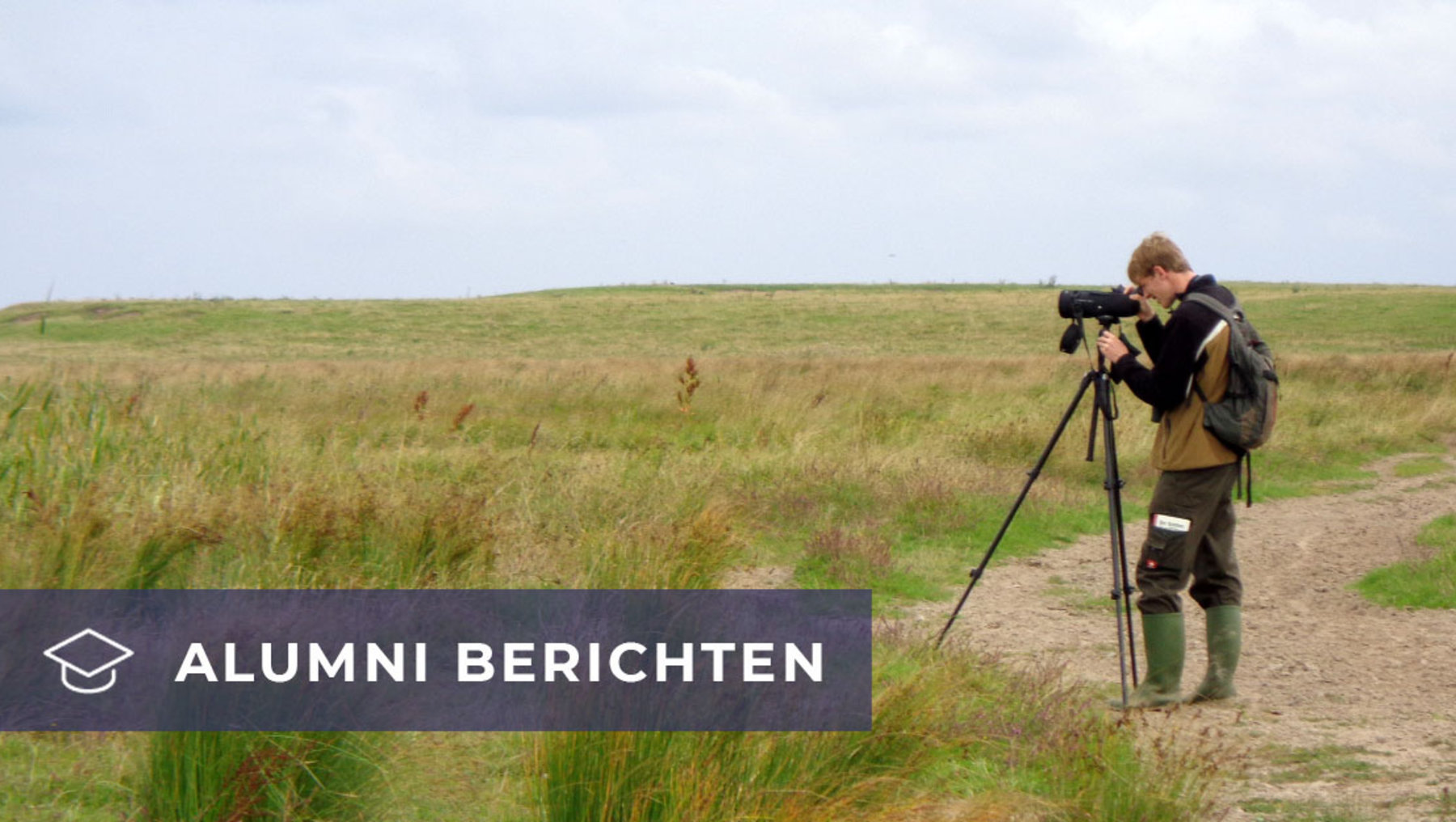
Erik Peretzke was awarded the DLG prize as the best Master's graduate in the Department of Agriculture, Ecotrophology and Landscape Development. Here he explains why he decided to study for a Master's degree in Nature Conservation and Landscape Planning at Anhalt University of Applied Sciences and which worries turned out to be unfounded in retrospect.
Mr Peretzke, you are a graduate of the Nature Conservation and Landscape Planning master's degree program. Why did you choose this course?
I studied "Landscape Use and Nature Conservation" at the Eberswalde University for Sustainable Development. I then wanted to do a Master's degree in order to expand and deepen my previous knowledge. Although I liked it very good in Eberswalde, I also wanted to get to know other focal points and perspectives in the large field of nature conservation through new instructors and fellow students. I heard about the degree program in Bernburg from a fellow student in the year above me and then went to the university information day in Bernburg to find out more.
Were there any special criteria that you looked for when deciding where to study?
Yes, it was important to me that the course content was practical and that the location, the university and the degree program were clearly laid out. I wanted to be able to make personal contact with lecturers and students quickly and easily.
Did you have any doubts before starting the course?
I was worried that Anhalt University of Applied Sciences would try to emulate the universities and prioritize scientific issues and research into ecology/biology in its teaching. I had explicitly decided to study at a university of applied sciences. I wanted a course with close links between research and practice. And practice also includes topics such as landscape planning and nature conservation law.
Were your doubts confirmed?
No, the content was taught in such a way that my fears were not confirmed. On the contrary, I think that the teaching of these topics by instructors with several years of experience in practical nature conservation is a unique selling point for the degree program in Germany. In my opinion, Anhalt University of Applied Sciences should therefore definitely retain this educational profile.
Many Bachelor's students find it difficult to decide on a specific Master's degree. And also to change universities. How did you decide on Anhalt University of Applied Sciences?
I looked at the module description handbooks of potentially suitable universities/degree programs in advance. The "Nature Conservation and Landscape Planning" degree program with its focus areas was an ideal match for my Bachelor's degree. However, the biggest plus point of the degree program was the connection to official professional nature conservation. This is where Anhalt University of Applied Sciences was able to set itself apart from other universities, which often focus on (more theoretical) biological and ecological research.
This plus point proved to be true in everyday study life...
I was impressed by the fact that in many modules, the assessments or examination results were geared towards real-life issues and challenges and that guest instructors from nature conservation practice were involved at the same time. I also found it particularly valuable that many instructors themselves have years of professional experience outside of university teaching and share their wealth of experience with the students. The uncomplicated, direct exchange with many professors left a positive impression. I experienced this both when working on student projects or theses and when working on research projects as a student/research assistant or research assistant.
You emphasize the practical relevance of the university: did you have a favorite project?
In addition to my Master's thesis, in which I worked on the designation of a nature reserve with a conservation value assessment, it was the planning project in the 3rd semester. In a group work project, we analyzed the draft state ordinance on the national protection of Natura 2000 areas in Saxony-Anhalt in terms of its suitability for nature conservation. The result was so convincing that the state associations of the BUND and the Bundesverband Beruflicher Naturschutz e.V. (BBN) adopted it as their own. We were very pleased about this and the intensive involvement with the topic of Natura 2000 also helped me in my job search after graduation.
What happened after you graduated, what are your career goals?
I already worked freelance for various environmental planning offices during my studies. I also had the great opportunity to work as a research assistant at the Professor Hellriegel Institut e.V. at Anhalt University of Applied Sciences from 2018 to 2020. I am currently working as an employee of the lower nature conservation authority of the Oberspreewald-Lausitz district until the end of April 2021. In mid-May, I will then start as an ecology officer with the German Armed Forces. Professionally, I am particularly interested in the protection, maintenance and development of nature and landscapes.
Mr. Peretzke, thank you very much for the interview.
