At the beginning of October 2020, Dr. Jörg Sauerhering was welcomed to the Köthen site for the field of Thermal Process and Energy Technology in the Applied Biosciences and Process Engineering department. In this interview, he gives an overview of his tasks in teaching and research and an insight into his career.
Professor Sauerhering, welcome to Anhalt University of Applied Sciences. You started working in the Applied Biosciences and Process Engineering department at the beginning of October.
Your career began at Otto von Guericke University in Magdeburg, where you graduated with a degree in energy technology in 2004. What stations awaited you after that?
Prof. Jörg Sauerhering: My studies in Magdeburg offered a very interesting and extensive curriculum ranging from Electrical and Process Engineering to Mechanical Engineering - from the primary energy source to the electrical consumer, so to speak. I got to know the German Aerospace Center (DLR), my next station in life, as a student on a lab course. As I wanted to do research in the field of renewable energy technology after my studies, I moved to Cologne in 2004, where I worked as a research assistant at the DLR Institute of Solar Research.
This was followed by my doctorate at RWTH Aachen University in 2012. What important events took place in the intervening years?
The most significant events in my professional life happened back in 2008, as I took over two lectures (refrigeration technology and thermal power plants) and a large number of thermodynamics seminars in Magdeburg from a standing start. After all, I had to learn how to teach first. At that time, I was offered a position as a senior engineer at the Chair of Technical Thermodynamics at Otto von Guericke University and have been teaching and researching in Magdeburg ever since. Over time, I added further classes in the context of thermodynamics, some of which were held in English, so that I now have a solid foundation to build on.
I took an important step in my scientific work in 2014 when I started investigating heating and cooling concepts in the context of e-mobility within the Editha research group. Since then, the influx of questions and students who want to work on these topics has not stopped.
You have now been appointed Professor of Thermal Process and Energy Technology at the Department of Applied Biosciences and Process Engineering. What will be your responsibilities?
First of all, to hold a basic lecture on technical thermodynamics for all students in the Department and to organize the associated seminars. These courses will also be offered as teaching exports for other departments. I will also be responsible for the lectures and seminars on Thermal Process Engineering and Energy Technology as well as various labs. Over time, I will also take on various supervisory tasks.
What goals are you pursuing?
Thermodynamic issues permeate pretty much all areas of our lives. By providing students with a sound knowledge of methods, I would like to give them a basic understanding of thermodynamic processes and also enable them to formulate energy-efficient solutions for current and future issues.
What challenges might there be?
The subject area requires the ability to think abstractly and its reputation certainly precedes it. My aim here is to make teaching as appealing as possible and thus motivate as many students as possible to tackle this complex topic.
What research projects are you currently involved in to enrich the university?
In addition to e-mobility, I am interested in the resource-saving provision of useful energy. The use of waste heat offers interesting opportunities here, as this is often little used in an industrial environment. I also see the linking of energy networks in the Process Engineering environment as a future field of work for the professorship, as this can be used to respond optimally to the challenges of our future energy supply.
How can students benefit from this?
I have supervised 12 theses in the field of e-mobility alone over the past three years. Due to the current paradigm shift in the automotive industry, the issues discussed here are highly topical, meaning that graduates are ideally prepared for the job market.
A question about the current semester: With the start of the 2020 winter semester, the university has returned to teaching that combines face-to-face and online courses. In December, with a few exceptions, teaching will only take place online or in hybrid form. Do you see any particular challenges?
First of all, I was pleased that we were able to start the semester in the thermodynamics lecture in face-to-face form. This gave both sides the chance to get to know each other. I got to know the students and the students got to know me. As I already taught online throughout the previous semester, I am well prepared in terms of technology and methodology. Now, in December, I will be making my classes available as video-on-demand on the Moodle learning platform. This means that the courses can be accessed at any time. Although there will be a lack of direct feedback, I think this is where the access threshold is lowest. And for questions and discussions, we simply exchange information online via the various communication channels.
Finally, a private question: Where do you live when you're not at the university in Köthen?
I've been living with my family on a very old farm in the Börde for 10 years. There's always something here that needs to be repaired, planted, tended, fed or harvested. I've also been involved in sport intensively since my youth, formerly judo, now preferably cycling.
Professor Sauerhering, thank you very much for the interview.
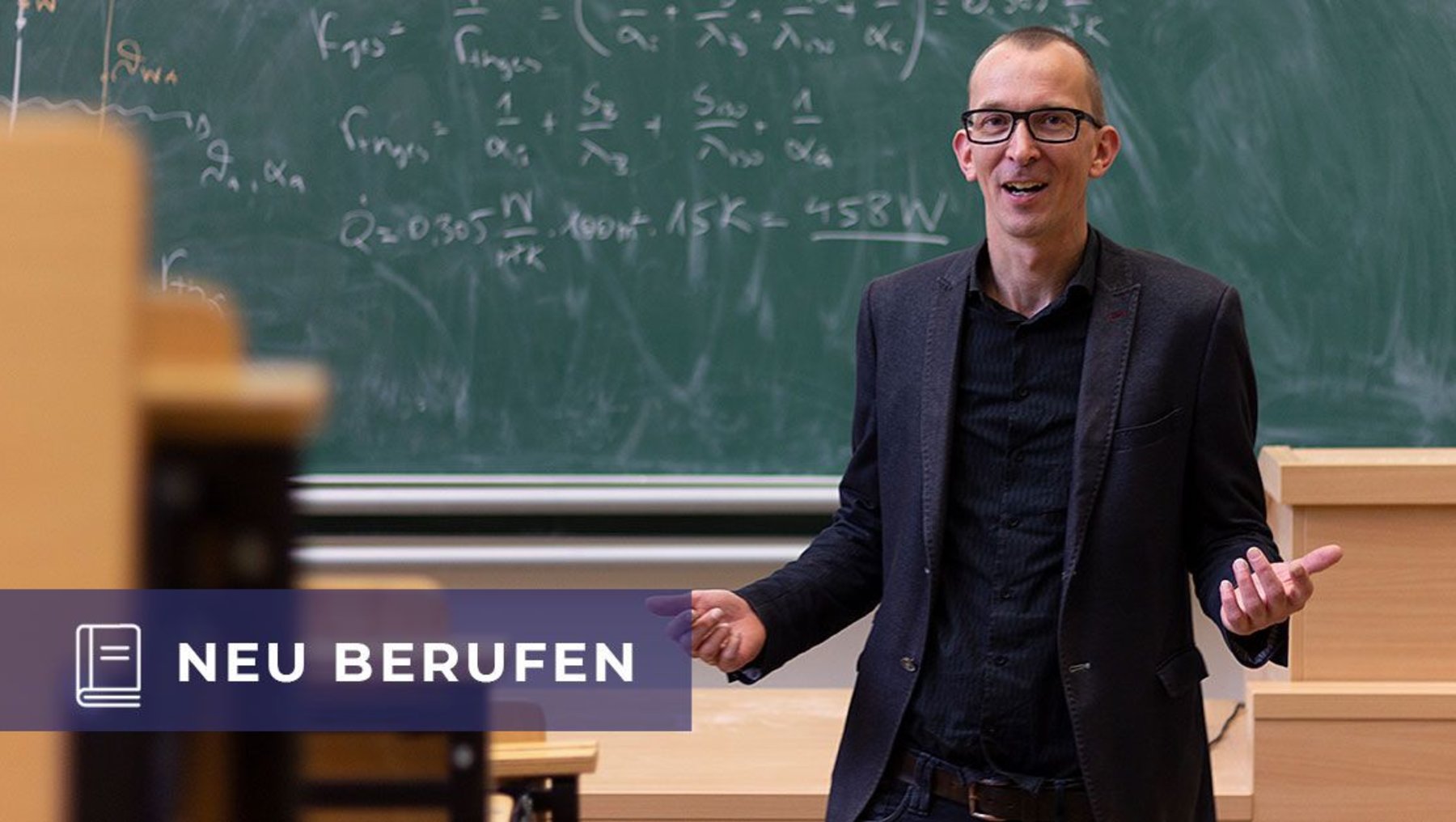
Dr. Jörg Sauerhering for the field of thermal process and energy technology
-
 © Andreas Bindseil
Redaktion
Veronika Eicher
