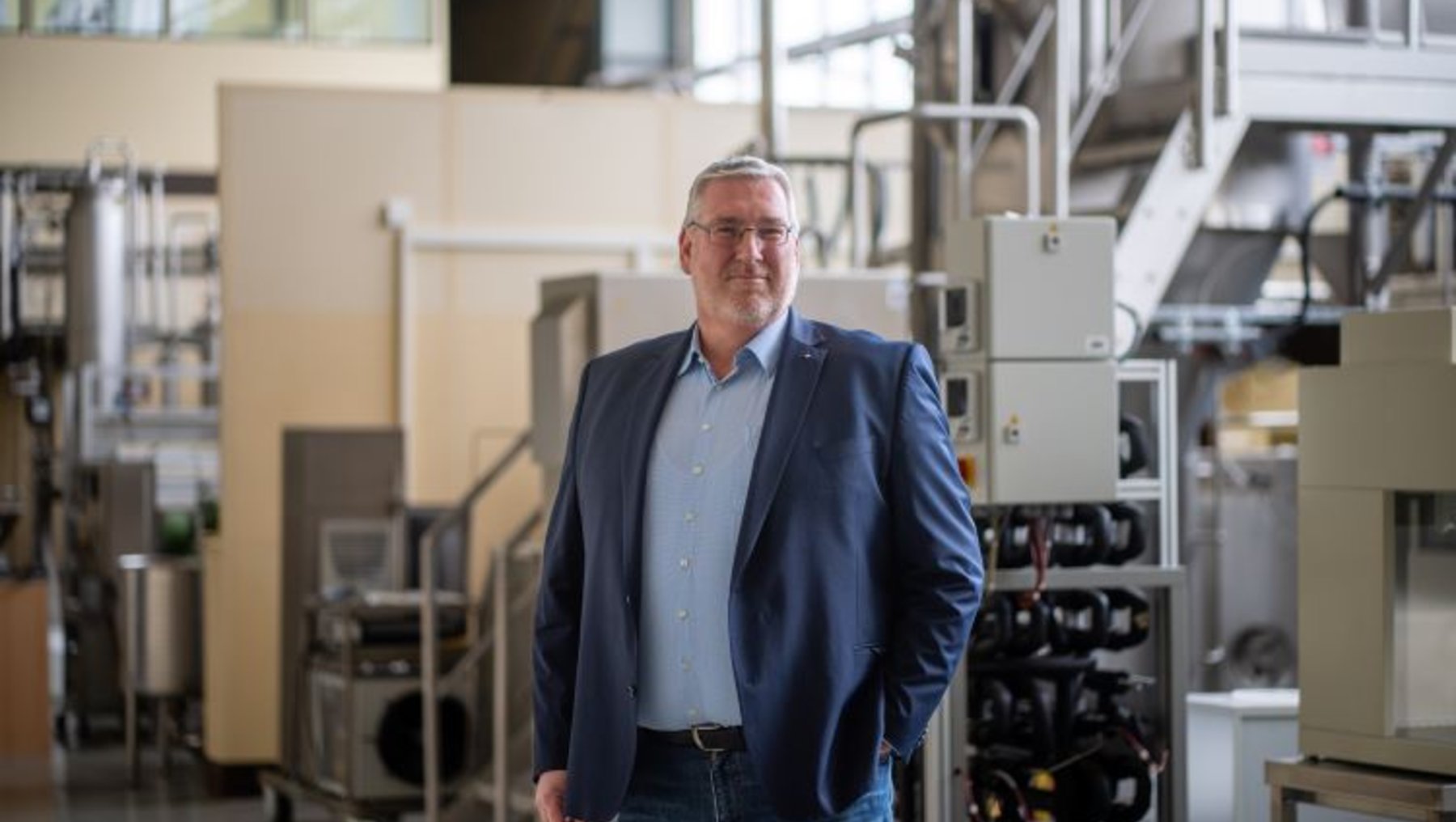
With almost three decades of experience as a manager in the food industry, Dr. Mike Eberle has been appointed as a deputy professor of Food Technology at Anhalt University of Applied Sciences from March 2024. The doctor of chemistry, who most recently held the position of Managing Director at Rotkäppchen-Mumm Sektkellereien, brings with him a wealth of experience that will provide students with valuable insights into practice. "Success comes to those who are passionate about a subject," Eberle is convinced. In this interview, he reveals what is particularly important to him in his profession.
Dr. Eberle, welcome to Anhalt University of Applied Sciences. You studied chemistry in Darmstadt and then completed your doctorate. Your career path then took you into industry. Was it clear to you from the outset that you would go into industry?
No, my doctoral supervisor actually wanted me to go to the USA as a postdoc, more specifically to the California Institute of Technology. I already had a scholarship. However, during this time I got to know people at Unilever. I realized that I could learn something there that I had previously lacked at university: namely the ability to lead people and take them with me. That's why I actually switched to industry after my doctorate, which was in 1996. This had nothing to do with money or anything else, but was a decision based on the motto: "You're now doing something that you've never mastered before because you're basically a chemist".
Did that appeal to you more than a career in science?
Two factors played a role. Firstly, I was already married at the time and our first daughter was already born. The idea of going to the USA with a small child, to California, and then the scholarship for just one year - what would happen after that? It was all pretty uncertain. It was a decision we made as a family. And I have to say that I have not regretted this decision. Although I did make the occasional trip to university during my time in industry. At Leuphana University, for example, I gave a lecture on sustainability.
That must have been at the beginning of the decade, right? Interesting, sustainability wasn't as big an issue back then as it is today.
Sustainability has always been a huge topic for me. If you studied chemistry, you produce things during your studies and then also in the chemical industry that are not always environmentally friendly. You're constantly thinking about how you can replace harmful or toxic substances with something better.
When I look at the curricula today, how chemistry is taught and what experiments are carried out, a lot has changed. You learn the same things, but there is much less toxic waste in the curriculum. It's about sustainability. We have to treat this planet differently, and that primarily concerns our actions. We have the power and the strength to bring about change, especially in my age group between 50 and 60.
Most recently, you were Managing Director at Rotkäppchen-Mumm, responsible for production, technology, quality management, purchasing and supply chains. How did this change from champagne to the lecture hall come about?
It's not a complete change, I'm a deputy professor of Food Technology and I'm still working in the industry. One leg here and one leg there, so to speak. I couldn't imagine a complete change, because I believe that you can combine the two. I have not yet reached the end of what I believe can be changed and where I have the strength and passion to make a difference in companies. At the same time, I want to encourage young people to embark on such a journey too. My goal is to teach students that it is possible to do things differently and that their skills are needed to bring about these changes.
What would you like to pass on to the students from your almost three decades of intensive professional experience?
What I would like to pass on is the circular economy. I believe that when we do something today, we have to think about the entire process from start to finish. Ideally, it should be a closed and sustainable process. We have to be prepared for our world to change. If we don't act on our own initiative, then someone will come along and make a law, as the European Union recently did with the Plastics and Packaging Act, for example. We don't need politicians to tell us what is right, we know it ourselves.
Can you give an example of what you would like to change?
My favorite example of a change I would like to see concerns the use of heavy metals in labels. Imagine if we could do away with heavy metals in labels. Then these labels, which you normally have to wash off to reuse the bottles, could be used to grow mushrooms on. But if you use printing inks containing heavy metals, then that's hazardous waste. It may look great on the shelf, but nobody cares in the cellar, and it shouldn't matter on the table either, because it's about the drink and not the label. But because we use heavy metals for printing, we have to dispose of all that junk, which is simply unnecessary and nonsensical.
This is packaging technology in practice. The question is: how can we change this? But not so that we can then stand on the street corner and proclaim: "Look, we're sustainable!". But rather because it is logical to make such changes. It is obvious that we should change these things, not only in the interests of the environment, but also for pragmatic and sensible reasons.
In your opinion, what is a particularly important skill that students should take away from their studies for their professional future?
For me, there are three points. Firstly, they should only study what they are really passionate about. I believe you can only be successful if you are passionate about a subject. And then you automatically do it well. There is no other way. Secondly, it is important that students take themselves seriously and accept that everyone is unique. Everyone has the right to be themselves, to be different, and not only the right but also the duty to develop this further and be proud of it. This creates differentiation among each other, which ultimately benefits both the individual personality and society. I would like to pass this on to the students as a strength. The third is to persevere, with integrity, passion and fun. These are my three core values. And I want to convey them.
Prof. Eberle, thank you very much for the interview.
