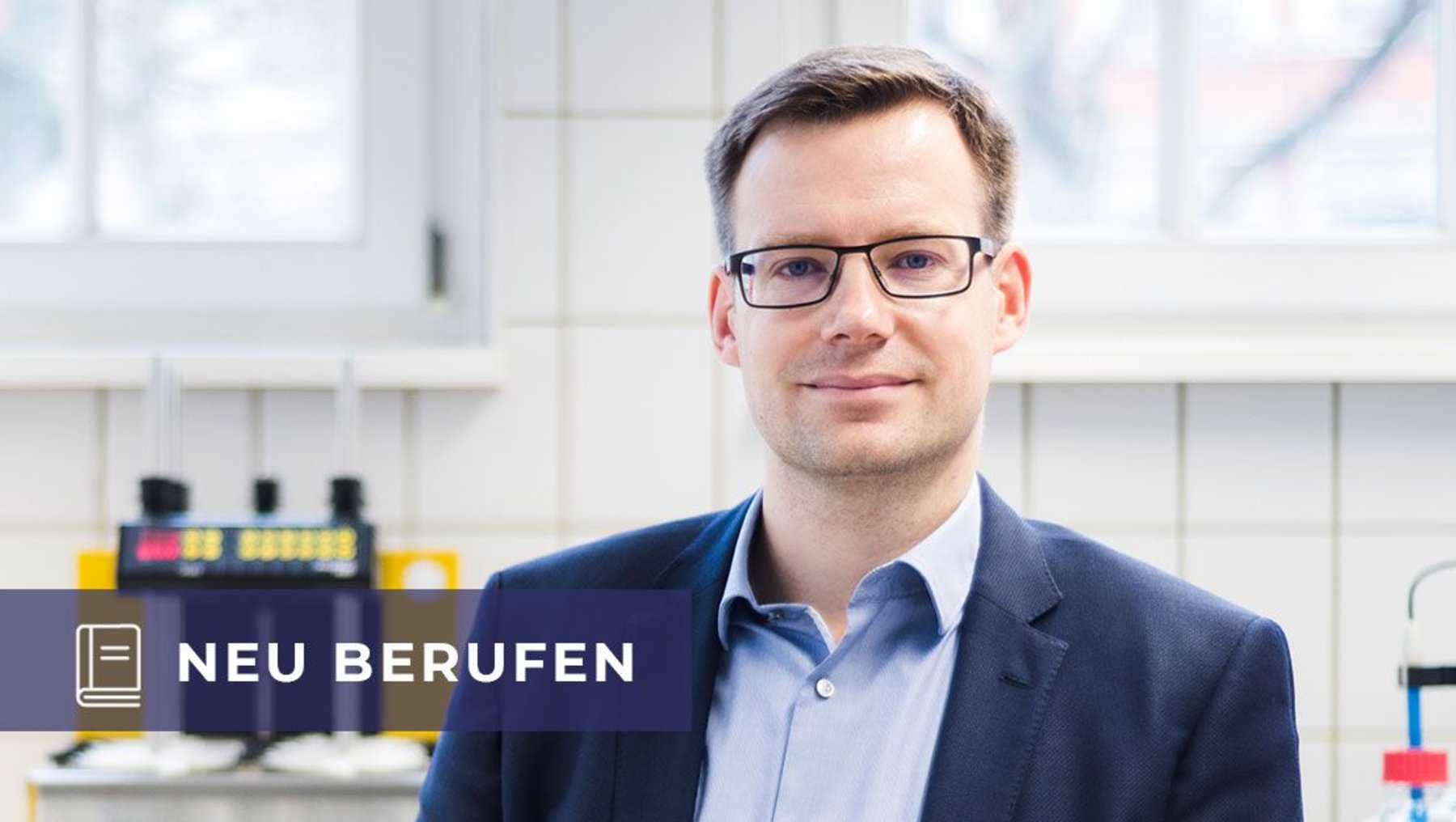
Florian Priese was born in Bernburg, studied Pharmaceutical Engineering in Magdeburg, completed his doctorate and then worked internationally in industry. He is now returning to Anhalt University of Applied Sciences to share his enthusiasm for analytical chemistry and Pharmaceutical Engineering with the students. For Professor Dr. Florian Priese himself, the possibility of improving life through various medicines was the decisive factor in choosing his field, as he explains in the interview.
Professor Priese, welcome to Anhalt University of Applied Sciences. Before we talk about your new tasks, let's take a brief look back. You studied Pharmaceutical Engineering at Magdeburg University of Applied Sciences from 2003 to 2007. How did you decide on your degree program? After graduating from high school in 2002, I wasn't sure what I wanted to study. At school, I liked the STEM subjects, especially the natural sciences, and I was wavering between Business Informatics or Mechanical Engineering. At the time, my grandma had told me that she only had to take her new antihypertensive medication once a day and no longer three times a day. That was a significant relief for her, as she also had to take other medicines every day. That changed my focus at the time. I then decided to go into Pharmaceutical Engineering to make a lasting difference to people's lives.
Has your grandmother been able to follow your career?
Yes, she still follows it today. She is happy that I am doing so well with the decision that influenced her. I already realized during my studies that it was the right thing for me. I liked the link between theory and practice and was able to apply the theoretical knowledge directly in the lab.
What were your most important career stages before your vocation?
I don't have a "classic" career path because I first went into industry for two years after graduating and gained professional experience there. Only then did I go back to Anhalt University of Applied Sciences and the University of Magdeburg for my doctorate (as part of a cooperative doctorate). That was both very formative, for example, as part of the doctorate I was able to work intensively on a topic over a longer period of time and traveled to international conferences in Istanbul or Amman to present my results there.
What were the next steps?
At the Swiss pharmaceutical company Novartis, I took on roles at different locations with increasing responsibility. This career is now benefiting me for the professorship: I have worked in fundamental positions in the pharmaceutical industry with various dosage forms myself and therefore have a broad spectrum of insights.
For the last three years before my appointment, I was head of the Drug Product division at IDT Biologika in Dessau-Roßlau. I was shaped by superiors who actively developed and encouraged me and enabled me to develop gradually. At the age of 32, I had no management responsibility and just four years later I was responsible for a team of 400 people and a divisional budget of several million.
In 2020, a study in collaboration with the Federal Employment Agency revealed that almost two thirds of our graduates stay close to the university. In your job in industry, you traveled a lot internationally - and as a native of Bernburg, you returned to the region even before you moved to the university. What motivated you to do this?
As a native of Bernburg, I wanted to return to Saxony-Anhalt in the long term. There is certainly a certain attachment to my homeland that made me come back, but above all the good pharmaceutical industry in Saxony-Anhalt with its many opportunities.
You were appointed Professor of Pharmaceutical Analysis and Quality Assurance in Köthen on January 1, 2022. What fascinates you about your field?
What fascinates me about the Pharmaceutical Engineering degree program is the broad portfolio of pharmaceutical dosage forms. During your studies, you deal with the classic solid (tablets, capsules), semi-solid (ointments, creams) and liquid (vials, syringes) dosage forms. Another positive aspect is that you can make a lasting difference to people's lives for the better. When a friend who has asthma can breathe again thanks to optimized technologies such as dry powder inhalers, that's a development that actively improves a life, and that's great.
Can you give us an insight into your field of research?
We are currently still setting up the laboratories in Köthen, the laboratory operations are moving from the Bernburg site to Köthen. Once these are up and running, we will concentrate on the area of solid dosage forms, specifically on the use of fluidized beds in the pharmaceutical sector. This enables us to control the release of a drug in a targeted manner. In other words, we can influence what was a relief for my grandmother back then: taking just one tablet instead of three. But there is much more potential - in addition to the time, we can also specifically control the release site in the body.
To what extent can students benefit from your research?
There will be project work in which students can consolidate their independent work and scientific writing. What I find particularly valuable, however, is the opportunity to do research jobs. I myself worked as a research assistant for most of my studies and I am convinced that this is a great way to train independent work and gain practical experience.
Can you briefly tell us about some of the areas you want to focus on in teaching?
I would like to structure the teaching in such a way that graduates have knowledge in all pharmaceutical areas for their career entry. While we are well positioned in the area of solid and semi-solid dosage forms, I would like to further expand the area of liquid dosage forms, as these are essential for the aseptic production of injection and infusion solutions for basic pharmaceutical care. Strengthening the combination of theory and practice is also important to me, as I believe this is the most effective way of imparting knowledge.
What opportunities do you see for future Pharmaceutical Engineering students?
It's the right course! Students have very good future prospects within Germany, but especially locally in Saxony-Anhalt, the career prospects are very good with starting salaries in the region of €50,000 per year. Due to the shortage of skilled workers, there is a low rate of fixed-term contracts, from which job entrants can benefit, and a strong local and international pharmaceutical industry.
What discovery, invention or insight would you like to see in the next ten years? I hope that new technologies and methods (mRNA, recombinant antibodies) will enable us to make further progress in the fight against the remaining scourges of humanity such as cancer, multiple sclerosis, AIDS and Alzheimer's disease. And in the long term, research should focus on developing a sustainable solution to the increasing resistance to antibiotics.
Do you have a motto that you would like to give students to take with them on their journey through life?
That lifelong learning doesn't end with your studies. Since I started my career in 2007, the pharmaceutical industry has developed continuously and rapidly. For example, the requirements of the health authorities in terms of quality management and process knowledge have increased significantly. Where a mean value and standard deviation used to be sufficient, numerous statistical methods now have to be used.
Professor Friese, thank you very much for the interview.
