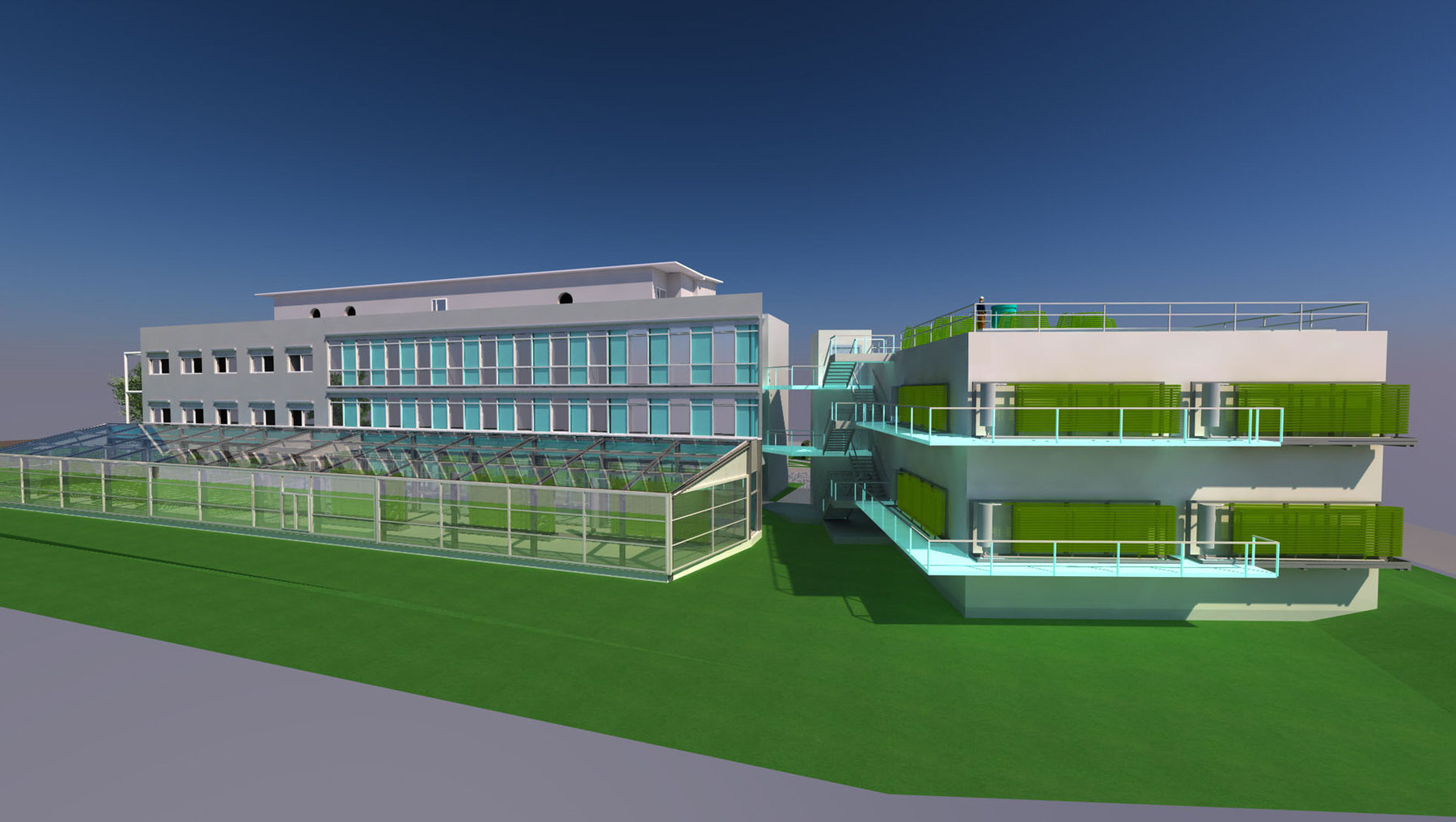
Anhalt University of Applied Sciences is one of the strongest international research institutions in the field of microalgae technology. With yesterday's decision by the Saxony-Anhalt state parliament, Anhalt University of Applied Sciences is continuing on its successful path. 32 million euros will be invested in the establishment of the Central German Algae Center (MAZ) at Campus Köthen.
The total investment volume comprises 20.5 million euros for construction costs and 11.5 million euros for equipment investments. With the MAZ, the entire process chain of algae biotechnology will be mapped on a technical scale at one location for the first time. Different technologies enable tailor-made solutions for various algae strains, recyclable materials and industrial applications.
"With the Central German Algae Center, we are consistently expanding our leading position in microalgae technology and at the same time strengthening our visibility at national and international level. It is particularly important that we can play an active role in the development of alternative raw materials for the future. As a university, this makes us an important partner for companies with whom we share knowledge, develop technologies and transfer innovations into practice," says Professor Jörg Bagdahn, President of Anhalt University of Applied Sciences.
Economics benefits for the region
With the help of sunlight and water, microalgae quickly convertCO2 into biomass that can be used for Economics. From food and medicines to oils and sustainable biomaterials - algae are versatile all-rounders in the bioeconomy. Numerous companies, including in Central Germany, have started the Economics implementation in recent years. According to current analyses, the market will grow to a volume of between USD 5.6 and 9.0 billion per year over the next 5 to 7 years.
The MAZ strengthens Saxony-Anhalt as a center of algae biotechnology and opens up new value chains for agricultural, food, cosmetics, pharmaceutical and chemical companies. Cooperation, technology transfer and spin-offs create high-quality jobs and new impetus for the regional and supra-regional bioeconomy.
What's new at the Central German Algae Center?
The MAZ combines research, application-oriented development and pilot production at one location. The modern infrastructure includes laboratories, algae technology, optimized algae strains, certified analytics and product development. The aim is to network research and industry even more closely and to significantly accelerate the implementation of marketable microalgae products.
Science Minister Professor Armin Willingmann emphasizes: "The planned new construction of the Central German Algae Center will strengthen Saxony-Anhalt as a location for innovation. The project creates modern infrastructure for research and cooperation with companies, promotes interdisciplinary cooperation and enables new processes to be tested under real conditions. The project thus makes an important contribution to food security, bioeconomy and the sustainable use of resources. At the same time, it strengthens the competitiveness of Anhalt University of Applied Sciences and increases the attractiveness of the location in the fields of agricultural and Food Technology and algae biotechnology for students, researchers and innovative companies. We are aware of the great importance of cutting-edge research for the development of our country. That is why we continue to invest consistently in our scientific infrastructure.
With the Central German Algae Center, Saxony-Anhalt is positioning itself as a globally visible leading region for algae biotechnology and as a driving force for sustainable economics beyond oil and coal.
