News-Detail

Sustainable forestry: So that the forest path can call for help via app

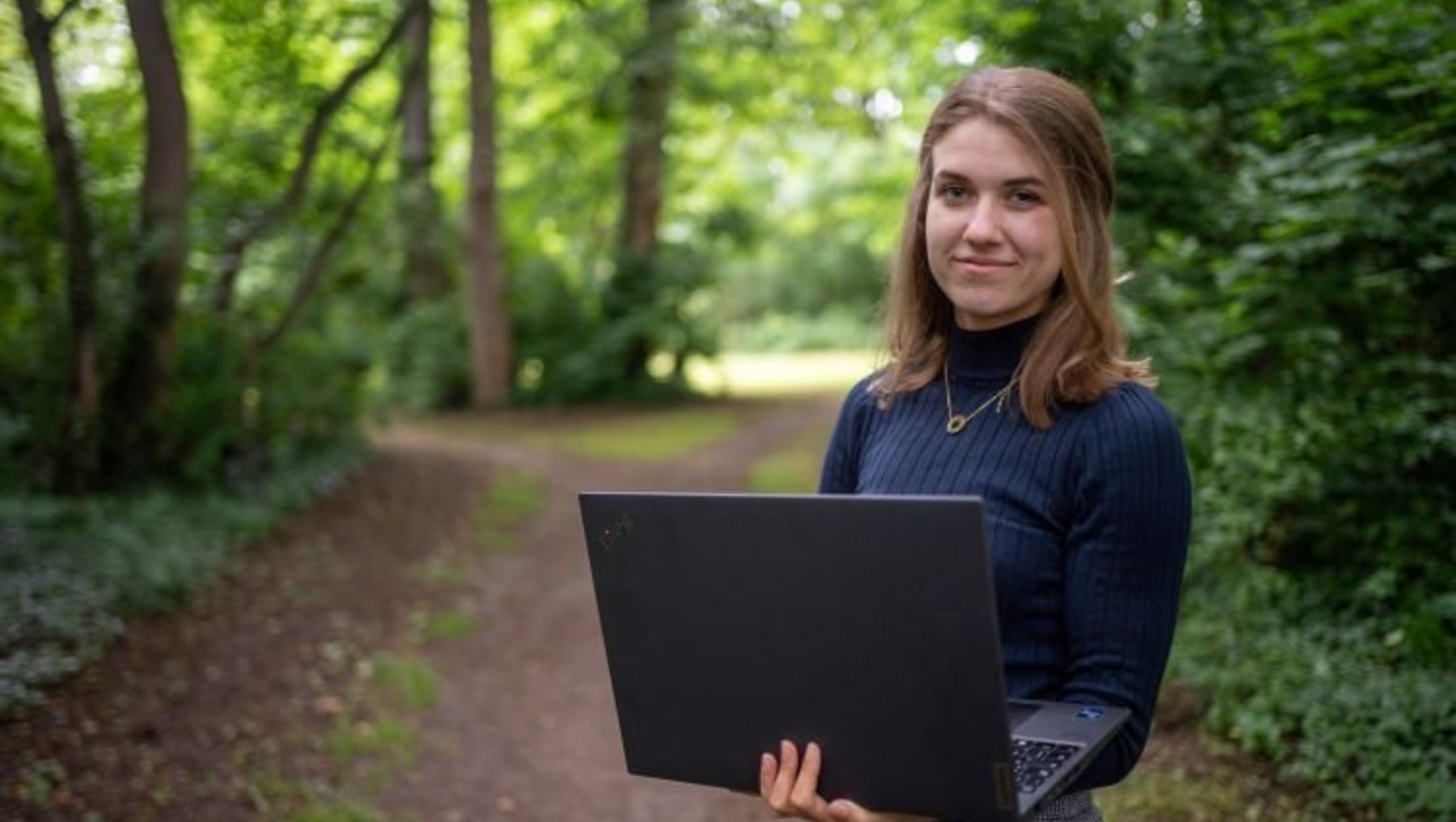
  • A woman stands on a forest path holding a black laptop. She is smiling and wearing a blue sweater and gray skirt. The background features green trees and foliage, creating a serene outdoor setting. © Hochschule Anhalt

Intervene before damage occurs: A warning system for forest paths would make forestry a little more sustainable. Artificial intelligence at the heart of an app could help. Sidney Kluge has clarified an important question in her Master's thesis in the Data Science degree program.

Sidney Kluge was never in the forest during her Master's thesis, although it played a central role. Instead, she spent a lot of time in front of the computer - processing data and inputting data like this: Information 1: Forest road coordinates 53.517181,13.376935. Information 2: impassable. Information 3: 15.2.2017. Information 4: Weather data for the past 3 days. Command: Calculate the condition of the forest road for the coming month. This is one of many examples with which she has "trained" a model. This means that tasks are solved by computer using a specific procedure. Because the data comes from the past, the result of the command is known: for example, "The path is softened and needs to be fixed", as in the example in Sidney Kluge's master's thesis. This allowed her to check: Is the model also correct?
Master's thesis in cooperation with the Fraunhofer IFF

"That was basically the central task of my master's thesis: can the available data be used to make reliable statements about the condition of forest roads using machine learning methods," says Sidney Kluge, explaining her contribution to the "Intelliway" project. In this project, the Fraunhofer Institute for Factory Operation and Automation IFF in Magdeburg is researching a way to automatically monitor forest roads instead of manually. This could save considerable resources and avoidCO2 emissions. It is one of several projects through which Anhalt University of Applied Sciences is cooperating with other research institutions - and can offer interesting topics for Master's theses.

Recognizing the condition of forest paths with machine learning?

"I was particularly interested in the high practical component, the added value and the link to sustainability," explains Sidney Kluge. For some of her calculations, she had to travel to the Fraunhofer IFF in Magdeburg, as the infrastructure for processing the data was set up there. It also turned out that although she already had thousands of years of data from a Thuringian forestry operation at her disposal, it was not yet sufficient to evaluate it using machine learning methods. "Even though my model was already able to make very precise statements, we will still need more and more precise data, for example on the paths themselves," she explains. But: "I was able to show what such a model could look like and which factors absolutely have to be included," adds the 27-year-old, who has now completed her Master's degree at the Department of Computer Science and Languages.

Next stop: intoMINT

If, in future, forestry managers or forest owners are able to use the app to find out the condition of a particular forest path and whether they need to repair it, this will probably be part of her master's thesis. "And of course the learning effect - especially in collaboration with the Fraunhofer researchers - was huge for me," she says, referring to her current job as a research assistant at the Department of Computer Science and Languages at Anhalt University of Applied Sciences, for which she was happy to stay in Köthen. Her new task: an app designed to get schoolchildren interested in mathematics, computer science, natural sciences and technology in a fun way - in short: intoMINT.

I was particularly interested in the high practical component, the added value and the link to sustainability.

Sidney Kluge

Big data for sustainability and biodiversity

"The quality of the database is often the decisive factor when training intelligent models," says Professor Korinna Bade from the Department of Computer Science and Languages at Anhalt University of Applied Sciences. She supervised Sidney Kluge's thesis together with Dr. Katharina Holstein. "For very few current Data Science projects, information is available in its entirety and prepared in such a way that it can be used to develop an automatic application at the touch of a button," adds Dr. Katharina Holstein, not least to explain the global hunger for data. "And we know that it works. For example, with the very good monitoring of freeways, where AI is already being used to provide early warnings of damage." Holstein is currently also contributing her knowledge of machine learning and artificial intelligence to the development of the AI Engineering degree program. It is intended to complement the existing range of courses at Anhalt University of Applied Sciences and introduce farmers in particular to new technologies in the future. Dr. Katharina Holstein: "Data Science is complex and that's why we need educational projects in addition to research in order to be able to operate more precisely and thus more sustainably in even more areas."