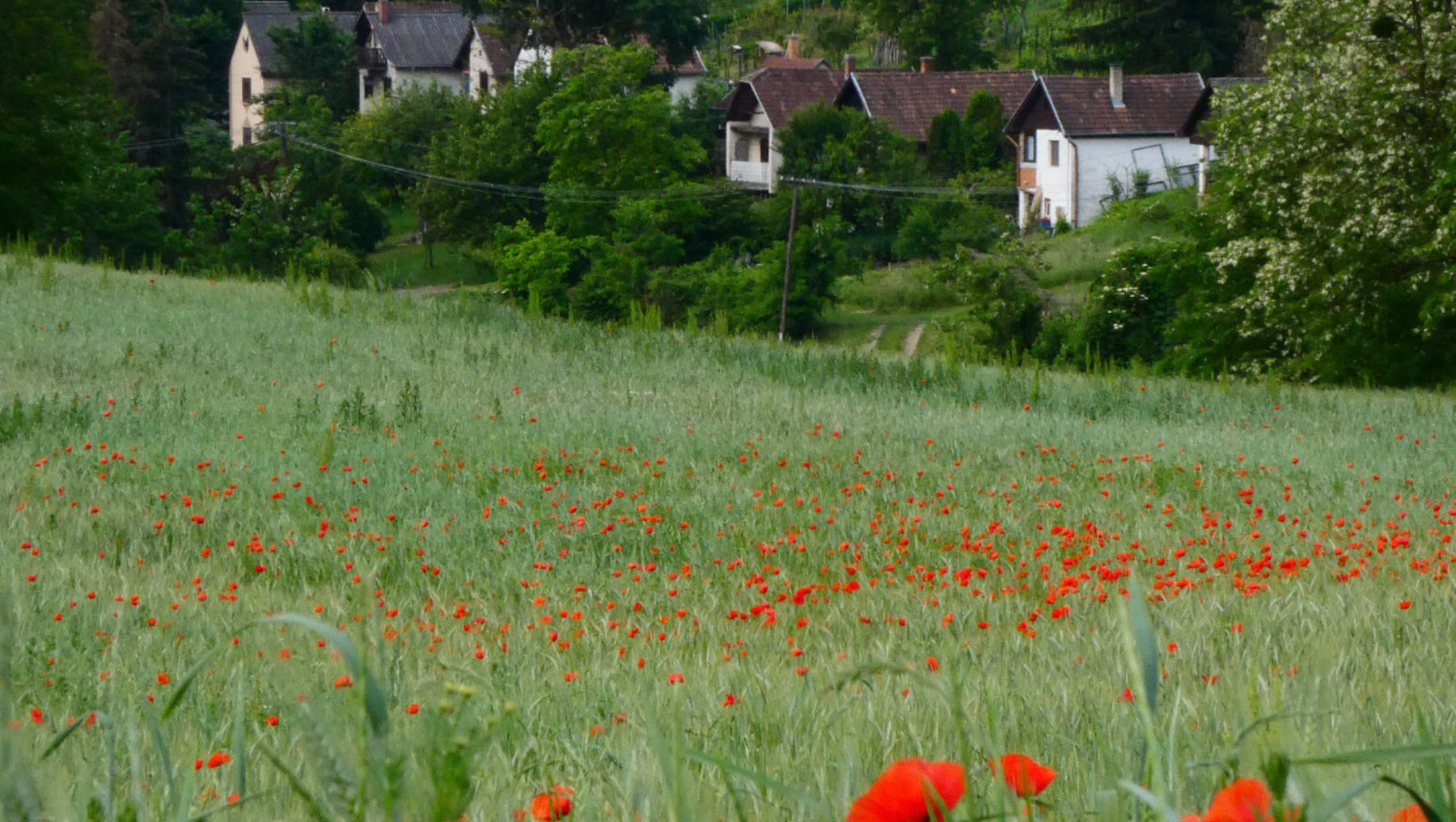


Villages play a key role in preserving biodiversity - especially in wooded landscapes. This is shown by a recent study published in "Nature Sustainability". An international research team with the participation of Anhalt University of Applied Sciences has investigated how landscape structures, proximity to cities, biodiversity and human well-being are linked. The results are groundbreaking for the development of rural areas.
Compared to urban and Agriculture systems, the biodiversity of villages has so far been little researched. The international project shows how landscape and settlement structures interact: "Our results illustrate the delicate balance required to increase human well-being without compromising the ecological health of rural landscapes," says Prof. Dr. Christina Fischer from Anhalt University of Applied Sciences, who co-authored the study. The lead author is Dr. Péter Batáry, who conducts research at both Anhalt University of Applied Sciences and the HUN-REN Centre for Ecological Research.
The research team studied 64 villages in Hungary and Romania: some near, some far from larger cities, located in forest or agricultural landscapes. Plants, insects and birds were recorded using various standardized methods such as ground traps, suction samples and point counts. In addition, socio-economic data was collected, geodata analyzed and the Better Life Index and Human Footprint Index (HFI) calculated.
The researchers documented 1,164 species from nine different animal and plant groups. Villages located in wooded landscapes were particularly rich in species. Diversity was significantly lower in areas used for Agriculture. Dr. Péter Batáry explains: "This underlines the importance of the landscape-wide species pool for biodiversity in villages. Proximity to the city had little effect on species numbers and overall species diversity, suggesting that other factors have a greater influence."
Data on living conditions and quality of life was collected for Hungarian villages and converted into the Better Life Index. It shows that The value was 27% higher in villages close to urban agglomerations and 14% higher in densely wooded areas than in agriculturally dominated landscapes. Co-author Prof. Dr. Teja Tscharntke from the University of Göttingen states: "Proximity to urban areas offers better access to services, while forested landscapes offer cleaner air and more green spaces, which increases the standard of living and quality of life."
The researchers also included the Human Footprint Index as another key factor in the study. This was calculated on the basis of geodata and credits the environmental impact of infrastructure and land use. This index was particularly high in villages with a higher quality of life - especially near cities. At the same time, a high value was associated with lower biodiversity. According to the authors of the study, this indicates a conflict of objectives between human development and biodiversity. In densely wooded areas, biodiversity was largely preserved despite human intervention. This in turn shows that complex landscapes can mitigate the loss of biodiversity.
The study makes it clear that sustainable village management must take the landscape context into account in order to safeguard biodiversity and quality of life. In villages close to urban areas, it is advisable to minimize soil sealing and develop green infrastructure with consideration for as many different species as possible. In densely wooded regions, it is important to limit Agriculture. A good connection to surrounding forests and green corridors can promote both: Biodiversity and well-being. Close cooperation between the population, authorities and land users is crucial. Dr. Péter Batáry emphasizes: "The EU Rural Development Strategy should prioritize biodiversity management to improve the protection and quality of the landscape in and around villages."
Notes for journalists:
Proof of publication of the study: Batáry, P., Gallé, R., Korányi, D., Lakatos, T., Deák, B., Gallé-Szpisjak, N., Kabai, M., Koszta, C., Kotowska, D., Marja, R., Palotás, B., Szabó, B., Torma, A., Báldi, A., Hornung, E., László, Z., Molnár, Z., Purger, J. J., Seress, G., Urák, I., Purger, D., Sándor, K., Somay, L., Süle, G., Valkó, O., Zsigmond, A. R., Fischer, C., Marini, L., Tscharntke, T., Szitár, K. & Török, E. (2025). Biodiversity and human well-being trade-offs and synergies in villages. Nature Sustainability. https://doi.org/10.1038/s41893-025-01592-y
Requests for copies of the study and interviews should be addressed to:
Dr. Péter Batáry - HUN-REN Centre for Ecological Research and Anhalt University of Applied Sciences: batary.peter@ecolres.hu
Prof. Dr. Teja Tscharntke - University of Göttingen: ttschar@gwdg.de
Prof. Dr. Christina Fischer - Anhalt University of Applied Sciences: christina.fischer@hs-anhalt.de
