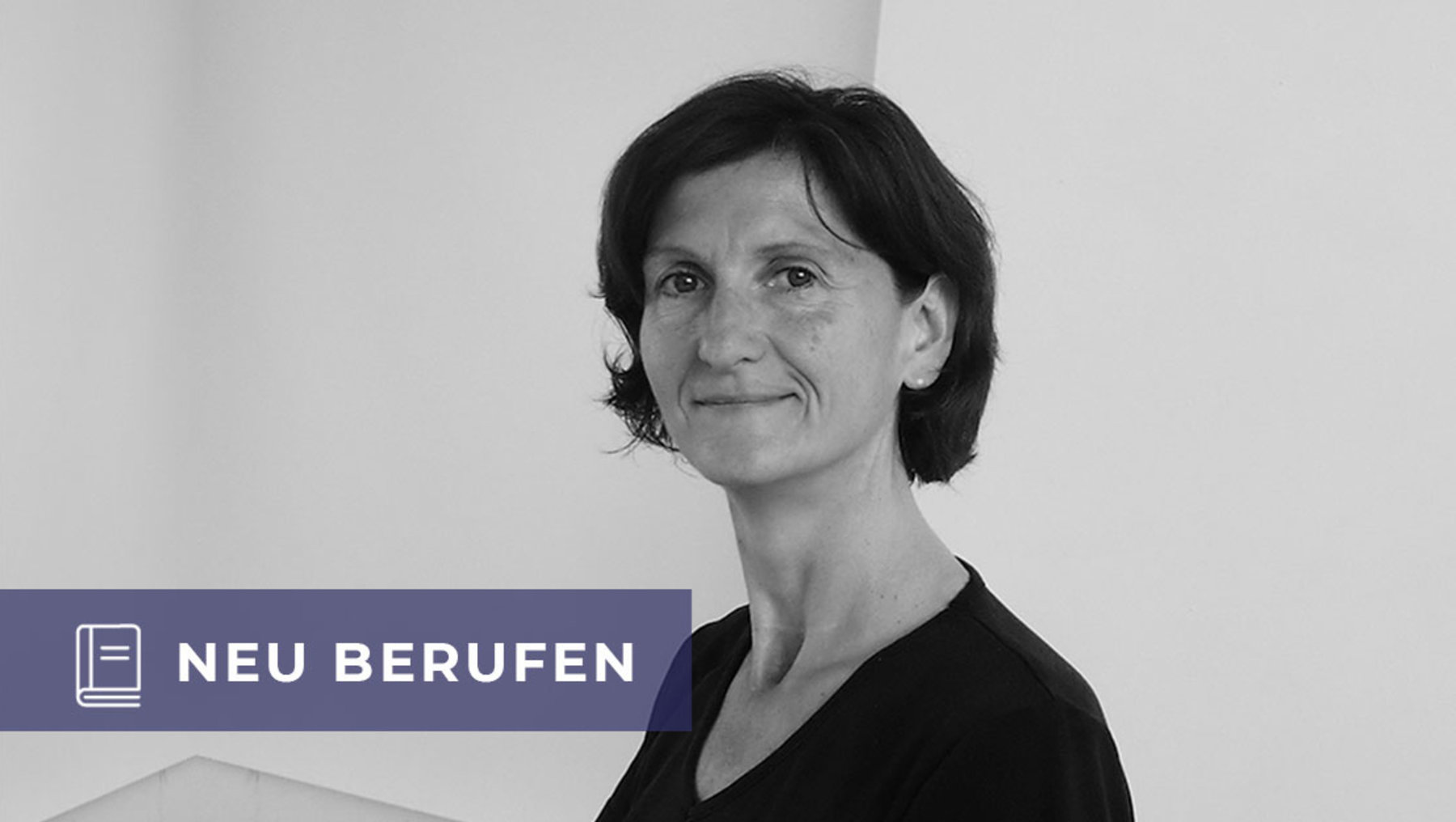
At the beginning of September 2020, the university welcomed Katrin Günther as the new Professor of Artistic-Experimental Foundations of Design in the Department of Design at the university's Dessau campus. In this interview, she gives an overview of the content of her teaching and research as well as an insight into her career.
Professor Günther, welcome to Anhalt University of Applied Sciences. You started working at the Department of Design at the beginning of September. Your career began at the Brandenburg University of Technology Cottbus, where you graduated in architecture in 1996. You have been working as a freelance draughtswoman since 2005. What important events followed on your career path from Architecture to Design?
In brief, my path was as follows: before studying architecture in Cottbus and Milan, I worked for several years in a sculptor's studios alongside my vocational training as a skilled construction worker. My artistic work there involved developing forms and experimenting with materials. After my studies, working in an architectural office in Berlin and on large construction sites gave me an insight into complex and technical areas of design. I then set up my own studios and taught art and design at various colleges and universities in Germany and abroad. At the same time, I developed design projects for and with landscape architects for federal and state garden shows and the IGA 2017 in Berlin.
The founding of my studios in Berlin and the deepening of my independent artistic work has ultimately led to international and interdisciplinary collaborations with artists, scientists, designers and institutions. From the qualification and interweaving of all these activities, collaborations and contexts, I moved from Architecture to Design and from Art to Teaching.
For the past seven years, you have been a professor at the University of Konstanz. In Dessau, you were appointed professor in the field of Artistic-Experimental Foundations of Design. What will be your tasks at Anhalt University of Applied Sciences?
My main task is to teach students the basics of design. In addition, experimenting in various design dimensions at the interface of design, fine arts, society, technology and science is important to me. This lays the foundations for acquiring basic skills - artistic skills - and learning about and carrying out analytical research and aesthetic processes.
What goals are you pursuing here?
Artistic-experimental work initially means being open to all areas of knowledge and society. Above all, it means having an offensive view, not excluding anything, encouraging and demanding curiosity and engaging with vague ideas (often referred to as a pale glimmer): This allows us to arrive at new solutions via unplanned paths. My aim is to promote an interdisciplinary way of thinking and working.
What research projects are you currently working on to enrich the university?
This year, I worked on the artwork "Schall" for the Konstanz Minster. This involved investigating digital tools that enable almost unrestricted temporal and spatial independence in the specific space and thus open up new perspectives for the creative process. The exhibition concept/nomination for the design of the German Pavilion at the Architecture Biennale in Venice last year in collaboration with the Tchoban Foundation Berlin was also based on this research interest. I am currently preparing contributions for a documentary presentation of works as part of an international conference of the architecture forum AEDES in Berlin 2020 with the American Society of Architectural Illustration. Of course, I also benefit from such projects in my teaching, as these experiences can be directly transferred to university work, incorporated into student projects and developed further.
Can you give examples of such student projects in your teaching to date?
Yes, in 2014 I initiated a series of collaborative projects. From 2014 to 2017, artists, academics and students worked together to examine historically prominent buildings such as the Berlin Cathedral or the Kestnergesellschaft in Hanover from a spatial-auditive perspective. We created artistic interventions that were presented in unique temporary spatial experiences in public vernissages. I would like to continue this series in a different form at Anhalt University of Applied Sciences. The university itself has such a wide range of knowledge in its "own house" that interdisciplinary collaborations are ideal.
When you start in the 2020 winter semester, face-to-face teaching at Anhalt University of Applied Sciences will resume. How are you preparing your teaching for the current situation?
I plan to teach in person. Of course, I am considering how this could also be done in a hybrid form with online events. However, when it comes to artistic and creative experimentation, I prefer to work together "directly on and in the object". Physical presence makes it possible to have visual, auditory and haptic experiences together, to analyze, discuss and recreate them... I wouldn't want to do without that.
Professor Günther, thank you very much for the interview.
