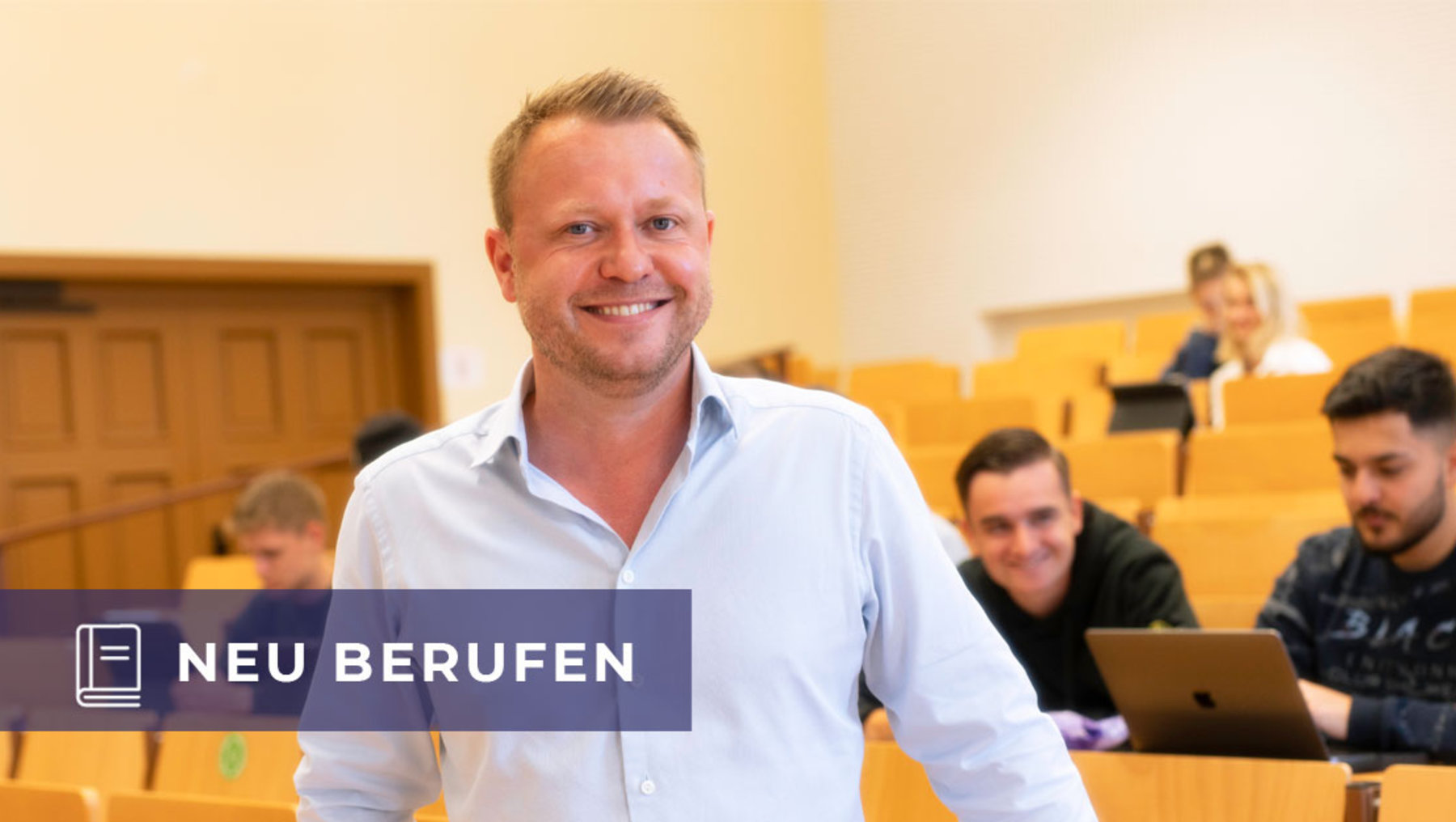
Real estate management is more than just selling houses! Those who pursue this course of study learn to classify economic and social contexts, how the market works and how to assess opportunities and risks. In order to be best prepared for professional life, a sound basic education is necessary, says Dr. André Zänker, the newly appointed Professor of Real Estate Management at Anhalt University of Applied Sciences. In this interview, he summarizes the trends in the real estate industry and shows what tools students need to be prepared for dynamic developments in the real estate sector.
Professor Zänker, before we talk about your new role, let's take a brief look back. How did you come to specialize in your field?
I had a wide range of interests and ultimately decided to study Business Studies at the University of Leipzig. The decision was made with the aim of focusing on real estate management during the program sequence. During a semester abroad in Lille, France, I then decided to specialize in real estate management, banking and controlling.
On March 15, 2022, you were appointed Professor of Real Estate, in particular Real Estate Management, at Anhalt University of Applied Sciences. You have been a deputy professor and Degree Program Advisor since October 2021. Did the appointment change your tasks?
As I had already taken on teaching and support activities in the Department of Economics at Anhalt University of Applied Sciences as a deputy professor, I already know the students and, of course, my colleagues very well. It was also very easy for me to start my career here in Bernburg. I also immediately took on the role of Degree Program Advisor for the bachelor's degree program in Real Estate Management. With the appointment, classes still have to be designed and developed. But I really enjoy developing new things and I'm looking forward to working with the students.
Does the real estate world need research and if so, which areas, aspects or developments should be researched?
We need to take a brief look back. Real estate management is a sub-aspect of business administration, which is still quite young and focuses specifically on real estate. Until the beginning of the 1990s, there were interfaces to real estate-related discussions mainly in the areas of construction, economics or housing policy. The theoretical foundation for solving real estate-specific Business Studies issues was lacking. Real Estate institutions recognized that a wide range of specific competencies and skills were required within the real estate industry.
What happened as a result?
Real Estate degree programs were founded - such as at Anhalt University of Applied Sciences - and further education and training opportunities were created. These courses have helped representatives of the real estate industry to become increasingly professionalized and qualified. Many people typically associate the Real Estate industry with real estate agents and their brokerage business, which does not do justice to the diverse business activities of real estate companies. The differentiated consideration of real estate management disciplines alone leads to very different professional and service profiles. However, basic research is currently well advanced and the real estate industry is increasingly being called upon to develop and set uniform standards.
So your answer is "yes", research is needed in real estate management. Which areas would you currently name?
There is a particular need for research in the area of digitalization in connection with the further or new development of business models and processes. In this context, analyzing the market relevance of so-called PropTechs is very interesting. Due to the special characteristics of real estate and real estate markets, topics such as market transparency and data availability will continue to be a focus of research at colleges and universities, which will of course also be included in teaching.
Keyword teaching: what is important to you, what would you like to pass on to students?
Basic knowledge that is ready for application is important. That sounds dry, but basic knowledge is the foundation of every application and research. Overlap-free definitions and precision in technical terms are also essential in everyday professional life.
My favorite example of this is the correct application of area definitions, as these typically form the basis of the key figures for rental or investment decisions and therefore an incorrect determination of area sizes very quickly has financial consequences.
At the end of the course, students have a solid foundation for their future career in the real estate industry. The requirements and framework conditions are developing dynamically. It is therefore necessary that problems from everyday working life are solved flexibly and that a solution to a problem is not memorized. Above all, my aim is for students to learn to think and also to learn to learn.
Real estate managers must also learn to find their way in a changing professional field. The major changes and challenges of our time, such as sustainability and globalization, will have a major impact on the future work of real estate managers. Can students be prepared for this?
Like many industries, the Real Estate sector is subject to and shaped by various trends. Topics such as sustainability, artificial intelligence, tenancy law, digitalization and the internationalization of markets are currently the subject of controversial debate. It is initially important for students to recognize the developments and trends. Some trends can develop into new standards within the industry and often form new technical, Economics and legal frameworks. Students are given good preparation for these changes and should learn to use the knowledge they have acquired to find their way in a dynamically developing environment.
The German real estate market has changed in recent years. International investors are increasingly acquiring real estate in Germany. Has this development had an impact on teaching?
Yes, international real estate investors have also been very active in Germany for almost two decades. This has also contributed to the professionalization of players in the real estate market. It is important for students to know what requirements the different types of real estate investors place on properties, real estate projects or the composition of real estate portfolios. On the other hand, German institutional real estate investors also invest in international real estate markets, which is why international reference points are made at appropriate points during the classes. However, the activities of most companies in the German real estate sector tend to have a regional or even local focus, which should not be forgotten in any discussion of internationalization. Only a small proportion of current students aspire to an internationally oriented career.
Prof. Zänker, thank you very much for the interview.
