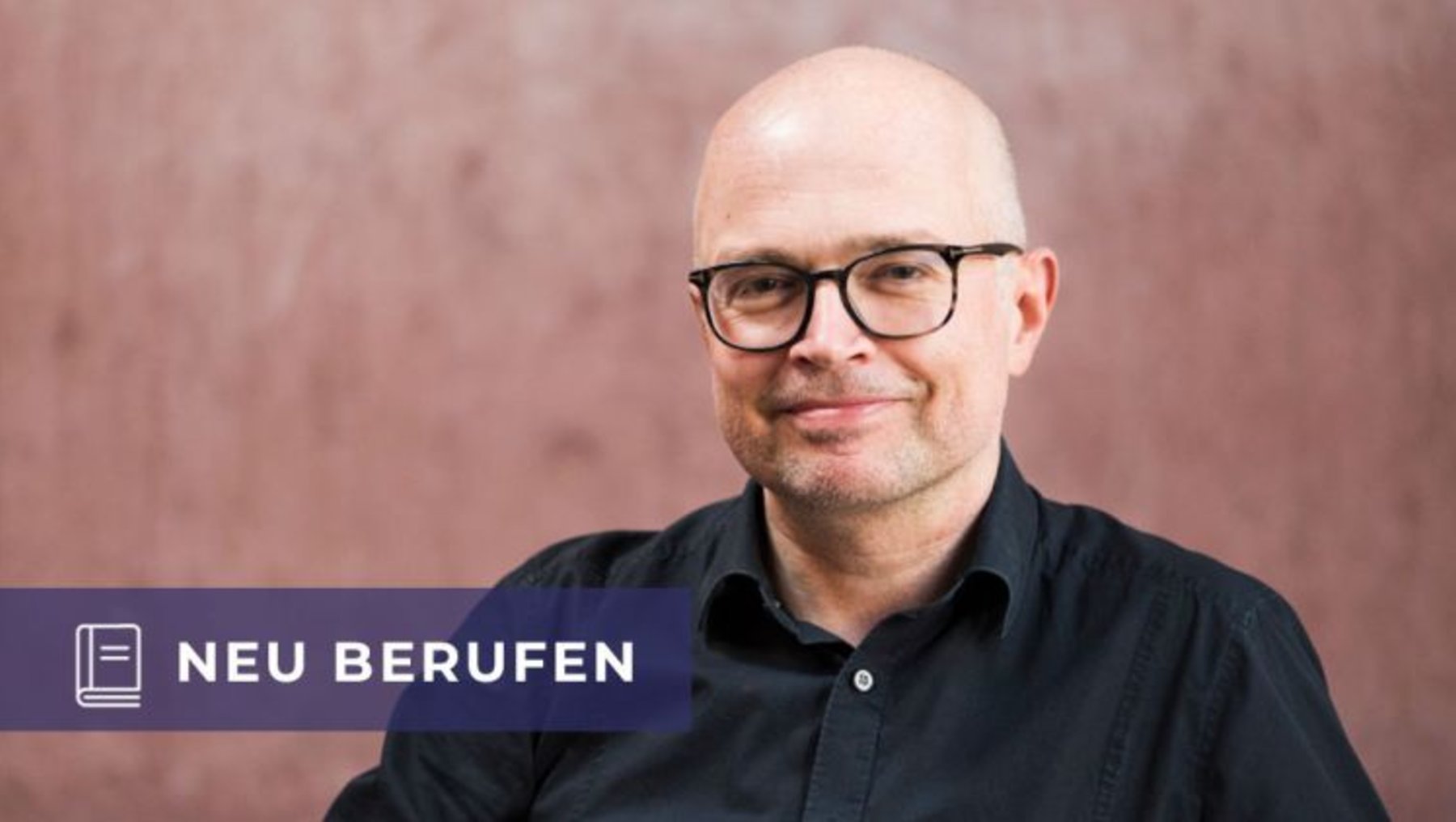
Like writing, reading, understanding music or the language of instruction, drawing should also be a cultural technique that goes beyond the simple tools of the trade and is fun: Professor Volker Schlecht has this guiding principle in mind for his teaching at Campus Dessau. He was appointed Professor of Drawing and Design at the Department of Architecture, Facility Management and Geoinformation in March 2022. In this interview, Professor Schlecht talks about his work as an illustrator, the topics he incorporates into his teaching and what is more important to him than pure talent.
Prof. Schlecht, how and why did you get into drawing?
That's easy to answer, or difficult to explain. I've always loved to draw, even when I was a small child. What is perhaps more important is that later, during my studies and at work, I decided more and more consciously in favor of drawing and against other possibilities that would have interested me as well.
You have been living and working in Berlin since 1999. Can you briefly describe your career before that?
I grew up in Radeberg, a small town near Dresden, where the famous beer comes from. I graduated from high school in Dresden and at the same time attended a remedial class and evening classes at the art academy in Dresden. I studied graphic design at Burg Giebichenstein in Halle. I also made my first two animated films there; the first as a diploma project, the second with the help of a graduate scholarship from the state of Saxony-Anhalt. In this respect, I've come full circle by returning to work here in this federal state.
Was teaching drawing a career aspiration of yours?
I didn't necessarily get into teaching because I wanted to teach so much. It happened more by chance, because after several years of working in a graphic design office, I finally wanted to draw again. When I was offered the opportunity to work on the animation degree program at the Film University in Potsdam-Babelsberg, I accepted. Of course, teaching was unfamiliar at first, I had to grow into it.
And after Potsdam, you moved to Berlin to the University of Europe for Applied Sciences, where you were Professor of Sequential Illustration from 2014 to 2020.
Now you have been appointed to the Department of Architecture, Facility Management and Geoinformation in Dessau for the field of drawing/design.
What do you focus on in your teaching at Anhalt University of Applied Sciences?
At my previous university in Berlin, I worked with my colleagues - and also with the students - to develop a basic drawing course, which we called "Drawing and Seeing". Of course, we also incorporated experiences from our own studies. I envision a similar approach in Dessau: further developing the teaching based on impressions and reregistration, especially from the students. I am particularly interested in drawing as a means of understanding, as an interaction between the eye, brain and hand, as a basic cultural technique like writing, reading, music or language of instruction.
Does your work as an illustrator balance or complement your teaching? To what extent do your topics flow into it?
I see my own work as a draughtsman, whether as an illustrator or filmmaker, less as a balance or supplement, but rather as the basis of my teaching, from which the experiences I pass on come and are constantly updated. I'm curious to see how this will change my teaching, as I'm no longer teaching illustration students, but budding architects.
How will this change your teaching in Dessau?
Probably not so fundamentally. I want to teach the basics. Above all, it's important to me to awaken a sensitivity for the drawing challenges that lie in very simple, everyday things and situations. For me, this is not only - and not primarily - a question of craft, but rather of understanding, which is developed from the drawing process. Changes certainly result from perspectives and priorities in which budding architects differ from illustration students.
After all, architecture students come to the university with a different background to your former illustration students. What would you say to a student who has respect for drawing in architecture studies and considers themselves to be less talented?
In my opinion, talent alone is not that important. What's important is having fun. If you study Architecture, you will certainly enjoy the creative processes before and after. In my experience, enjoyment and pleasure in artistic work also lead to the necessary perseverance, which is often more important for quality and originality than talent. Having fun drawing is therefore an important concern in my teaching.
Our newly appointed professors are always asked about their field of research. What is it like in art, do you have an area of research?
My field of research is drawing. My wife is a scientist - so I am very aware of the difference between what has been called artistic research for some time now and scientific research. But there are certainly more similarities, or at least parallels, than is often assumed. Every painting, book or film is a project with a starting point but an uncertain outcome, much like an expedition or an experiment.
Together with a former fellow student, you have been working as the designer duo "Drushba Pankow" since 2002. Together you illustrate for magazines such as Rolling Stone, Die Zeit and arte magazine. What is your current project with Drushba Pankow?
Unfortunately, there hasn't been much time for larger projects in recent months. We have done a few illustrations for various magazines and designed some book covers. The last major project was an exhibition with a selection of our work entitled "Drawing and Responsibility", which opened in summer 2020 in a former NATO ammunition bunker in Rhineland-Palatinate and will be shown in Frankfurt am Main at Haus am Dom until the end of March. The next stop will be in Rome, this year in the fall.
You have published several award-winning books, in 2020 the graphic documentary "Und wenn die Wahrheit mich vernichtet" (And if the truth destroys me) about the life of a priest in the Dachau concentration camp. In an interview, you said about this intensive work: "Emotionally, of course, it was an abyss to deal intensively with the subject of concentration camps and the Nazi era for nine months." Is drawing a way for you to make the brutality of reality easier to bear?
This graphic documentary is also the core of the exhibition I just mentioned. But to answer your question specifically: unfortunately quite the opposite. With a work like this, you are forced to deal with it intensively, to research images, to read a lot and, if possible, to visit these places. I sometimes cried in the studios.
But at the moment I was answering this question [the interview was conducted in March 2022, editor's note], I received a message that our new Ukrainian roommate had seen a video that might show her destroyed apartment building in Kiev. This makes everything else we've talked about so far almost irrelevant.
In 2016, in the animated documentary film "Kaputt", you dealt with the Hoheneck Castle prison, the central women's prison in the former GDR. Looking at your portfolio, the motto "art is political" runs almost like a common thread through your work. Would you also pass this motto on to your students?
Art should not be seen as political per se. Art is free or should be free. However, freedom does result in responsibility. With our illustrations, we try to somehow keep this responsibility in mind. With the films or this graphic documentary, the political aspect arose from the themes. It was more a question of whether we should get involved in the project or keep our hands off it. With Architecture, on the other hand, the aspect of responsibility is much more obvious than with illustration, film or comics.
At school, you were advised to study architecture. You decided against it. Why?
When someone builds a house or a bridge, they naturally have to meet certain requirements and should still be standing and safe in at least ten years' time. In fact, I had so much respect for this that I was more interested in illustration and graphic design. I thought at the time that I could do less damage there. In terms of design and art history, however, my interest in Architecture was always very strong.
Professor Schlecht, thank you very much for the interview.
