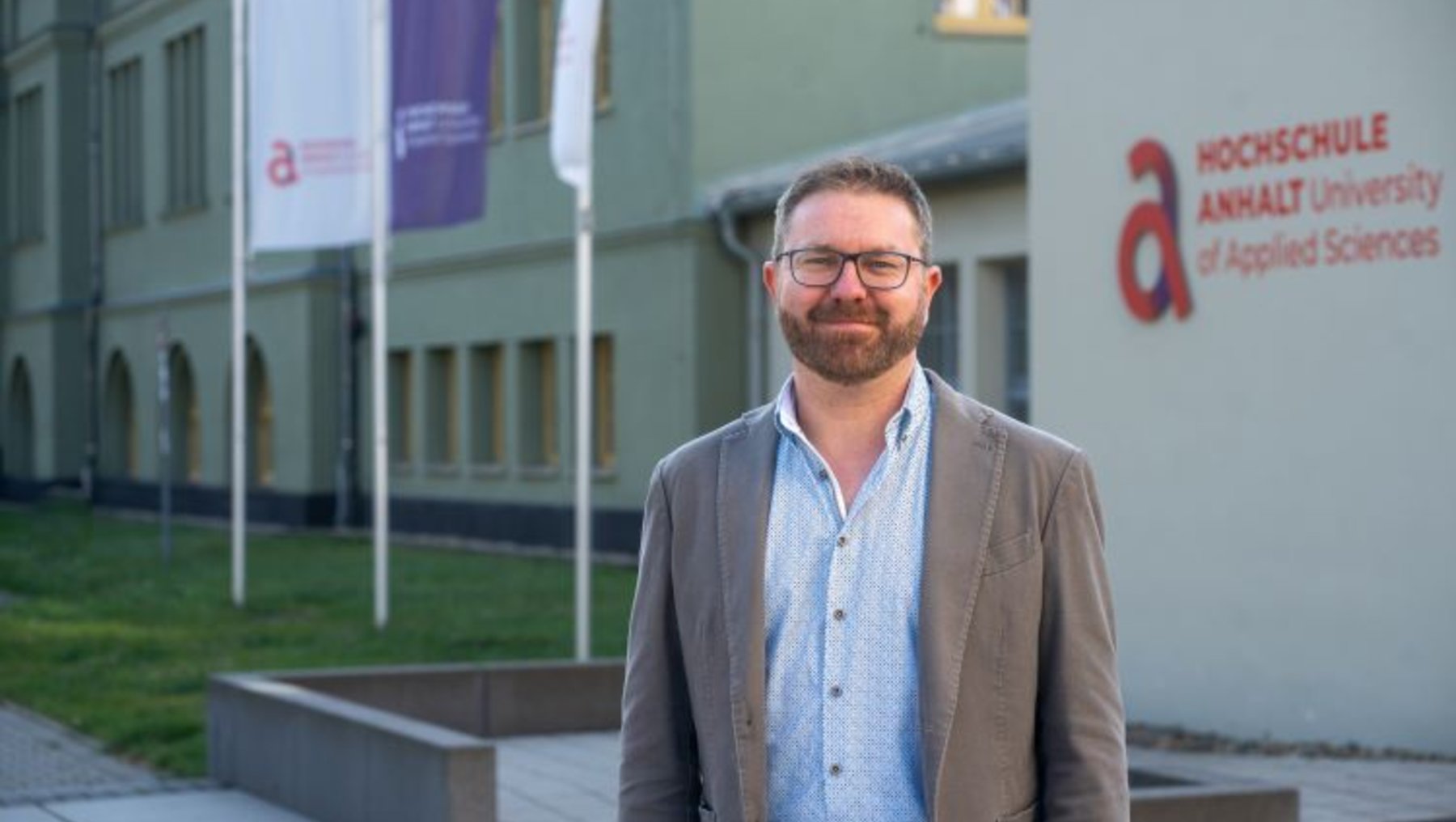
"There's something fascinating about what you can do with small molecules in a large, complex organism," says Professor Dr. Daniel Ramsbeck, the newly appointed Professor of Pharmaceutical Chemistry and Pharmacology at Anhalt University of Applied Sciences. But how did his path lead him from a vacation job in a pharmacy to scientific research? What challenges await his students on the new "Pharmaceutical Chemistry" bachelor's degree program? And what advice would he give his younger self? Professor Ramsbeck answers these and other questions in this interview.
Professor Ramsbeck, you were recently appointed to the "Pharmaceutical Chemistry and Pharmacology" department in Köthen. Can you tell us something about your career and what made you decide to specialize in these fields?
With pleasure. I originally planned to become a "real" pharmacist and supply people with medicines in a pharmacy. I already worked in pharmacies during my school vacations, so it was clear to me that I would study pharmacy in Halle after my A-levels and military service. I had always been fascinated by chemistry, but the decisive impetus came during my advanced studies when I attended a lecture on Pharmaceutical Chemistry and Medicinal Chemistry. The way the professor presented the subject fascinated me so much that I was more interested in the science behind the active ingredients than dispensing them later in the pharmacy.
What exactly fascinated you so much?
That you can do so much with small molecules in a large, complex organism! The way in which molecules and organisms interact with each other is incredibly exciting. What's more, in drug development you're always on the lookout for something new, for molecules that no one has produced before. It's not just about synthesizing compounds, but also about "designing" active ingredients. This creative aspect of research has fascinated me from the very beginning.
What projects are you currently focusing on in your research?
In recent years, I have been working intensively on the development of inhibitors for various metal-dependent enzymes, and I am looking forward to continuing this work here at Anhalt University of Applied Sciences and expanding existing collaborations. I find the development of new active substances against parasitic worms, especially nematodes, particularly exciting. This research is relevant for human and veterinary medicine as well as for plant protection, as there is increasing resistance to established agents.
We keep hearing about antibiotic resistance. Is this also part of your research?
Yes, it is. The need to develop new, effective active substances to combat resistance is enormous. We are seeing a dramatic increase in resistant bacteria, particularly in the field of antibiotics. In the coming years, I would like to work on active substances with new mechanisms that will hopefully also be effective against resistant germs. It is a field that is of great importance not only scientifically, but also socially.
Let's talk about your teaching. You will be co-supervising the new bachelor's degree program in Pharmaceutical Chemistry. How do you convey complex topics in an understandable and exciting way?
I try to tell the students a story and also like to include the odd anecdote to suit the topic. A brief moment of humor often helps to increase the students' concentration and get them excited about the topic. I like to bring in experiences from my own studies or examples from my research, as this is more tangible for the students than case studies from literature.
Do you also use modern teaching methods to involve your students?
Absolutely! I use interactive elements, such as live surveys during lectures, to get direct feedback and make the lessons more lively. But I'm also a big fan of traditional blackboard work. I find it particularly helpful to develop reaction mechanisms in organic chemistry step by step on the blackboard. This gives the students the opportunity to think along and internalize the material in a good way. Sometimes I also use abstract analogies or comparisons from everyday life to illustrate complicated relationships. Even if I sometimes realize that my film references are no longer quite up to date. For example, in connection with "Magic Potions", I was told that Harry Potter would now be a more suitable example than Asterix and Obelix...
What are the biggest challenges for students on your courses and how do you help them overcome them?
One of the biggest challenges is the sheer amount of knowledge that needs to be covered in a short space of time. This can be daunting at first. I have learned that teaching always means reduction. Accordingly, I also try not to overload my lecture materials. It is not possible or even necessary to know every example down to the last detail. It's more about teaching basic principles, creating links to the other courses ("thinking out of the box") and giving students the tools they need to work on more complex issues later on. Due to the smaller student groups, teaching here also has a more personal character and it is possible to engage in conversation, ask questions more openly and solve problems individually.
What advice would you give your younger self?
I would actually like to wait a few more years before answering this question. So far, perhaps only: "The direct route is not always the best. Perseverance is the way forward, even if it's not always immediately obvious."
Professor Ramsbeck, thank you very much for the interview!
