News-Detail

From Metal Building Sets to 3D Printers: Sebastian Gersch Conducts Research and Teaches for the Manufacturing of Tomorrow

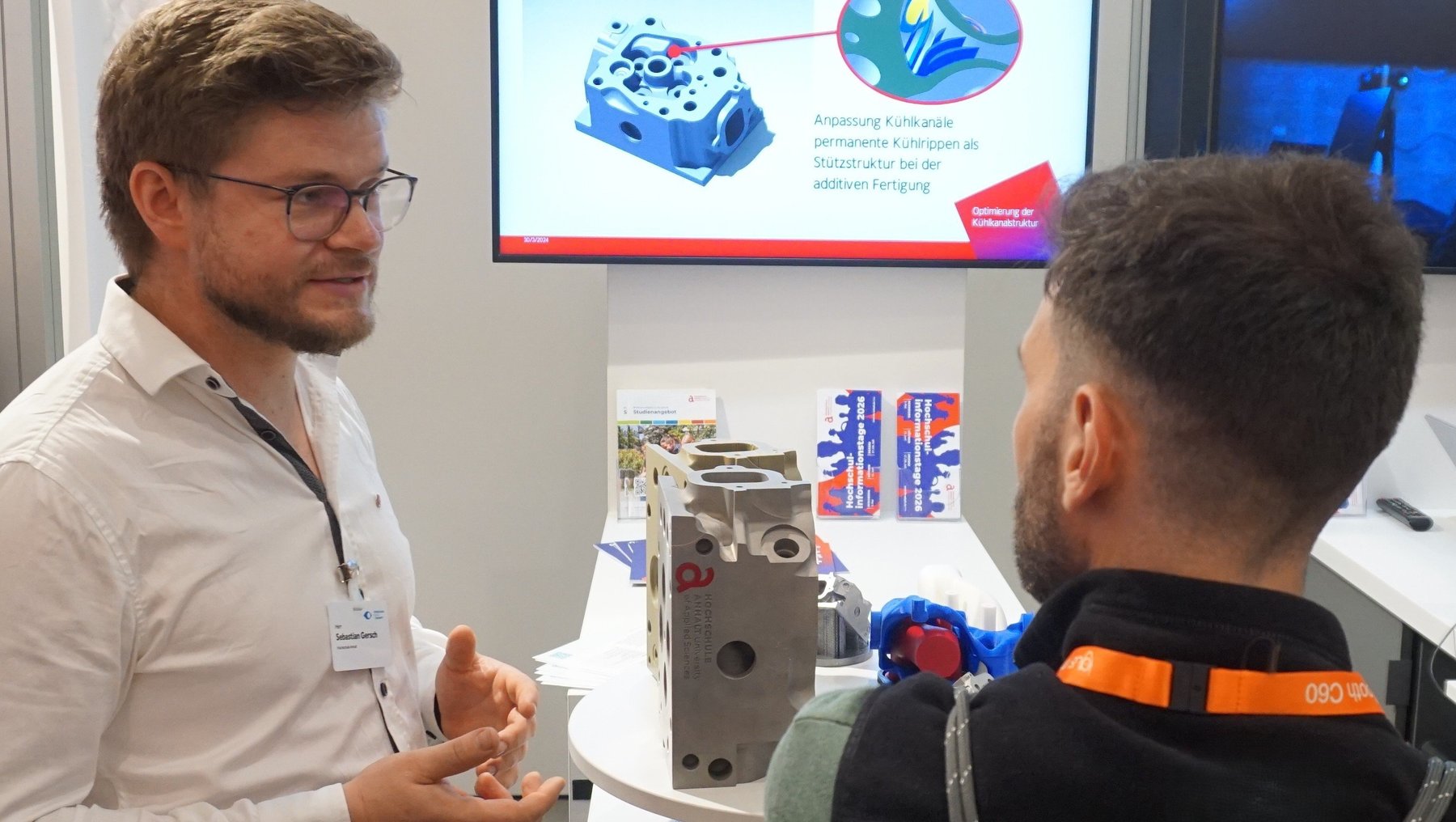
  • Zwei Männer auf einer Messe: Einer erklärt mit Gesten und zeigt auf ein technisches Bauteil, während der andere aufmerksam zuhört. Im Hintergrund ist eine Präsentation mit Schema einer Kühlmittelpumpe zu sehen. © hochschule anhalt
    Sebastian Gersch stellt sein Promotionsprojekt zum metallischen 3D-Druck dem Publikum der Hannover Messe vor.

A 3D-printed metal component is created layer by layer. But what ultimately makes it stable, rigid, or durable is often determined much earlier: in the molten pool, during solidification, and by the way the individual layers are arranged next to one another. This is where Sebastian Gersch’s research at Anhalt University of Applied Sciences comes in.

In his doctorate, he is investigating how process control, microstructure, crystallographic texture, and internal stresses in metal 3D printing influence one another. His goal is to describe these relationships and harness them specifically to create better components.
Measuring What's Happening Inside

One specific application is the 3DAlu project. At Anhalt University of Applied Sciences, researchers are developing heat-resistant aluminum alloys for components used in hydrogen engines. Manufacturing is carried out using the so-called PBF-LB process, a laser powder bed fusion method widely used in industry for producing metallic components.

Sebastian Gersch is investigating, among other things, the aluminum alloy AlSi10Mg. Using scanning electron microscopy and EBSD analyses, he visualizes how grain structure and texture form depending on the melt pool, hatch strategy, and build orientation. The results show that the manufacturing strategy leaves distinct patterns in the material. What initially appears to be an unavoidable process trace can thus become a targeted tool.

He finds the question of how component properties can be influenced by the process strategy particularly fascinating. Current studies show, for example, that the modulus of elasticity of PBF-LB-manufactured AlSi10Mg can be measurably altered by adjusting the hatch spacing, scan strategy, and build orientation.

For Sebastian Gersch, this “anisotropy” is therefore not just a manufacturing artifact, but a potential design parameter.

I enjoy exploring, experimenting, and creating something new in the process.

Sebastian Gersch

From the Field to the Research Lab

Sebastian Gersch, 35, did not immediately pursue a career in research. After graduating from high school, he first completed an apprenticeship as an industrial mechatronics technician in the power plant sector. Only then did he decide to study mechanical engineering at Anhalt University of Applied Sciences. Bachelor’s, master’s—and now his doctorate, while also teaching.

“I enjoy exploring, testing, and creating something new in the process,” he says. Even as a child, he was fascinated by technology—for example, when building with a metal construction set. If something didn’t fit, he would experiment, make adjustments, and keep building. This combination of curiosity and tenacity has stayed with him to this day.

Teaching What Will Be Needed Tomorrow

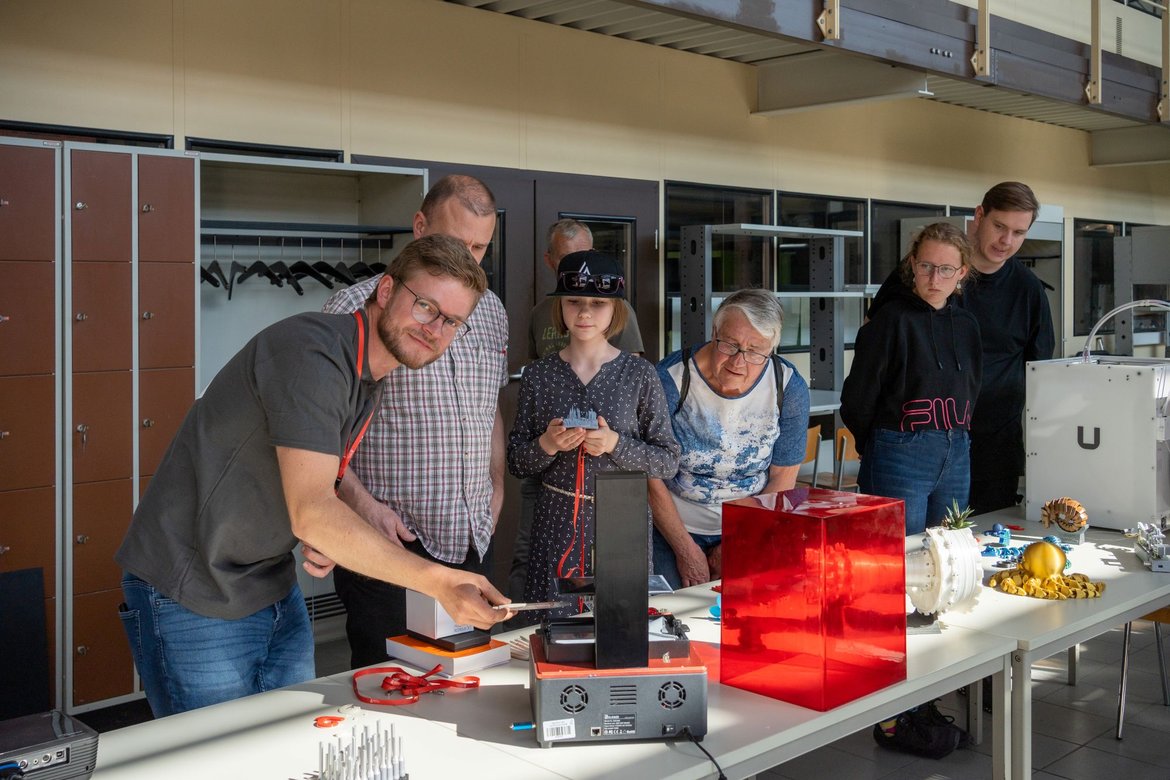
In addition to his research, Sebastian Gersch also aims to inspire students to take an interest in additive manufacturing. In the Department of Electrical, Mechanical and Industrial Engineering, he teaches, among other things, fused deposition modeling, or FDM for short. Here, too, components are built layer by layer, but this time from plastic.

To minimize material waste, he has set up a recycling program together with a colleague. Unused plastic material is collected, shredded, mixed, and reprocessed into filament. More than 20 kilograms of material can be reused in this way each semester.

Aluminum today, steel and titanium tomorrow

Research on additive manufacturing at Anhalt University of Applied Sciences is not limited to a single material. While aluminum is currently the focus of the 3DAlu project, the research facility—which has been under development since 2022—has a broader scope. In the future, steel and titanium are also expected to take on greater prominence.

For Sebastian Gersch, this means he won’t run out of research questions anytime soon. “The reactions to our results show that we are addressing a relevant topic through the targeted use of hatch strategies to adjust component properties,” he says. “The combination of process control, microstructure, and mechanical properties in particular still offers a great deal of potential.”


An initial sub-study on measurement techniques was published in September 2025 in the journal *Applied Sciences* (https://www.mdpi.com/2076-3417/15/18/9861). Further research is focusing on the targeted adjustment of texture and stiffness in PBF-LB-manufactured aluminum.

Redaktion

Claudia Aldinger

Sebastian Gersch

... can be reached for questions and inquiries by phone at +49 (0) 3496 672359 or by email at sebastian.gersch(at)hs-anhalt.de

Recent Publication: Influence of the Process-Related Surface Structure of L-PBF Manufactured Components on Residual Stress Measurement Using the Incremental Hole Drilling Method / Sebastian Gersch, Ulf Noster, Carsten Schulz, Jörg Bagdahn. Published in: Applied Sciences. Vol. 15 (2025), 18, pp. 1–17. https://doi.org/10.3390/app15189861