A master's thesis at Anhalt University of Applied Sciences has shown that surplus wind power can be converted into district heating for Köthen in a cost-effective manner. Based on this preliminary study, the grid operator 50Hertz has built a power-to-heat plant.
From the Desk to the District Heating Network: The City of Köthen’s Power-to-Heat Model
-
 © hochschule anhalt | felix giesa
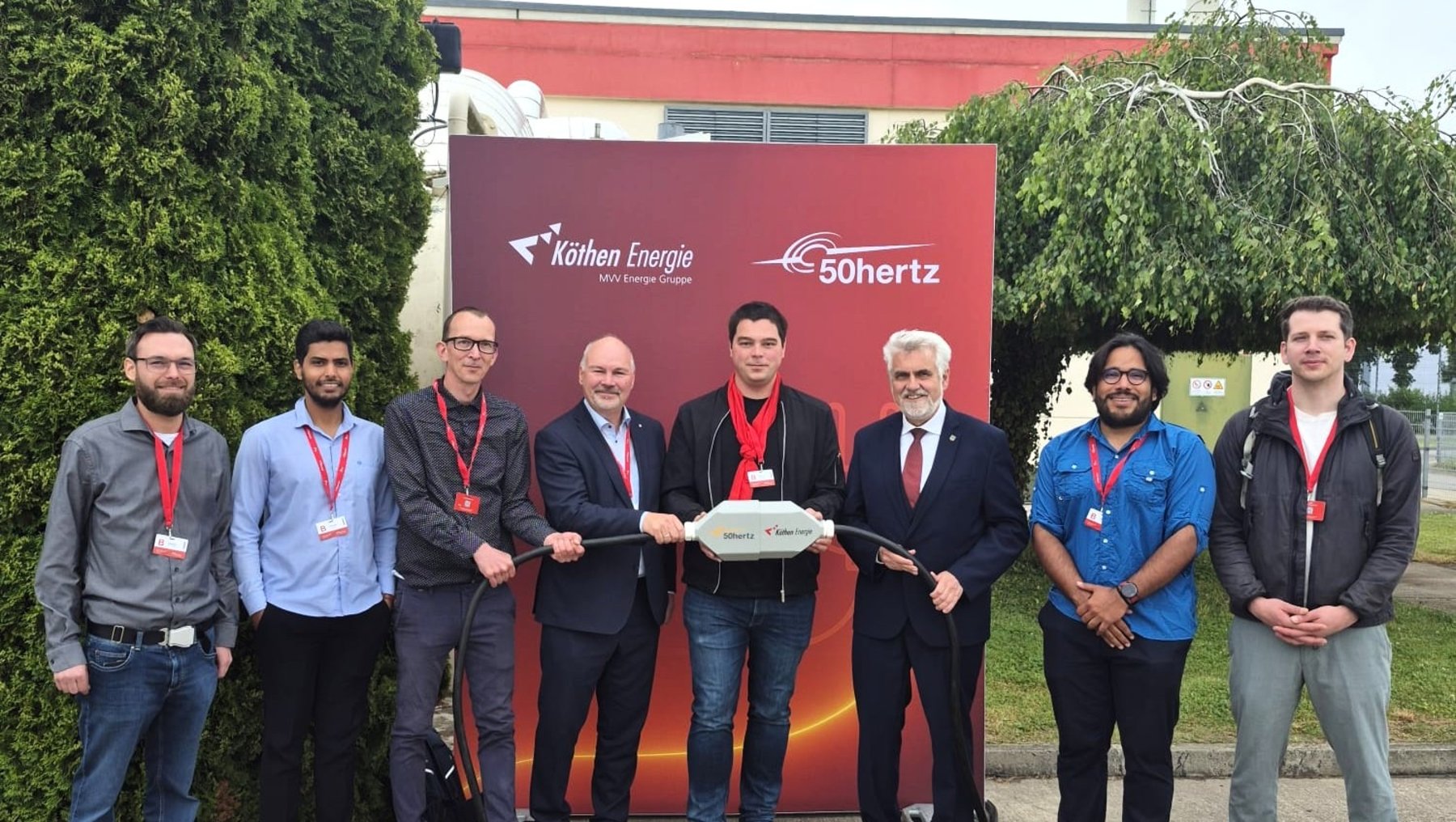
Im Juni nahm Köthen Energie die Power-to-Heat-Anlage in Betrieb, die Strom aufnimmt und als Wärme nutzt.
A master's thesis on converting electricity into heat for grid use
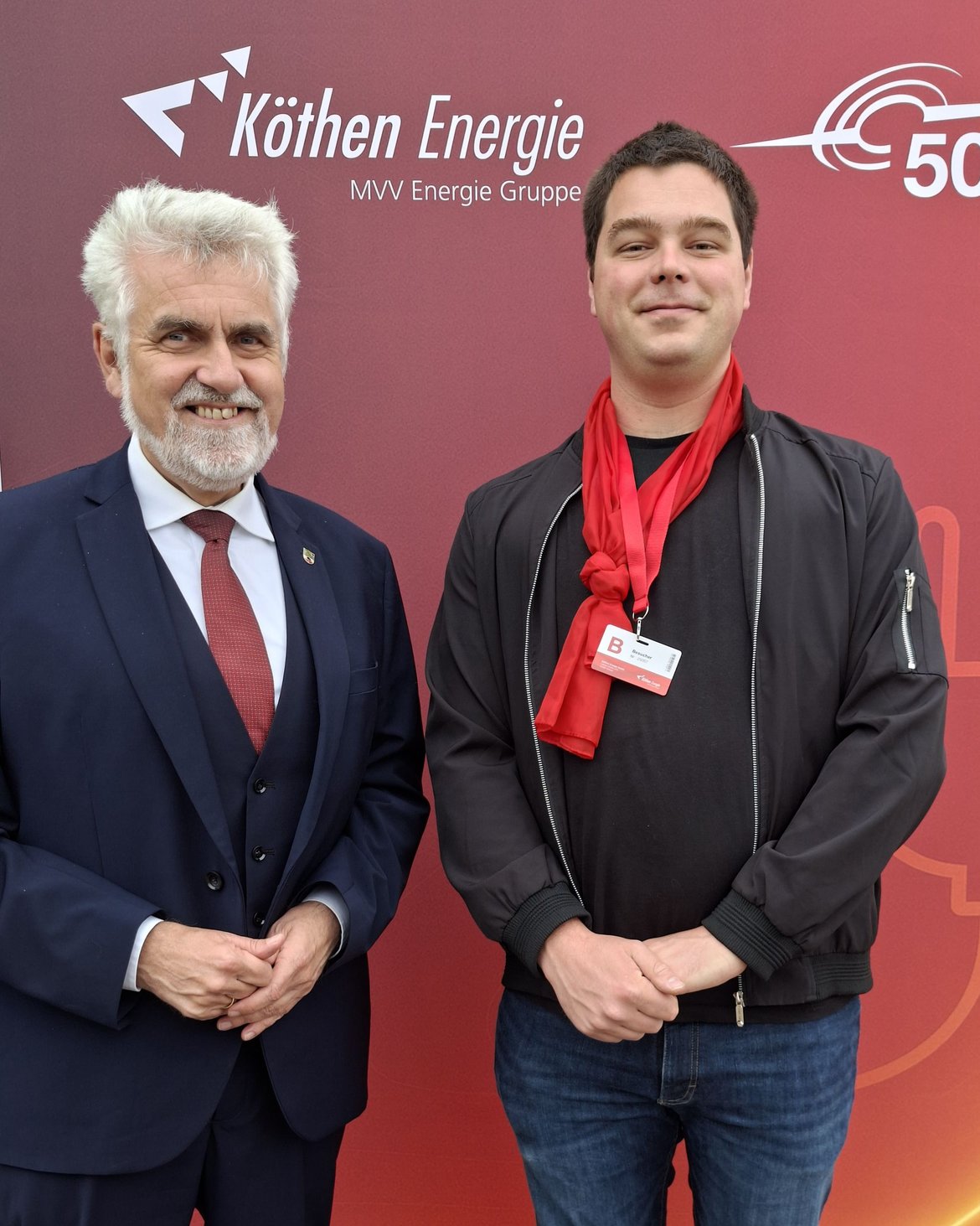
Felix Giesa was pursuing a master's degree program in Sustainable Energy and Process Engineering at Anhalt University of Applied Sciences when, in 2024, he began looking for an industry partner for his thesis. He reached out directly to Köthen Energie GmbH. This led to a collaboration centered on a specific question: Can the company operate a power-to-heat (PtH) plant economically? A PtH plant converts excess electricity directly into heat. “My main task was the examination of how the plant could be operated economically and what impact that would have on the heat supply within the existing system,” Giesa says of his work. He explicitly describes it as a preliminary study.
How does the power-to-heat system work in the municipality?
The PtH plant in Köthen has a capacity of 1.2 megawatts. This is equivalent, in theoretical terms, to the heat supply for up to 200 single-family homes. It absorbs excess electricity from wind or solar power plants and feeds the generated heat into the district heating network. This allows Köthen Energie to save on natural gas that would otherwise be consumed by the existing combined heat and power plant (CHP). Combined heat and power plants generate both electricity and heat from natural gas.
 © hochschule anhalt | felix giesa
Why 50Hertz Financed the Facility
50Hertz is the transmission system operator for northern and eastern Germany; it financed the construction with 600,000 euros and, in return, receives permanent remote access to the plant’s control system. The background is well known: When wind and solar plants generate more electricity than the grid can handle, grid operators shut down individual feed-in systems. For such curtailments, the operators receive compensation per curtailed kilowatt-hour. These costs, in turn, are borne by all electricity customers.
In Köthen, 50Hertz now has good control options: If there is too much electricity in the grid, the grid operator remotely shuts down the combined heat and power plant and switches on the power-to-heat system. The CHP plant then stops feeding electricity into the grid, while the power-to-heat (PtH) system directly consumes the excess electricity.
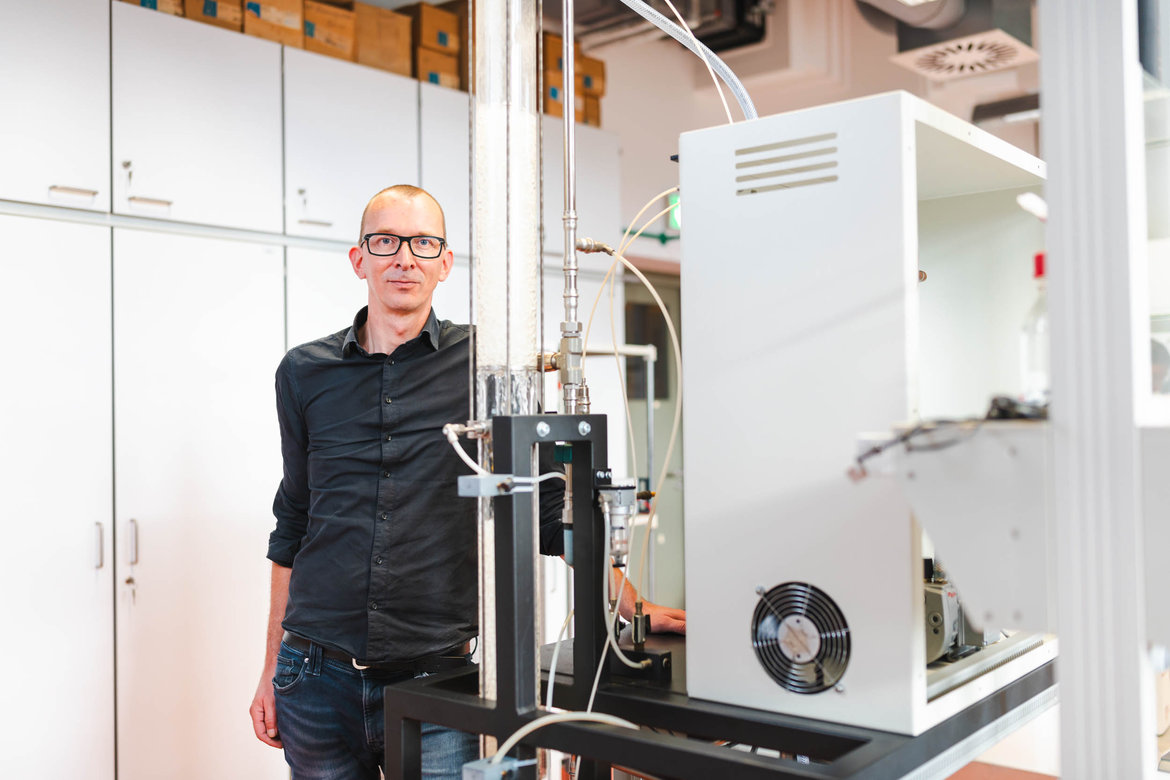
“Being able to remotely disconnect a large CHP plant from the grid while simultaneously connecting a large consumer is an enormous incentive,” says Prof. Dr. Jörg Sauerhering, who supervised the master’s thesis at Anhalt University of Applied Sciences. 50Hertz itself expects the investment to pay for itself in a short period of time.
Cooperation Between the University and the Region
The collaboration between Anhalt University of Applied Sciences and Köthen Energie began with a lecture. Prof. Dr. Jörg Sauerhering had given a public talk on energy supply at Anhalt University of Applied Sciences. Afterward, the managing director of Köthen Energie approached him. “That’s how the collaboration developed,” he explains. Since then, two graduates of the university have been hired full-time by Köthen Energie, and several labs and theses have resulted from the partnership. It took a good two years from the initial idea for the power-to-heat plant (based on Felix Giesa’s master’s thesis) to the plant’s commissioning.
 © Jan-Billy Blum-Arndt
Local Solution vs. Large Network Infrastructure
Power-to-heat systems are already in use in other municipalities. Köthen represents yet another example of their application. Essentially, according to Jörg Sauerhering, the model can be applied to any location where combined heat and power (CHP) plants provide the heat supply. This applies to most district and local heating networks in Germany. PtH systems are less expensive to purchase than battery storage systems. Grid expansion, on the other hand, often takes years, as demonstrated by the ongoing construction of the SuedOstLink in Saxony-Anhalt: “Especially in northern and eastern Germany, we are feeling the effects of the delayed expansion of the grid infrastructure, as it cannot keep pace with the volume of renewable electricity being generated,” says Sauerhering. “The concept of ‘using rather than curtailing’ makes sense because locally and renewably generated electricity is used for heating, the consumption of fossil fuels decreases, and transmission grids are spared.”
Decarbonizing the energy supply as a major goal
“The fact that my master’s thesis on decarbonization was able to make a contribution fills me with pride,” says Felix Giesa, who remains involved with the topic as a research assistant at Anhalt University of Applied Sciences. The Heat Planning Act, which has been in effect since early 2024, requires all municipalities to develop heat plans. For the district heating sector, the federal government has set a target of sourcing at least 30 percent of heat from climate-neutral sources by 2030. The Climate Protection Act sets the overarching framework: Germany must be climate-neutral by 2045.
Specific data on CO2 savings or cost implications for district heating customers in Köthen are not yet available. The plant was officially commissioned in the spring of 2026 in a ceremony attended by Science Minister Armin Willingmann. Reliable figures will not be available until after a full year of operation.
Information & Links
Title of Felix Giesa’s master’s thesis (2024): “Options for Decarbonizing the Köthen Energie District Heating Network, Considering Technical and Economic Factors, with a Focus on a Power-to-Heat Plant.”
Learn more about Prof. Dr. Jörg Sauerhering on his personal website: https://www.hs-anhalt.de/hochschule-anhalt/service/personenverzeichnis/person/prof-dr-joerg-sauerhering.html
Press release from Köthen Energie: https://www.koethenergie.de/2026/06/starker-schritt-fuer-die-energiewende-in-koethen/
Master's Degree Program in Sustainable Energy and Process Engineering: https://www.hs-anhalt.de/studiengaenge/mep.html
Additional articles on climate adaptation in municipalities and organizations on the Anhalt University of Applied Sciences Climate Blog.
