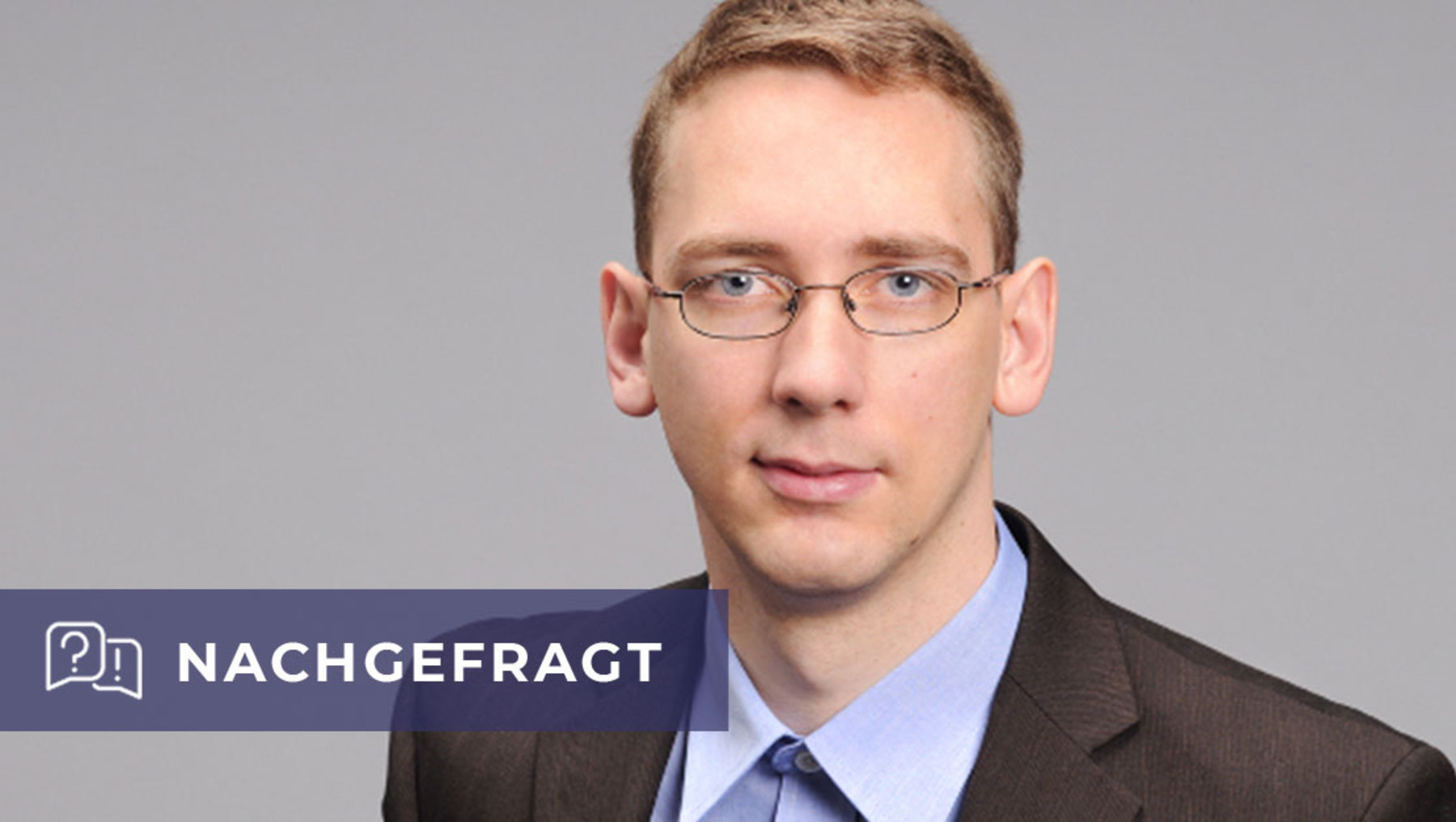
Professor Andreas Both expanded the Federal Administration's coronavirus chatbot together with students from the master's degree program in Data Science. In this interview, he talks about the strengths of the "new bot" and what possibilities artificial intelligence has in store for the future.
Prof. Both, what can the Federal Administration's current chatbot do and what should it be able to do?
Prof. Andreas Both: The chatbot solution provided by the federal administration is able to deliver the current case numbers for federal states and districts. With case numbers fluctuating practically daily and the conversion into incidence, it is easy to lose track of things. In order to get an overview of comparative values and the course of the pandemic in your own region, you have to search hard for the relevant information. Although this information is available somewhere, it is not easy to find or evaluate in a user-friendly way. We want to close this gap by making it possible to ask directly for relevant values, for example with the query: "What were the case numbers in Halle an der Saale two weeks ago?"
The Federal Ministry of the Interior, Building and Community and the IT service provider of the federal administration (ITZBund) have therefore entered into a cooperation with Anhalt University of Applied Sciences to offer the chatbot even more freely, accurately and comparatively in the future. What is the cooperation about and what is your aim?
The cooperation partners were also very interested in expanding the functionality of the existing chatbot. We therefore defined our common goal as developing a subsystem that takes a knowledge-driven approach to interpreting user input and can provide more detailed answers.
What expertise were you able to contribute with your team?
The basis for the project objectives is provided by the research areas of "question answering" and "dialog systems", in which I have been conducting successful research together with many partners for many years. Colloquially, these are usually summarized under the term chatbots. It is a very active field of research in which new challenges are constantly being addressed and innovative technologies developed. Ultimately, we are also driven by large companies such as Google, Amazon and Apple, which are also working on the further development of chatbots with very large research budgets. Like most companies, the ITZBund can only counteract this disadvantage economically by entering into collaborations with universities. This harmonizes very well with our practice-oriented research approach, as our newly developed technologies are repeatedly tested with a wide variety of partners, small and large companies and organizations. This results in a constant transfer of knowledge, synergies and new impulses on all sides, which ultimately benefit further product development and the improvement of our research results. The intensive discussions often lead to completely new ideas for innovative solutions on both sides.
How many people worked with you on this project?
Five students and Aleksandr Perevalov, a doctoral student in my working group who is researching these technologies for his dissertation, worked on the project.
How do you involve the students?
The project is one of three projects that we are carrying out as final projects in the "Question Answering & Chatbots" module. In this module, my aim is for students to learn about new technologies as well as the specific focus on project results. This is so important because the use of artificial intelligence (AI) methods in software projects poses particular challenges. These are caused on the one hand by the high data dependency and on the other by the significantly higher complexity of AI solutions. At the same time, the actual project implementation enables us to pass on both theoretical approaches and best practices directly to our students and thus ensure a sustainable qualification combined with social commitment. In principle, the students are responsible for the implementation of the projects. They receive intensive support and solution options from the two participating instructors at our university as well as from the equally highly qualified project supervisors at the ITZBund. This approach ensures that knowledge is built up and that the students remain committed to the project. Our students are therefore by no means recipients of orders, but actively shape the development.
What is the strength of the new chatbot?
The chatbot functionality, which will soon be available, is able to retrieve more specific questions on all case numbers using natural language of instruction. However, its particular strength lies in its generalizability. The coronavirus pandemic will hopefully be over in a few months, but the technical structures that have now been created make it easy to adapt to other knowledge domains. This will allow new functionalities with similar data models to be developed even faster in the future and the creation of corresponding chatbots will be semi-automated. This will enable the ITZBund to react more flexibly to requirements and develop more efficiently. In addition to the actual data access, the company will also benefit from the greater efficiency and speed of the IT solutions, which will ultimately also make a significant contribution to further digitalization.
When will the service be available to everyone?
The final integration into the chatbot will take place after a final quality check by the ITZBund. For software that is used throughout Germany, a special responsibility must of course be fulfilled here. We expect integration to take place at the beginning of April 2021, and the university will soon be making its own test environment freely available.
How likely is it that chatbots will also become indispensable for other areas in the future?
The current topics show a great social as well as entrepreneurial benefit that will probably be used in pretty much every environment in the future. Let me give you another example: imagine someone who has your entire email account with all emails, content and data, including the context, in their head. Someone who knows exactly where which information is hidden and can quickly and precisely reproduce the relevant information when asked by voice. That would save an enormous amount of time. The question-answering technologies we are researching make it possible to integrate background knowledge and special functionalities quickly and efficiently. So you don't have to reinvent the wheel, you just need to use existing knowledge or combine it in new ways to solve problems.
In 2018, you were appointed Professor of Web Engineering at Anhalt University of Applied Sciences. What are your responsibilities?
My tasks include teaching and research. In addition to basic lectures, I also cover specialist topics such as agile software development, linked data and question answering & chatbots. In research, I work at the interface between web technologies, software engineering and Data Science. I am also a member of the IT Commission of Anhalt University of Applied Sciences and a representative for international cooperation at the Department of Computer Science and Languages.
Prof. Both, thank you very much for the interesting interview.
