Things to know about studying
Our guiding principle: the CAx process chain
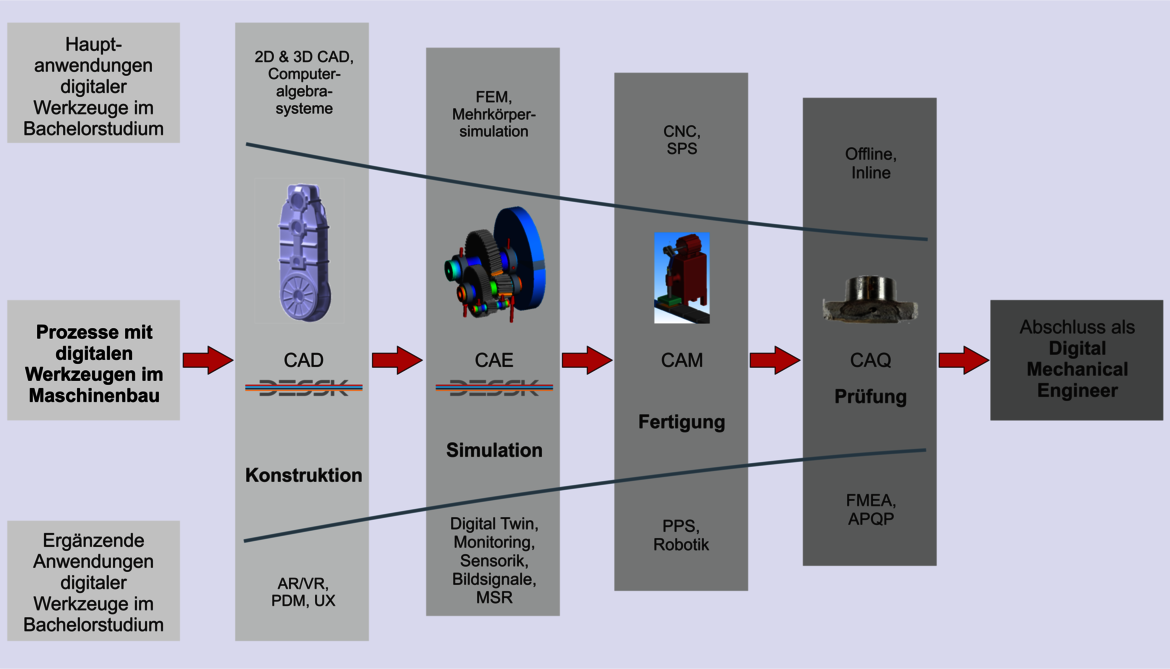
High competitive pressure, tight budgets, small time windows and reproducible quality requirements in the company's development, testing, production and examination of new products will require the use of digital tools and their linking to form a self-contained CAx process chain even more in the future.
 © Hochschule Anhalt
The course is based on the CAx process chain
With us, you will study Digital Mechanical Engineering as it will be in demand in the future. Good prospects for your future!

Showcase for the degree program: impressions in the video
Module description handbook as of winter semester 2022/2023
Using digital tools to become a digital mechanical engineer
What does CAx stand for?
CAx stands for Computer Aided x. The x can be used as a placeholder e.g. for design(construction), engineering(calculation/simulation), manufacturing(production), quality(quality assurance). These and other aspects are defined as processes and describe in their entirety the complete range of computer-aided planning, development, design, production and quality assurance of physical products.
Our course design is based on the following central question:
How does it get from the idea to the creation of a product?
Whether eyeglasses or an aircraft turbine, products differ in their structure and properties depending on the application. This results in different product development strategies, which may focus, for example, on design, production technology, materials technology or quality assurance.
However, the individual aspects must always be considered in their complex interaction with each other and holistically, and many, sometimes conflicting objectives must be resolved. And so there is no one right solution! This is why our modules are coordinated in terms of content and chronology in the context of the CAx process chain and the content is application-oriented.
We also support you on your way to becoming a Digital Mechanical Engineer in the efficient use of digital tools.
With our balanced mix of the main engineering fundamentals and specializations as well as applications with clear practical relevance, your time at university will remain interesting and exciting.
What are complexes and modules?
Our 3 main complexes are divided into subordinate complexes, which in turn are made up of several modules. You are familiar with subjects from your school or training; at our university, subjects are called modules.
Why the division into complexes?
It is important to us that you always know what the individual modules mean for you during your studies. These are logically arranged and interlinked in the course of study. For a better overview, we have therefore classified the modules according to basics, specializations and practical applications and bundled them into corresponding complexes.
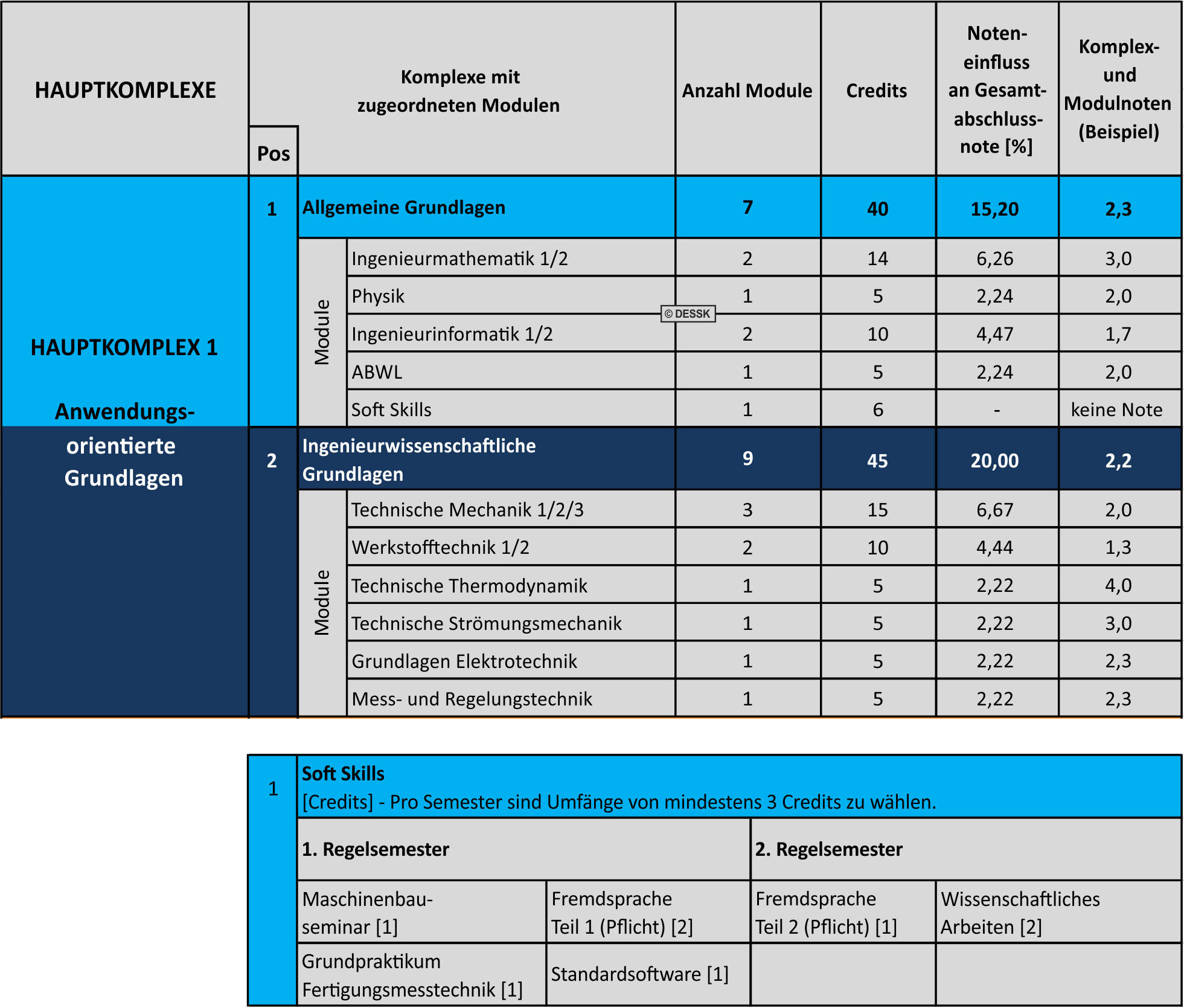
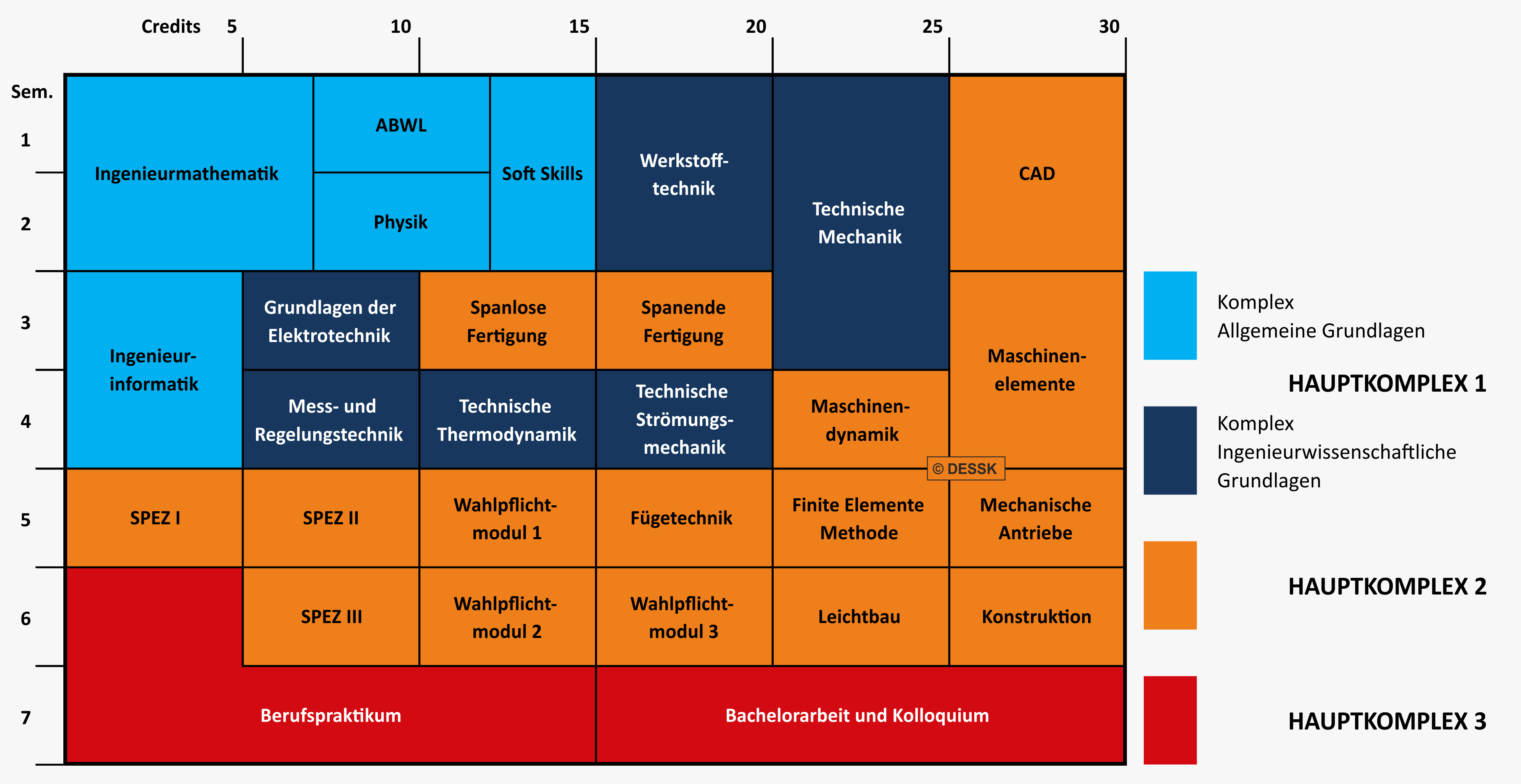
Our study program is divided into main complexes (as of 2020)
 © Hochschule Anhalt
The main complex 1 is divided into the complexes General Fundamentals (1) and Engineering Fundamentals (2).
The general basics (1) subsume the M, I and N modules from STEM as well as the soft skills package. The engineering fundamentals (2), however, include the T modules from STEM. Both basic complexes are spread over the first 4 semesters.
Our soft skills package includes several module options and is offered in the first two semesters.
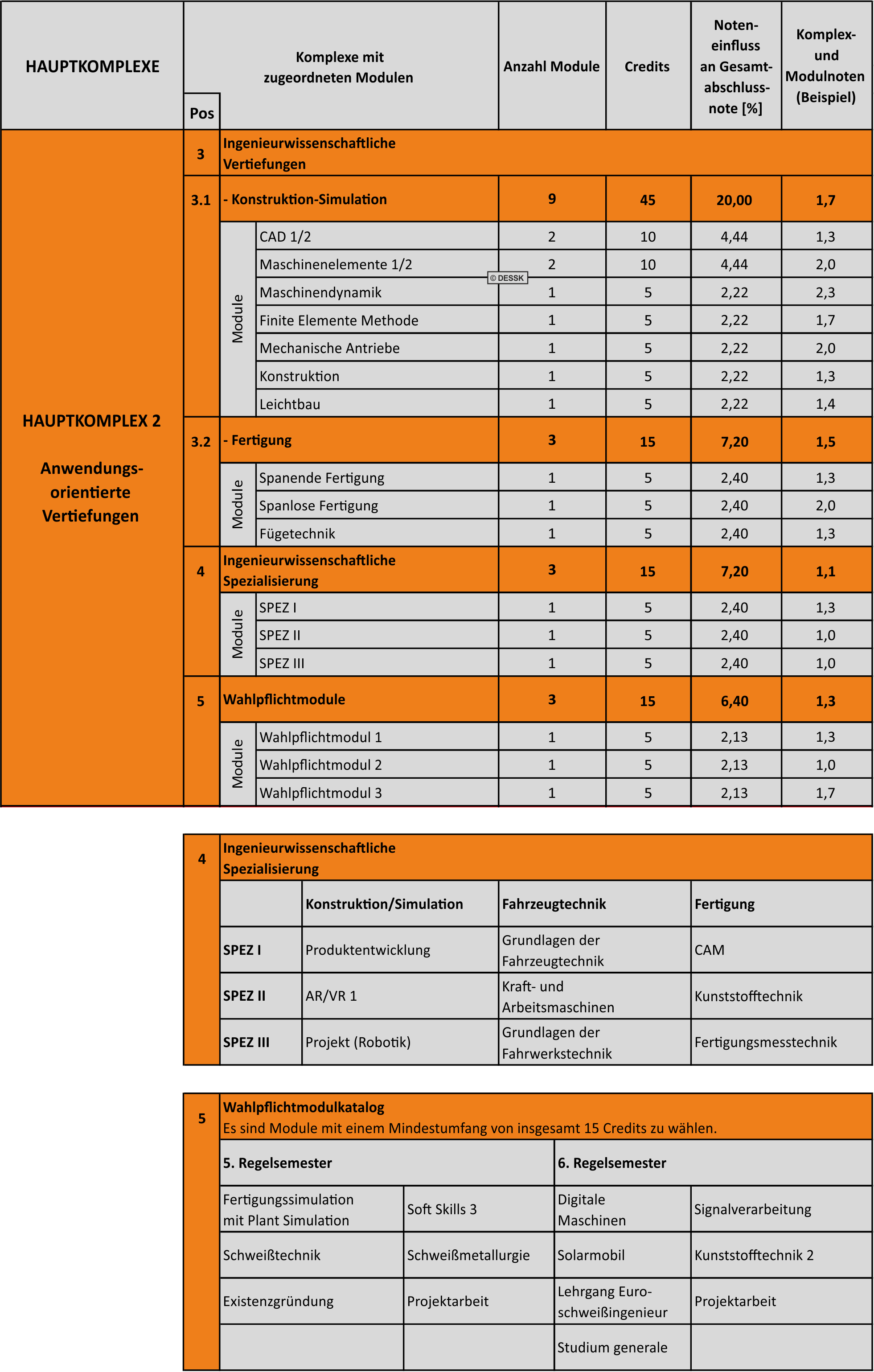
The main complex is made up of the engineering specializations (3), engineering specialization (4) and elective modules (5).
The engineering specialization complex (3) is in turn divided into the sub-complexes design/simulation (3.1) and production (3.2), which significantly shape the CAX profile of our degree program. It is thus geared towards the demand for young engineering specialists in companies relevant to mechanical engineering in Saxony-Anhalt.
The Compex Engineering Specialization (4) offers a choice of three different specializations: Design/Simulation, Automotive Engineering and Production Engineering.
Our range of specializations as well as elective options of subject-specific and interdisciplinary modules are offered in the 5th and 6th semesters.
 © Hochschule Anhalt
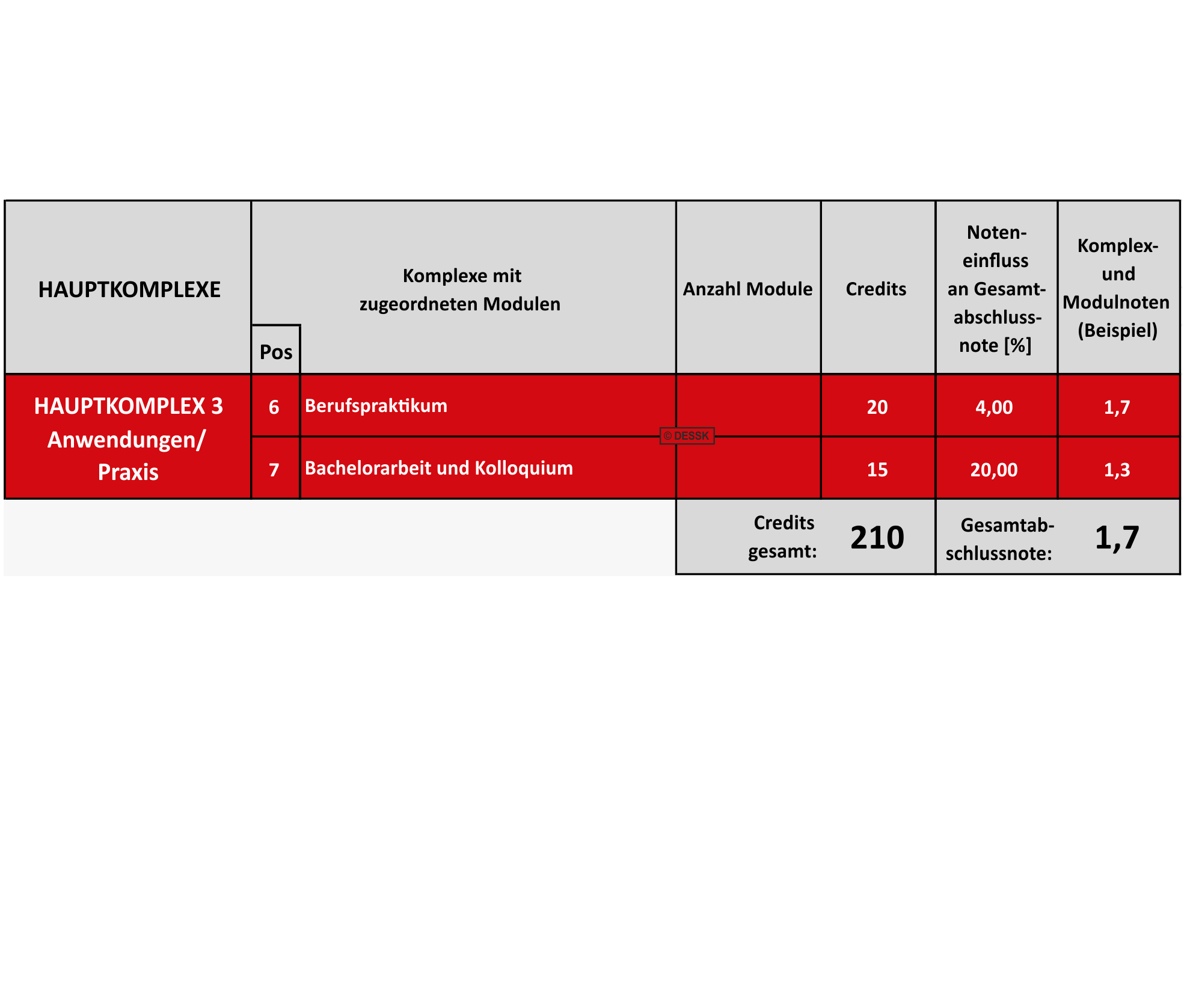
At the end of the Bachelor's degree course, the acquired basics and specializations are applied in practice in the form of the internship (6) and the Bachelor's thesis (7).
Depending on your personal interests, you can choose your own specialist focus and decide whether you want to work on the topic at the university or in a company.
 © Hochschule Anhalt
In our complex module plan, the complex-dependent modules are sorted according to standard semesters and presented in the form of credits.
What are credits?
The "European Credit Transfer and Accumulation System" (ECTS) is used in the European Higher Education Area. As part of the "Bologna Process", ECTS serves as the basis for aligning national higher education systems and program sequences for Bachelor's and Master's phases.
At our university, ECTS points are referred to as "credits" and are synonymous with learning objectives. For a successfully completed module, we award the credits specified in the respective module description or curriculum. With the exception of a few modules, there are 5 credits per semester.
30 credits can be achieved in each semester. In this 7-semester degree program, including internship and Bachelor's thesis, you will receive 210 credits.
Your workload during your studies
For each credit point, your workload (time spent) for lectures, practical courses, labs and time spent independently studying amounts to approx. 25 hours per semester. With 5 credits to be awarded, this means a workload of around 125 hours per week per semester per module.
With 30 credits to be achieved per semester, your total workload will therefore be approximately 750 hours per week per semester.
We look forward to receiving your application
Recognized qualifications: Abitur, Fachabitur. Master craftsman, technician
Aptitude test: no
Numerus clausus: no
Internship: yes, see internship
Contact for questions: Mechanical Engineering[at]hs-anhalt.de
Application period: 15.05. - 15.09.2020
Step by step:
/ Register in the >>application portal of the Student Service Center (SSC).
/ After logging in, select "Bachelor's degree", type of degree program: "Full-time program", the degree program "Mechanical Engineering (B.Eng.)", etc.
/ Complete the online process and print, complete and sign the generated document "Application for Admission to Studies" (including applicant number).
/ Attach further documents (see checklist) to the application form and send it to Anhalt University of Applied Sciences by enrollment.
/ Finally, send an informal e-mail with your contact details (postal address and e-mail address) to our Department for prompt registration of your application:
Mechanical Engineering[at]hs-anhalt.de
/ officially certified copy of the university entrance qualification in the form of a higher education entrance qualification, master craftsman's certificate or technical certificate
/ curriculum vitae with details of school/academic and professional background
/ copy of identity card or passport on both sides (ID number can be blacked out)
/ Passport photo (35 x 45 mm, with applicant number on the back)
/ deregistration and clearance certificate (if you were already enrolled at a university)
/ Training contract/employment contract (only for dual studies)
