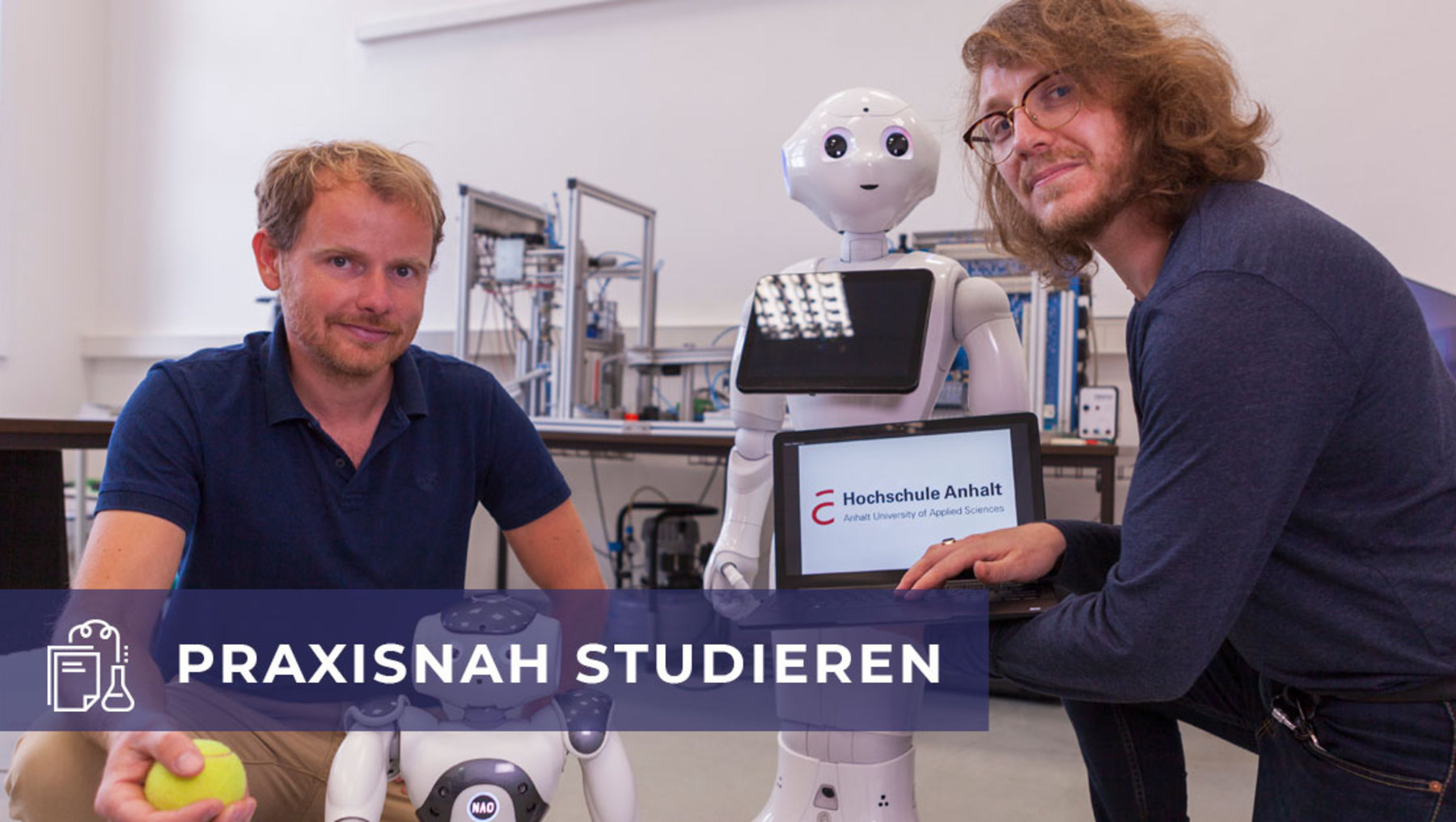
In the science fiction film I, Robot, humanoid robots are a reality in Chicago in the year 2035. They are used as workers and helpers in both private and business settings. But is this realistic for life in the future? The Department of Electrical, Mechanical and Industrial Engineering at Anhalt University of Applied Sciences is researching and developing future technologies at the interface between medicine, humans and technology. Since last year, the department has been using two humanoid robots from Softbank Robotics to further strengthen its practical studies.
Two smart robots, "Pepper" and "Nao", open up new opportunities and challenges for students at Campus Köthen and are regarded as innovative tools that have already established themselves as a learning platform. "The challenging subject area of robotics is particularly good for imparting diverse and varied specialist knowledge to students in order to prepare them for the working world of tomorrow. In addition, the budding engineers also enjoy looking at non-technical aspects - from personal acceptance when dealing with robots to intuitive interaction," reports Professor Stefan Twieg, who teaches electrical and automation engineering at Anhalt University of Applied Sciences. He and his team, consisting of students from the Department and Johannes Coertze, a doctoral student on the Biomedical Engineering degree program, are working on the artificial intelligence of robots. Together, they are testing and developing ways in which the robots can be integrated into everyday life. In doing so, they are pursuing the premise of not reducing jobs, but rather creating new supportive areas of application.
While "Pepper" moves around on wheels, "Nao" has two independent legs that allow it to play soccer, walk, sit and stand up without much difficulty. The two charming-looking robots offer ideal prerequisites for interdisciplinary collaboration, especially for engineering degree programs with a focus on mathematics, computer science, natural sciences and technology. Students are introduced to the topics of project management, Electrical Engineering, programming, mechatronics and human-machine interaction in an application-oriented and practical way.
The two robots are still mainly at home in research and education. In the future, however, they could be found more and more on the market. For example, "Pepper" could work in various retail service areas and "Nao" could support daycare centers or nursing homes in the future.
More information about the department and the degree programs can be found at www.hs-anhalt.de/emw
Engineering Sciences at the virtual university information day
Other exciting topics from the Department of Electrical, Mechanical and Industrial Engineering will also be presented online at the virtual university information day on June 20, 2020. In addition, pupils, parents and prospective students will have the opportunity to find out even more interesting facts about the Bachelor's and Master's degree programs at Anhalt University of Applied Sciences. Degree Program Advisors and their colleagues will be available online for discussions. More information on the program and registration can be found at www.hs-anhalt.de/hochschulinformationstag
Artificial intelligence: Humanoid robots complement practical studies
-
 © Andreas Bindseil
Kontakt
