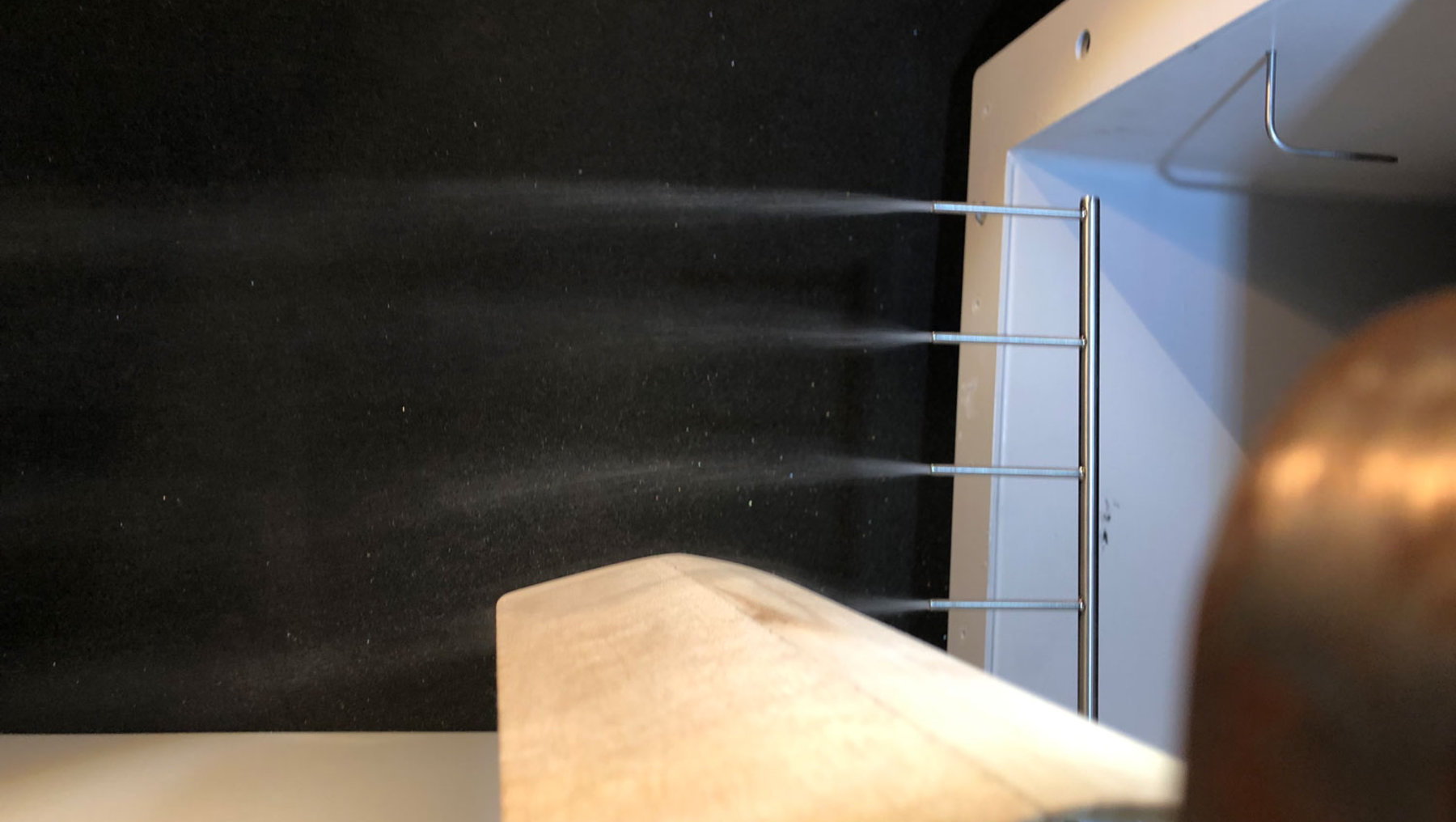
The system reaches top speeds of 175 kilometers per hour and enables precise flow experiments. Equipped with a fog generator and spatial force sensor, the system closes a gap between theory and practice. The facility complements existing virtual tools and enables verification tests. Researchers use it to test the fluid mechanical properties of components and optimize digital twins - a virtual image of the real behavior of the components on the computer.
Making flows visible
The new wind tunnel makes complex aerodynamic processes literally tangible. Thanks to the integrated fog system, air currents are visible to everyone. At low speeds, students can even feel by hand how solid structures react to flows. "This direct experience is no substitute for simulation," explains Prof. Dr. Klaus Günzel. He procured the system together with his colleague Prof. Dr. Stefan Wollny and supervises it with a team from the Department of Electrical, Mechanical and Industrial Engineering.
Important questions from aviation research
The wind tunnel supports ongoing research work with the German Aerospace Center (DLR) and companies such as DG Aviation and IFF E&C GmbH. The scientists are planning specific projects. The focus is on the aeroelasticity of gliders, i.e. the interaction between airflow and deformable structures. This field of research has far-reaching prospects. "The target technology will be fundamental for future, more fuel-efficient commercial aircraft," says Günzel. Together with his colleague Tom Scholz, he is researching the fundamental principles of sustainable mobility in aviation.
Practical training in Mechanical Engineering
In addition to research, teaching also benefits from the new facility. Students from the Departments of Mechanical Engineering and Electrical Engineering apply their theoretical knowledge directly. They gain practical experience with fluid mechanical effects such as air resistance, lift and downforce. Klaus Günzel emphasizes: "This also helps with questions of automation technology, which students work on in their final theses." With the help of the wind tunnel, schoolchildren can clearly and vividly experience how important technical degree programs are for the questions of tomorrow.
Mechanical Engineering with future prospects
"Our Mechanical Engineering degree program combines sound fundamentals with the requirements of modern experimental practice," continues Klaus Günzel. The job market continues to show a high level of interest in well-trained specialists. Calculation engineers are particularly in demand. They work with simulation techniques and evaluate design properties such as service life. Mechanical Engineering students at Anhalt University of Applied Sciences therefore receive a broad education in mechanics, design, manufacturing and computer science. "The wind tunnel is an important extension in the direction of practical application."
Contact:
Prof. Dr. Klaus Günzel
E-mail: klaus.guenzel@hs-anhalt.de
