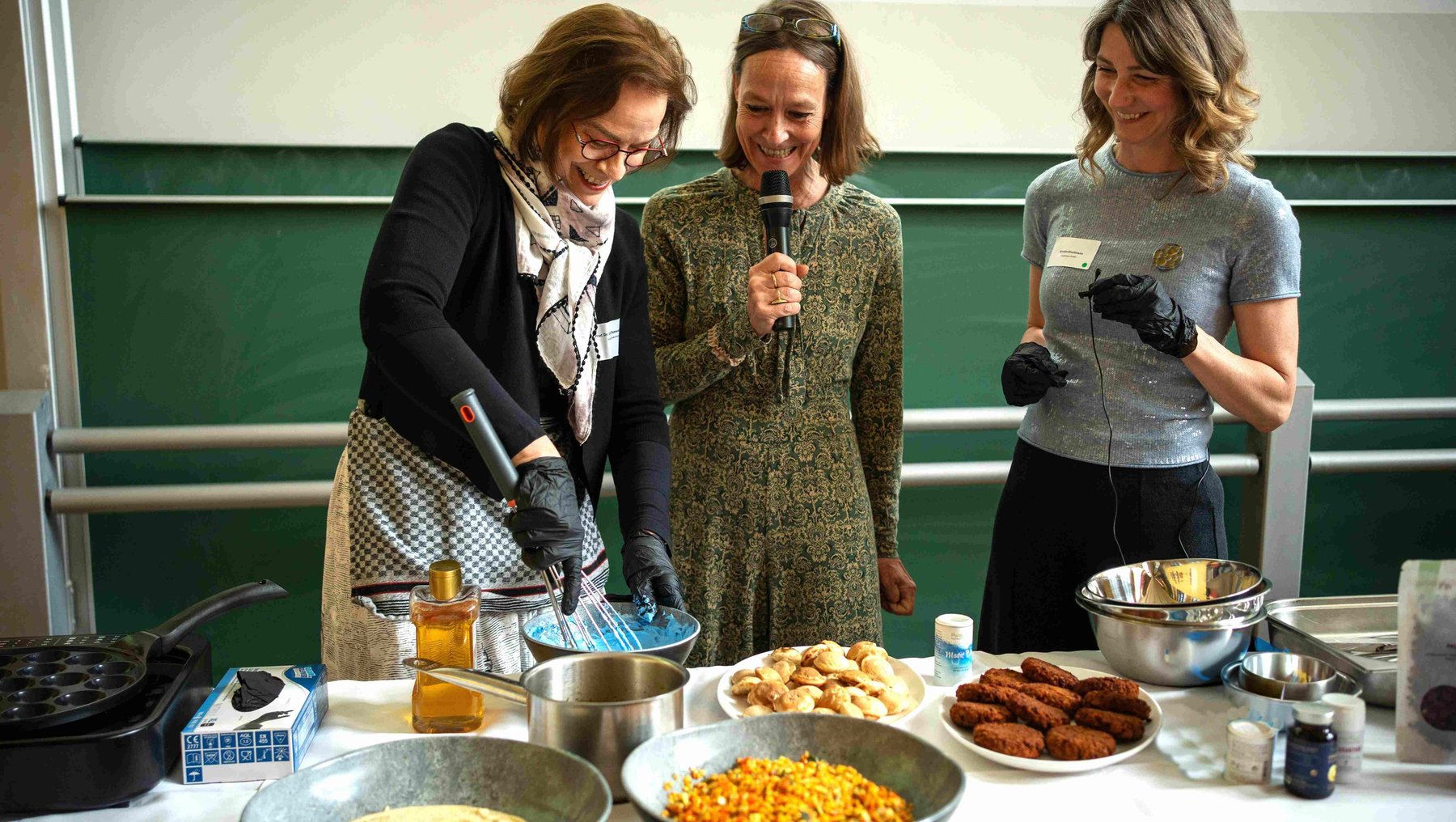
At the 4th Central German Algae Round Table at Anhalt University of Applied Sciences, the cooking course was one of the more unusual items on the program. In the session "The future on the plate - algae for the palate", Kirstin Knufmann stood on the podium, which had been converted into a cooking area. Knufmann has been working with algae as a food for over 20 years, founded the "PureRaw" label, written cookbooks, runs workshops and cooking courses and now works with the Competence Center Algae Biotechnology at Anhalt University of Applied Sciences in science communication.
4 misconceptions about algae and nutrition - what research and practice say about it
-
 © hsanhalt | sascha perten
Prof. Dr. Uta Seewald-Heeg (l.) und Kirstin Knufmann (r.) beim Algen-Kochkurs des 4. Mitteldeutschen Algenstammtischs. Ilka Bickmann, science2public – Gesellschaft für Wissenschaftskommunikation e.V., Halle, moderierte die Session „Zukunft auf dem Teller“.
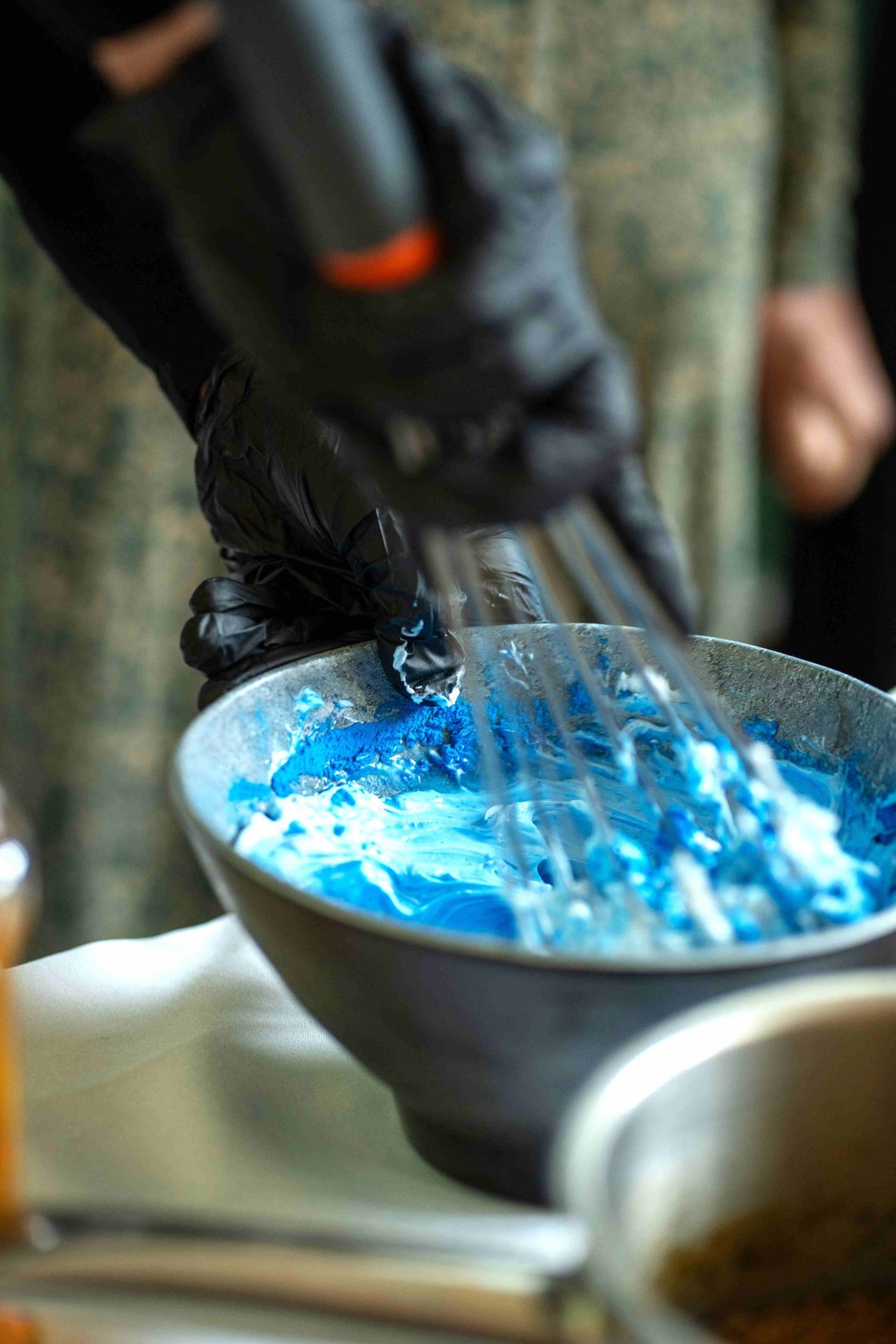
The panel discussed the preparation of savory dips, sweet pancakes and potato salad. Suitable bread and meatballs were then served at the buffet - all prepared or refined with algae. Kirstin Knufmann was on hand to help:
- Dr. Steffen Eichner (State Secretary in the Ministry of Science, Energy, Climate Protection and the Environment of Saxony-Anhalt)
- Christian Jahr, IHK Training Academy Magdeburg
- Stefanie Pötzsch, State Secretary in the Ministry of Economics, Tourism, Agriculture and Forestry of the State of Saxony-Anhalt
- Prof. Dr. Uta Seewald-Heeg (Vice-President for International Affairs and Gender Equality at Anhalt University of Applied Sciences)
- Oliver Skoluda, Head Chef RETIGO Deutschland GmbH, Ruhpolding
Between stirring and costs, Knufmann also spoke about misconceptions that she has encountered for years: at trade fairs, in cooking courses, in discussions with politicians and scientists. She explains four of them here:
Misconception 1: Algae are a new type of food
In this country, algae are seen as a trend, as something slightly strange from the future. Historically speaking, this is a very European perspective.
Kirstin Knufmann:
In Japan, Korea and China, seaweed has been an integral part of the cuisine for centuries. In Irish and Breton coastal regions, seaweed was dried, cooked, pickled and used as a staple food. This is still the case in many parts of the world today.
In Central Europe, this tradition has been lost for generations, while other cultures have simply carried it on. Algae on the plate is therefore more of a return than a novelty.
 © hsanhalt | sascha perten
Misconception 2: Vitamin B12 is only available from animal sources and B12 deficiency is a vegan problem
This misconception occurs in two closely related variants. Vitamin B12 is considered by many to be an exclusively animal product, and its deficiency is seen as a problem for those who abstain from meat and milk.
Kirstin Knufmann:
Neither is true. B12 is essential for all people, regardless of their diet. It is originally produced by bacteria; meat and milk are merely an intermediate carrier in the food chain.
The VitAL research project at Anhalt University of Applied Sciences, carried out together with the Klötze algae farm, is investigating precisely this question: Can the microalgae Chlorella serve as a reliable source of B12 for human nutrition? Initial results show that this is possible. The decisive factor here is the cultivation method, as the B12 content in chlorella varies considerably depending on the cultivation method. Researchers are working on systematically understanding this relationship and establishing a plant-based, scalable source of B12.
Misconception 3: Algae contain too much iodine
Germany has had an iodine deficiency problem for decades. Iodized table salt is far from sufficient to cover the demand, especially as milk consumption, another source of iodine, has been declining for years. At the same time, there are concerns that algae could provide too much iodine.
Kirstin Knufmann:
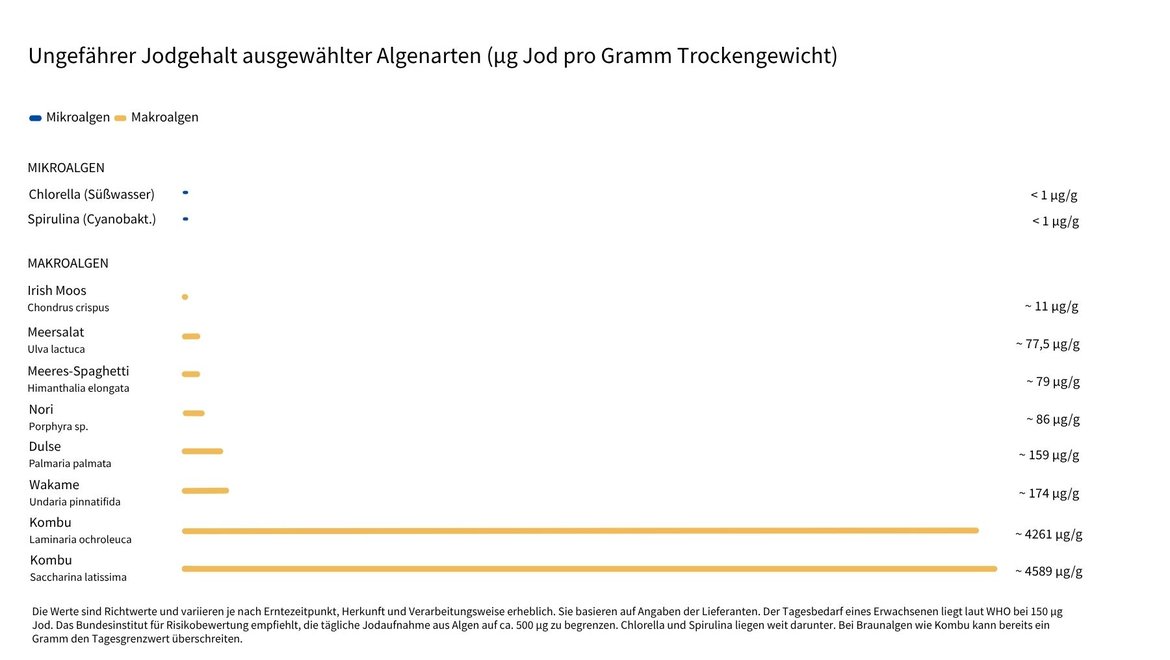
This blanket statement is not true. The iodine content depends on which algae you look at. Chlorella and spirulina, the most commonly used microalgae, do not contain relevant amounts of iodine. With macroalgae, i.e. marine algae, the values vary greatly: red algae such as dulse are significantly lower than brown algae such as kelp, and even within a species the iodine content depends on the time of harvest and the region of origin.
My practical recommendation is always: if you are new to algae, start slowly, especially with iodine-containing varieties. And learn to differentiate: for example, between microalgae and macroalgae, between red algae and brown algae.
 © hsanhalt
Misconception 4: Algae taste like fish
Anyone who says this usually has wakame salad or sushi in mind, and that is understandable. Most people are simply unaware of the variety of flavors algae has to offer.
Kirstin Knufmann:
That's often the biggest aha effect in my cooking courses: the flavors of seaweed, just as we wanted to convey them through dips, potato salad, bread and meatballs at the regulars' table. Some of my favorite examples are: Dulse roasted briefly produces a slightly bacony flavor that goes well over fried potatoes. Kombu brings umami, is suitable for seasoning vegetables and soups and allows you to reduce salt. Chlorella tastes like hay. The calcium algae tastes like nothing and can be stirred into porridge without you noticing its taste. Nori algae in a seasoning broth gives eggplants exactly the same taste as herring. The herring salad is ready, making it much less complicated and less delicate to handle.
Kirstin Knufmann sums it up like this: "If you don't like a type of vegetable, you don't say you don't like vegetables at all. When it comes to algae, many people still lack experience with the variety. A lot of education, practical experience and research is still needed."
What remains: Algae research & algae management
The 4th Central German Algae Round Table showed that knowledge about algae is growing in research, Economics, politics and society. Anhalt University of Applied Sciences is contributing to this with projects on vitamin B12, natural colorants such as phycocyanin and astaxanthin and sustainable cultivation methods.
More about the research of the Competence Center Algae Biotechnology at Anhalt University of Applied Sciences: https://www.hs-anhalt.de/hochschule-anhalt/angewandte-biowissenschaften-und-prozesstechnik/forschung/forschungsgruppen/kompetenzzentrum-algenbiotechnologie/ag-prof-dr-carola-griehl-algenbiotechnologie-in-koethen.html
Review of the complete program of the 4th Central German Algae Round Table in Köthen: https://www.hs-anhalt.de/hochschule-anhalt/einrichtungen/forschungs-transfer-und-gruenderzentrum/veranstaltungsorganisation/4-mitteldeutscher-algenstammtisch-mista.html
Redaktion
Claudia Aldinger
Kirstin Knufmann
... can be contacted for questions and inquiries by e-mail: kirstin.knufmann(at)hs-anhalt.de
To the program of the 4th Central German Algae Round Table: https://www.hs-anhalt.de/hochschule-anhalt/einrichtungen/forschungs-transfer-und-gruenderzentrum/veranstaltungsorganisation/4-mitteldeutscher-algenstammtisch-mista.html
