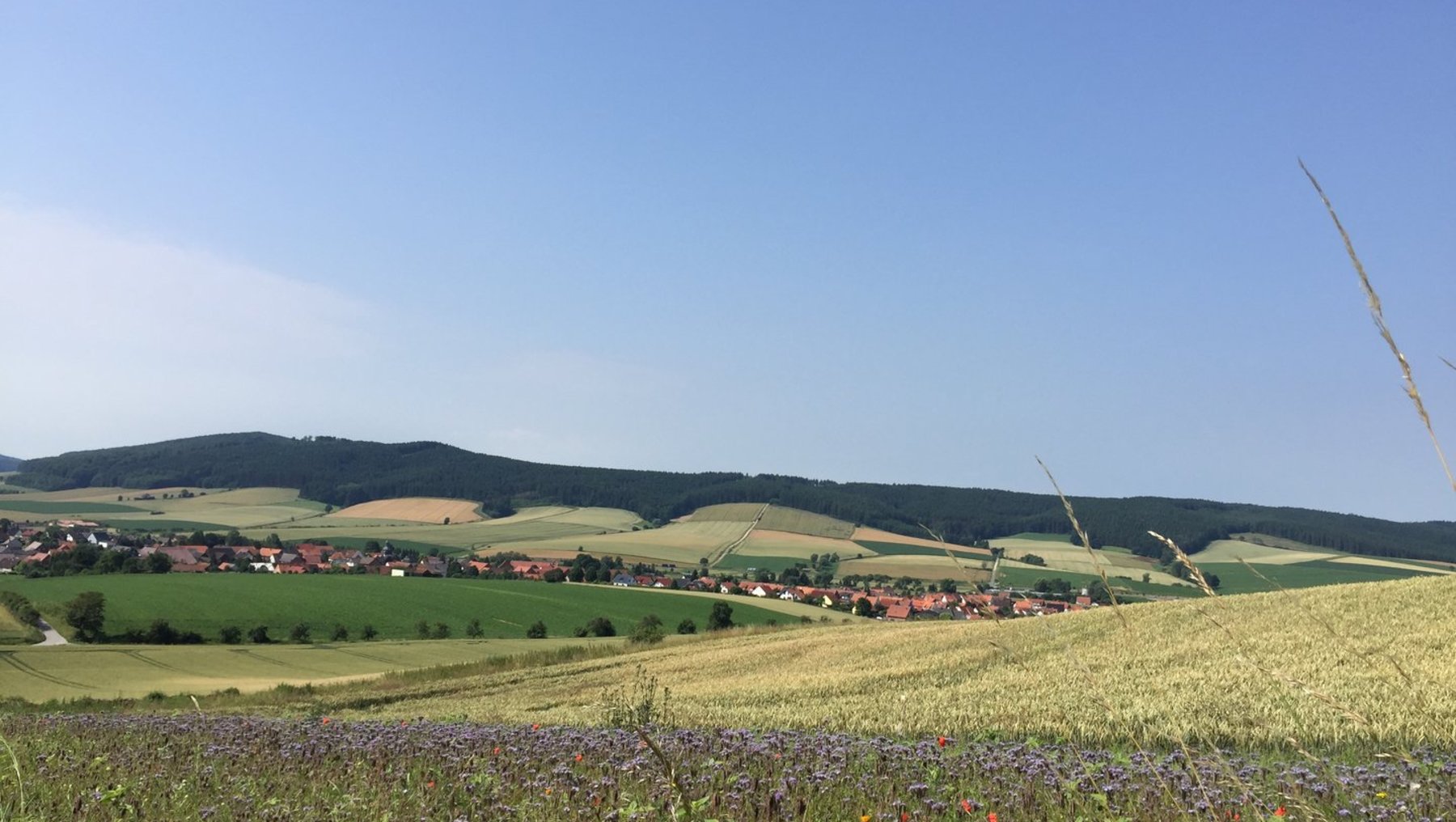
How can biodiversity and economically sustainable Agriculture be reconciled? A recent study involving Anhalt University of Applied Sciences shows that both wildflower strips and organic farming promote biodiversity on agricultural land. Both measures increased biodiversity by 20 to 30 percent compared to conventionally farmed wheat fields. Economically, the organically farmed fields performed well under the conditions studied. The results were published in the Journal of Applied Ecology and provide important insights for the AgriRestore project at Anhalt University of Applied Sciences, which is funded by the German Research Foundation (DFG).
Over a two-year period, the research team studied winter wheat fields in nine landscapes around Göttingen. They compared conventional fields with and without flower strips to organically farmed fields. The findings showed that organic farming supported the greatest number of wild plant species, while flower strips were visited by three times as many bee species as the organically farmed fields. The composition of the species communities also differed significantly. “Organic farming and flower strips are therefore not an either/or choice. They sometimes support different species and can complement each other effectively in preserving biodiversity,” explains Dr. Peter Batáry, lead author of the study and research associate at Anhalt University of Applied Sciences.
The researchers found the economic results particularly interesting. Although the organically farmed fields yielded about 50 percent less wheat, their profits were more than 150 percent higher than those of the conventional control fields. Reasons for this included good marketing opportunities and EU subsidies. Flower strips also proved to be economically competitive when the corresponding subsidies were taken into account. “The results show that measures to promote biodiversity do not necessarily have to be associated with economic disadvantages,” emphasizes Batáry. “For sustainable Agriculture, we must consider both aspects together: the ecological impact and economic viability.”
For researchers at Anhalt University of Applied Sciences, these findings are relevant even beyond the scope of the current study. “The results provide us with a very good foundation for further field research in our AgriRestore project,” explains co-author Prof. Dr. Christina Fischer. The professor of faunistics and species conservation at Anhalt University of Applied Sciences is working with a research team to investigate how biodiversity in intensively farmed agricultural landscapes in Saxony-Anhalt can be restored and preserved in the long term. The study provides important insights in this regard.
Contact:
Prof. Dr. Christina Fischer
Anhalt
University of Applied Sciences Department of Agriculture, Ecotrophology and Landscape
Development Christina.Fischer@hs-anhalt.de
Tel.: +49 (0) 3471 355 1197
