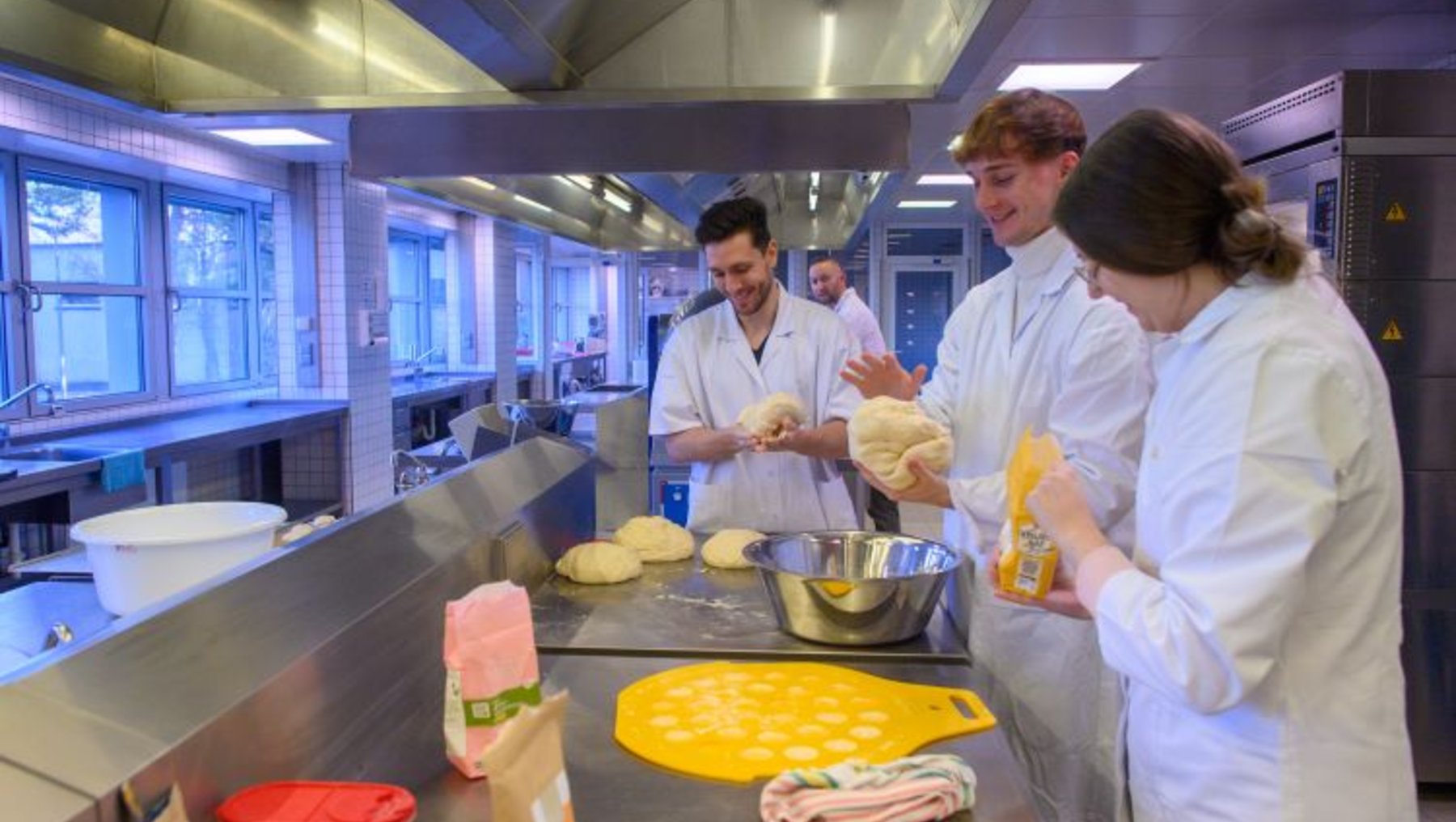
Researching, exploring, developing a product further - the project work of Hannah Raudszus, Finn Spielmann and Timon Strauch shows how this can be achieved. The students on the master's degree program in Ecotrophology at Anhalt University of Applied Sciences have upgraded the nutritional value of a conventional wheat roll. They used the "Methodological Competence" module in the third semester to carry out an exploratory study on the use of legume flours in wheat rolls in the laboratory and in the oven.
Bread rolls with added value
-
 © Klaus-Dietmar Gabbert
 © Klaus-Dietmar Gabbert
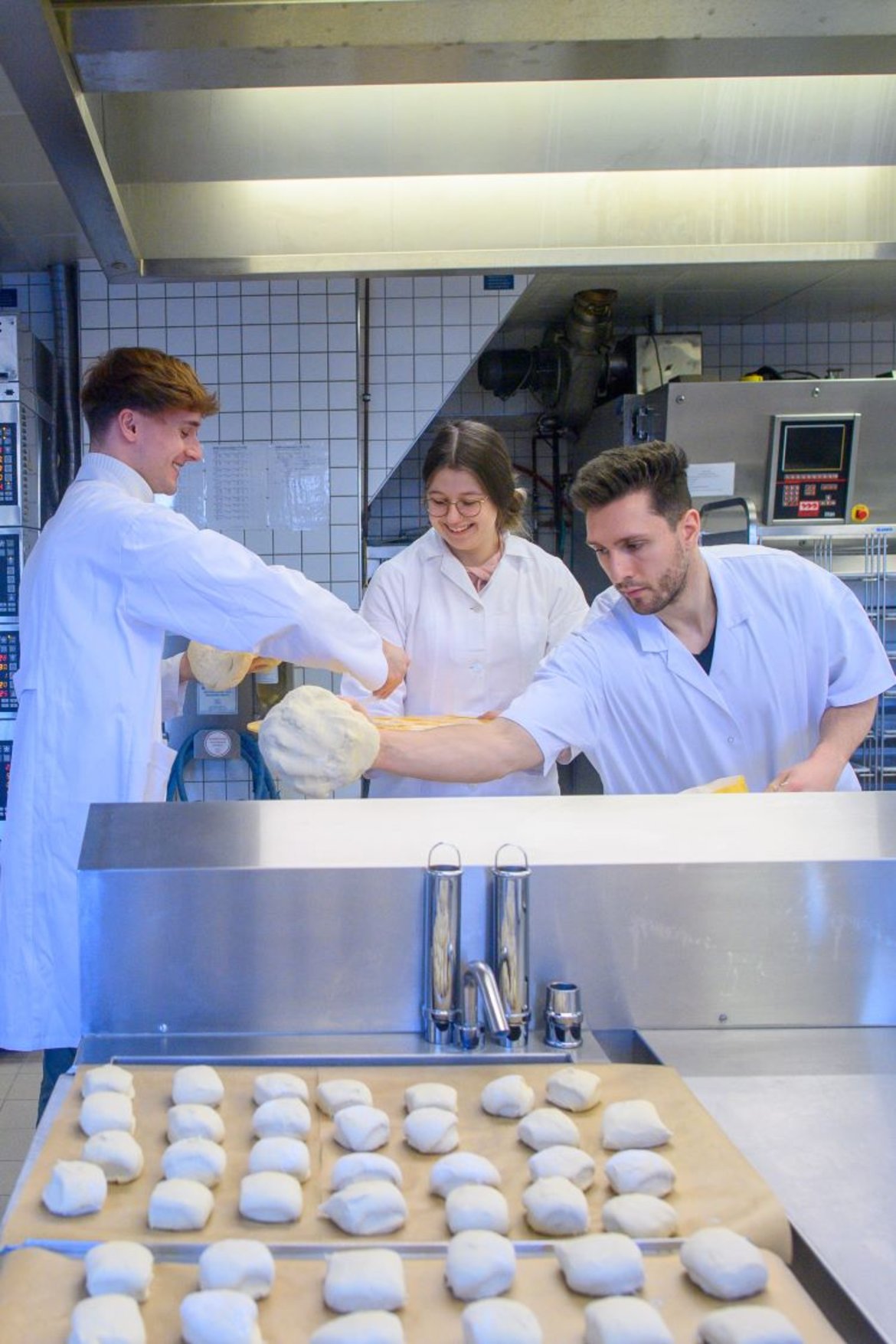
Can a wheat roll improve its nutritional value? It can - and without compromising on taste or sensory properties! Hannah Raudszus, Finn Spielmann and Timon Strauch have provided the proof. They baked hundreds of rolls for their project work and let their fellow students at the Department of Agriculture, Ecotrophology and Landscape Development taste and vote. "It was a cool project, we really developed something new," says Finn. "We wanted this strong practical relevance, were able to redesign a real product and were given all the freedom we needed to do so," adds Timon. Hannah also has fond memories of the experiments with the bread roll dough, although there were also stressful phases to get through. "It was a miserable amount of calculating until the recipe was right," she says. "I also think it's good that we dealt with a socially relevant topic, because healthy or even meat-free eating is now important to many people. And the fact that we worked together harmoniously as a group was also a good experience."
Flour made from peas or field beans
The study was based on a wheat roll recipe with one hundred parts flour, fifty parts water, two percent salt and fresh yeast. The three students varied this recipe and replaced the percentage of wheat flour with ten, twenty or thirty percent legume flour. Legumi...what? Legumes are pulses. Plants that have long received little attention in Germany. The plant family from the butterfly family is mainly used as animal feed and as fertilizer for Agriculture, because legumes are one of the few plants in the world that can collect nitrogen from the air and make it available in the soil as a natural fertilizer. Hannah, Finn and Timon knew from Professor Dr. Karsten Paditz's classes that peas, beans and lentils can do more than that. The university lecturer is enthusiastic about the many possible uses of legumes, as they contain a lot of protein and are rich in fiber. He inspired and motivated the Master's students to try out the use of pulses in a well-known product.
Will the rolls be too yellow or too gray?
 © Klaus-Dietmar Gabbert
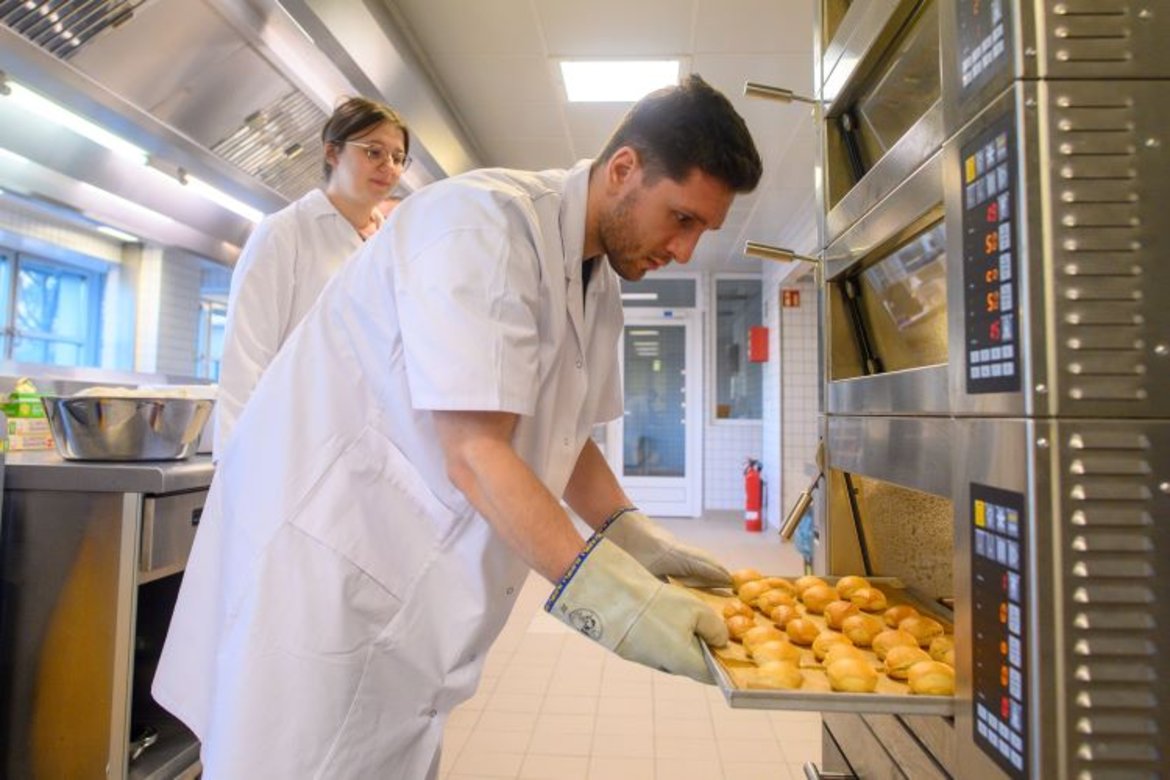
Hannah, Finn and Timon chose a standard wheat roll for their analysis. They asked themselves basic questions: How does a bread roll taste that is baked with more or less field bean flour? Is it fluffy and fresh? Do we get a crispy roll with a good crust? Does a roll with a proportion of pea flour look good or does it turn too yellow? Will a roll made from field bean flour be too gray, perhaps even too dark? Will we be able to expand the product?
In order to answer these questions, they had to read up intensively, as none of the group had any specialist knowledge of the bakery trade. They then tested countless times in the test lab and experienced some frustrating hours per week per semester. It took longer than expected for the dough to meet their requirements. They struggled with the fact that pulses absorb a lot of water and legume flour has its own unique swelling properties: "We had to constantly fine-tune and work on the recipe. This required many baking trials and cost us a lot of nerves," say the students.
"All bread roll variants found their fans"
When, after many failures, they had finally produced presentable bread rolls, the bread roll tasting could begin. It was a good feeling just to smell the aroma while baking. They also set new accents in terms of taste. Was there a top bun? "There wasn't actually a clear winner, all the variations had their fans," Hannah remembers. "The ten percent pea flour roll came closest to the typical bakery roll in terms of appearance," says Finn. "That was also the version that Anhalt University of Applied Sciences presented to the general public at the Green Week, where it was well received," adds Timon.
The Master's students are now gaining work experience and working on their theses. Finn Spielmann has remained loyal to baked goods and is taking the opportunity to gain work experience in quality assurance at a large industrial bakery in Frankfurt am Main. In addition to his Master's thesis, Timon Strauch is currently working in quality management at a B2B food supplier in Hamburg, where he is responsible for the international distribution of nuts, and Hannah Raudszus is expanding her knowledge at a company in the Altmark region that specializes in marketing freeze-dried fruit in the B2B sector.
I think it's good that we are dealing with a socially relevant topic, because healthy or even meat-free eating is now important to many people.
Hannah Raudszus
