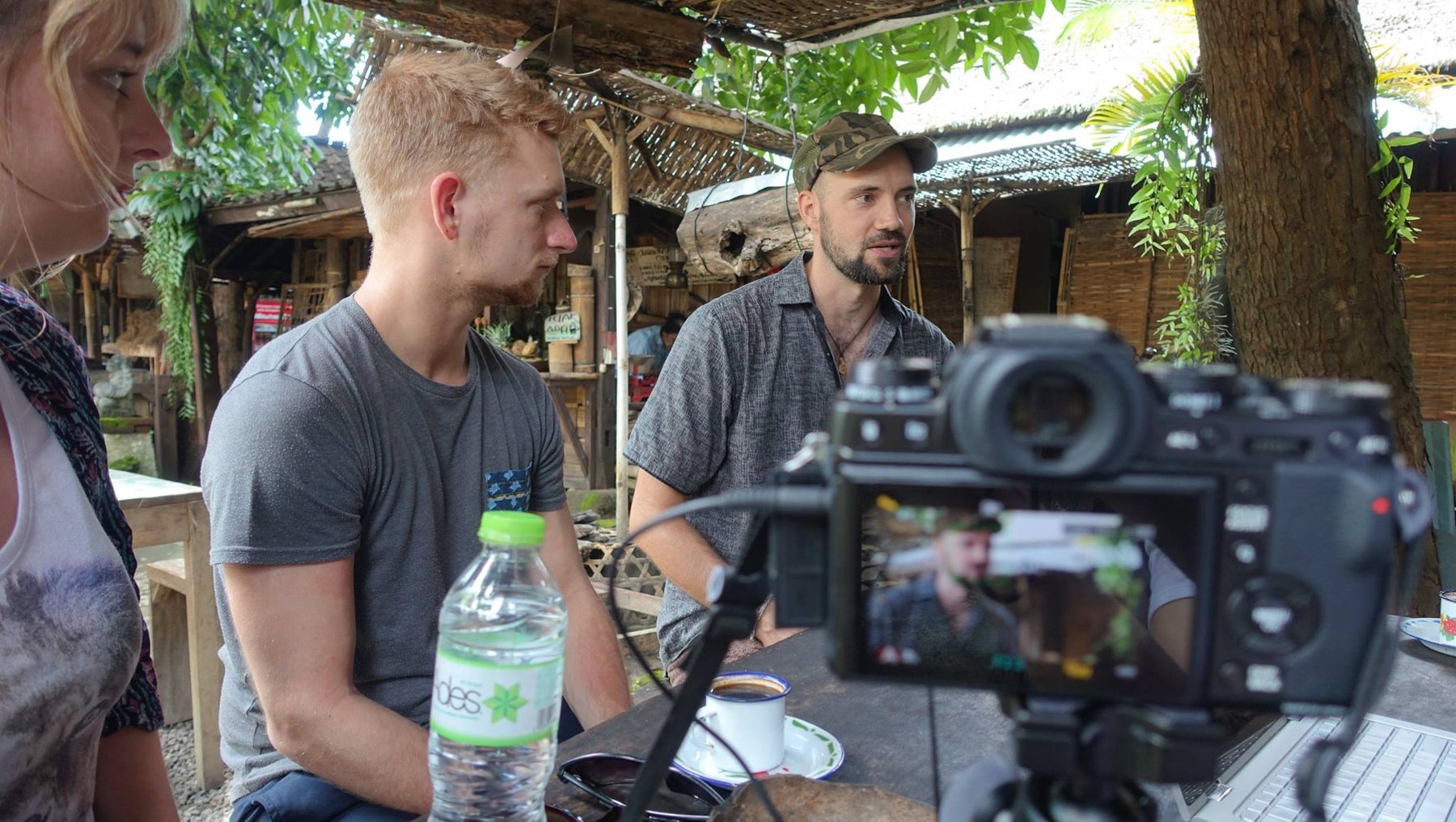
In February, 12 students from Anhalt University of Applied Sciences took off for Indonesia. Bali was on the agenda! But not to escape the German winter. During the week-long excursion, the young people took a look at the future of the digital working world and visited digital nomads. They wanted to find out whether modern working life could be a pioneer for the work of the future. An interesting question for the Master's students on the Online Communications degree program - who everyone just calls MOKs. What can we learn from digital workers?
Bali has become one of the most popular work locations for digital nomads in recent years. On the small island in the Indian Ocean, employees and freelancers who work from home and are location-independent find an intensive work-life balance. The cost of living is low, the feel-good factor in the sun is high - and the most important thing: there is fast and reliable internet in the co-working spaces, but also on every corner, in every café or restaurant.
>> Click here for the YouTube video.
In various interviews, the MOKs were to gain an impression of the everyday working life of digital nomads, according to the plan of Professor Send, head of the Master's program. They learned that working remotely with a few project management tools and adjusting working hours to the time zone works quite easily. "What we learn here is how to work autonomously," says Dirk Franke, who was born in Magdeburg and has been a digital nomad since 2009. He talks about his day-to-day work and his learning experiences. Franke counts "project planning and project management" among the core skills of digital nomads. Because even if you are not employed as a project manager, you learn to work proactively on problems. The transition to the digital working day is always a challenge. In the office from eight to five? Lunch break together in the canteen? The colleague sitting at the neighboring desk? There are no such structures in this world of work. But the students also encounter a fixed working day here.
In the cities of Ubud and Canggu, they visited the co-working spaces "Hubud" and "Dojo". The two cities are particularly popular with digital nomads in Bali. Co-working spaces are set up like cafés and equipped with large wooden tables, electricity and high-speed internet. Some people work barefoot, in T-shirts and shorts. Here, laptop follows laptop - the workstations are rented by the hour. A bamboo roof provides shade, with a view of rice fields in front of them. Linda Koinzer, one of the students from the research group, is amazed at the concentrated atmosphere. "Even though you might not expect it, a lot of work really does get done in the various co-working spaces." And not just alone. Koinzer noticed many conversations in the cafés. "But they are always of a professional nature too." The co-working spaces are both office and living room for the nomads. "The community there makes an important contribution to the quality of life in Bali." Overall, the quality of life in Bali is very good. Because although people here work just as much, or even more, than in a "normal" job, they are happier. The nomads made a highly motivated impression on student Linda Koinzer: "People don't work less here in Bali, they usually work more because they are motivated." A harmonious work-life balance ensures greater satisfaction. Dirk Franke, the nomad from Magdeburg, confirms this: "I earn less in Bali. But my quality of life is still better. I can organize my working hours independently and have more of my money due to the low cost of living."
"Independent time management, a good work-life balance and autonomous working," is what Master's student Nathalie Malke takes home with her as the core content of the digital working life of nomads in Bali. Requirements for a working world that the student and her fellow students would also welcome. And which they see being fulfilled more and more in the coming years as digitalization progresses. Like his fellow students, Erich Etzel sees a strong trend towards more flexibility in everyday working life in the future: "A strong increase in the digitalization of the working world will ensure that location independence and flexible working hours will gradually become the norm." Stefan Stumpp, who led the excursion together with Professor Hendrik Send, also draws his own personal conclusions from the trip. He sees the organizational skills of nomads as essential for good work: "I am fascinated by the realization of how important the right self-management approaches are. Although the new digital platforms provide the basis for remote working, our interviewees first had to develop suitable processes and structures."
Working life requirements that students also have in mind for their professional lives. Their study profile could enable them to do so. In the online world, they will be well versed in communications, marketing strategies and various types of digital content after graduation. And in their future careers, they will certainly often think back to their research excursion. Because then it will be up to them to work proactively, gather information and make and communicate decisions. "We can learn from the digital nomads for precisely this way of working," says Professor Send, summarizing the work requirements of the future. The location is secondary. Students could also work under palm trees. They have the option of setting up their workplace anywhere in the world.
Information on the degree program
Contact:
Prof. Dr. Hendrik Send
