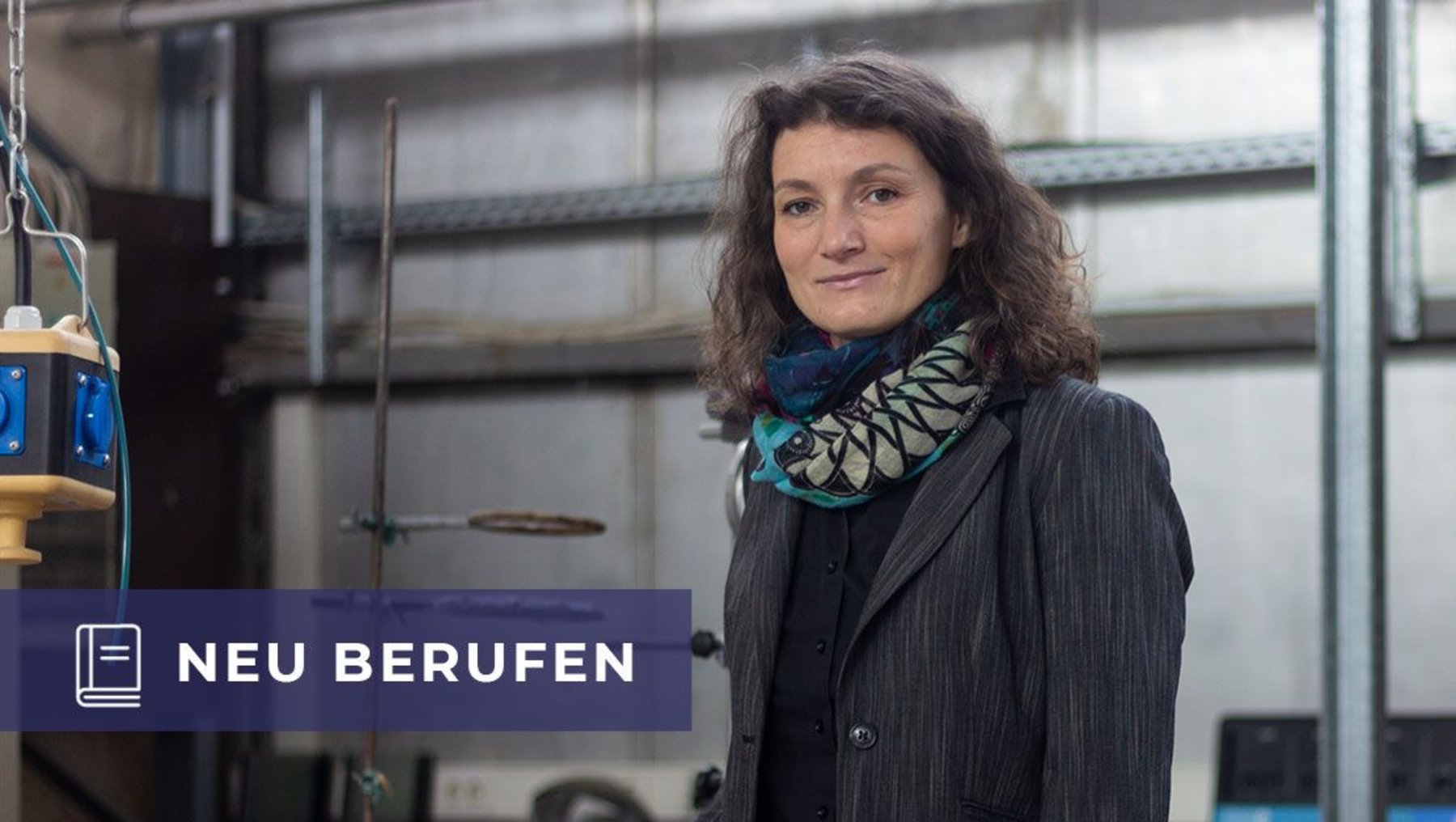
At the beginning of September 2020, Dr. Claudia Grewe was welcomed to the Department of Applied Biosciences and Process Engineering in Köthen. In this interview, she gives an overview of the content of her teaching and research and an insight into her career.
Professor Grewe, welcome to Anhalt University of Applied Sciences.
With your appointment to Köthen, you are returning to your old place of study. What positive experiences from your own time as a student would you like to pass on to your students? Essential parts of the sound engineering education, coupled with industrial application aspects. I also want to promote the ability to think and then act in a problem-solving manner.
What important events followed your studies in Köthen?
In 2002, I completed my studies in Biotechnology with a focus on Biotechnical Processes/Pharmaceutical Engineering in Köthen with an engineering degree. I then completed my doctorate as part of a cooperative doctoral project with Martin Luther University Halle-Wittenberg on the applied production of valuable materials from microalgae with a focus on biotechnological process development and optimization. Since 2007, I have been working as Head of Research and Development at Salata AG, which produces microalgae and cyanobacteria on an industrial scale. Here I was responsible for product development, production management and quality management.
You have now been appointed Professor of Bioprocess Engineering in the Department of Applied Biosciences and Process Engineering. What will be your responsibilities?
My tasks include teaching in the specialist areas of bioprocess engineering, processing technology and bioapparatus engineering. I see it as my task to design all traditional forms of teaching in a varied and challenging way in order to ensure the highest possible learning success for the students. In addition to the practical preparation of the material to be taught, the focus should also be on providing guidance for time spent independently studying and implementing new teaching methods.
What goals are you pursuing in addition to teaching?
I see another very important task in third-party funded research in the field of applied Biotechnology. By implementing projects that are as interdisciplinary as possible, I want to offer students up-to-date teaching that reflects their future professional field. They should learn and implement a variety of modern methods using practical examples. At the same time, small and medium-sized companies in the region, as well as national and international companies, could be encouraged to cooperate with the university.
In this way, the students should benefit from their education, the university from its visibility and reputation and the industry from the provision of skilled workers and knowledge-based process and product generation. I would also like to address the topic of in-service training - the keyword here is "lifelong learning". Here too, both the university and the learners can contribute to each other's profile in the respective specialist areas.
What research projects are you currently working on to enrich the university?
I am currently working on a project funded by the Federal Ministry of Education and Research in cooperation with Professor Carola Griehl 's working group and Salata AG. The main aim is to expand the microalgae-based, functional product range. Anhalt University of Applied Sciences has outstanding expertise in this area, which I would like to use to acquire new algae research projects. In my opinion, industry and academia can be even more closely interlinked.
Do you already have specific projects in mind?
Specifically, we are planning projects that will make new strains of algae, as well as species that are already commercially produced today, usable as holistically as possible in the breadth of their possible applications in the areas of food, food supplements, animal feed, cosmetics, medical products and pharmaceuticals. Bioprocess development plays a central role in this. I am very much looking forward to working with my colleagues in the department, but also beyond that at Anhalt University of Applied Sciences, in this extremely exciting field and in this way being able to generate a unique selling point for the department and the university in the national competition for funding.
How can students benefit from this?
Students benefit in every conceivable way: on the one hand through the topicality of the research topics that flow directly into teaching. On the other hand, through networking with Economics, which offers attractive job opportunities in times of skills shortages. By maximizing the number of projects, students can choose a field of work according to their own interests. Finally, I hope that giving students the opportunity to work on current research projects will give them a motivation boost during their studies that goes beyond individual modules.
With the start of the 2020 winter semester, the university has returned to teaching that combines face-to-face and online courses. Do you see any particular challenges?
I am pleased about the return to face-to-face teaching. Both lectures and seminars are being prepared by me and my staff in face-to-face and online formats in order to be able to react flexibly to current developments in the pandemic. The laboratory practicals are an exception here, as their didactic goal - learning practical skills - can only be achieved through physical presence. We already have experience with block courses here, so we are very well prepared for the semester.
Where do you live now when you are not at the university in Köthen?
I moved with my family from Brandenburg to Porst, a district of Köthen, in August and already feel very much at home here in my old home. In addition to my job, I find balance in working with horses and equestrian sports. I also play the piano, a hobby that I would like to continue in the Bach city.
Professor Grewe, thank you very much for the interview.
Dr. Claudia Grewe - new to bioprocess engineering
-
 © Andreas Bindseil
