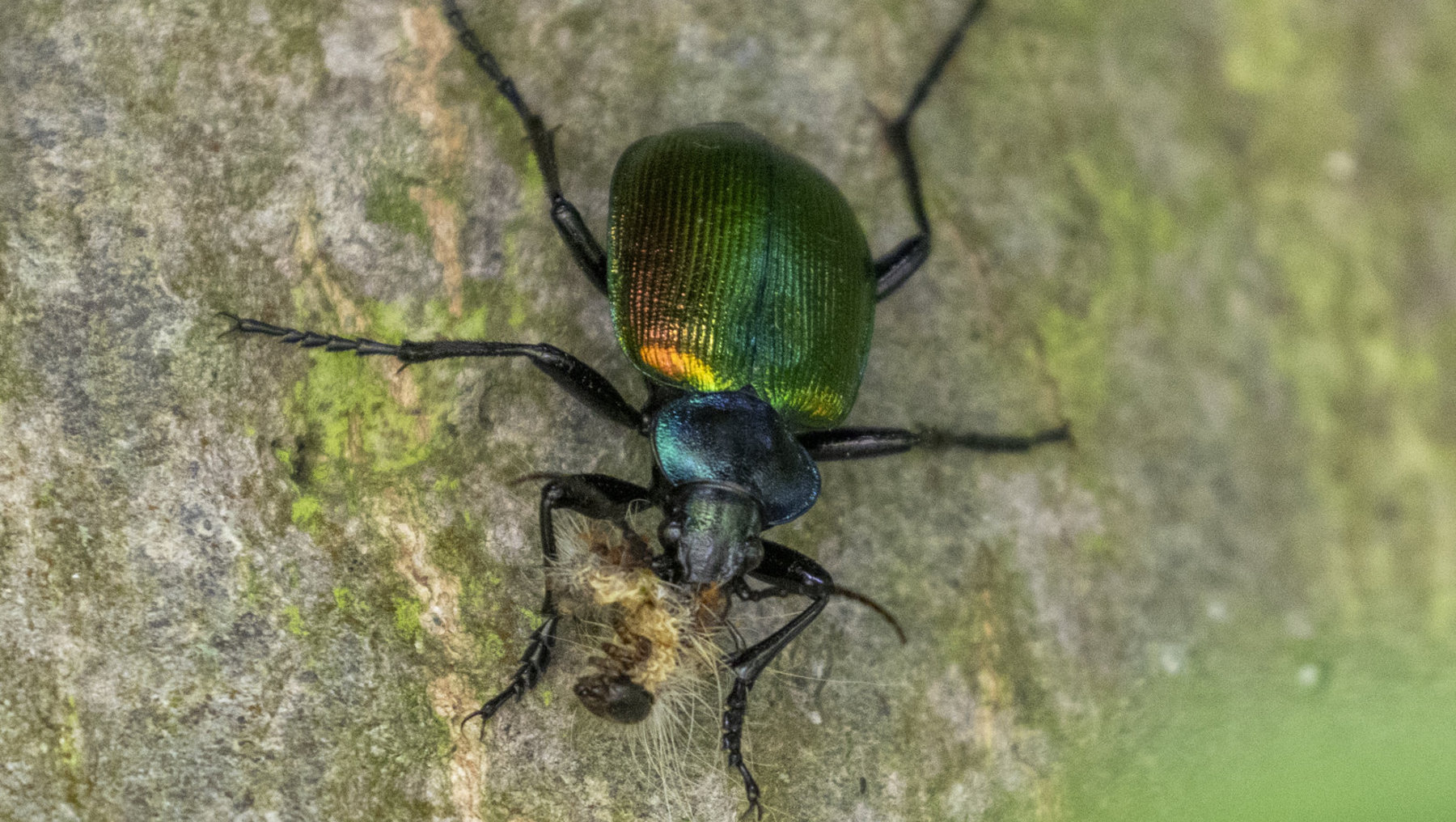
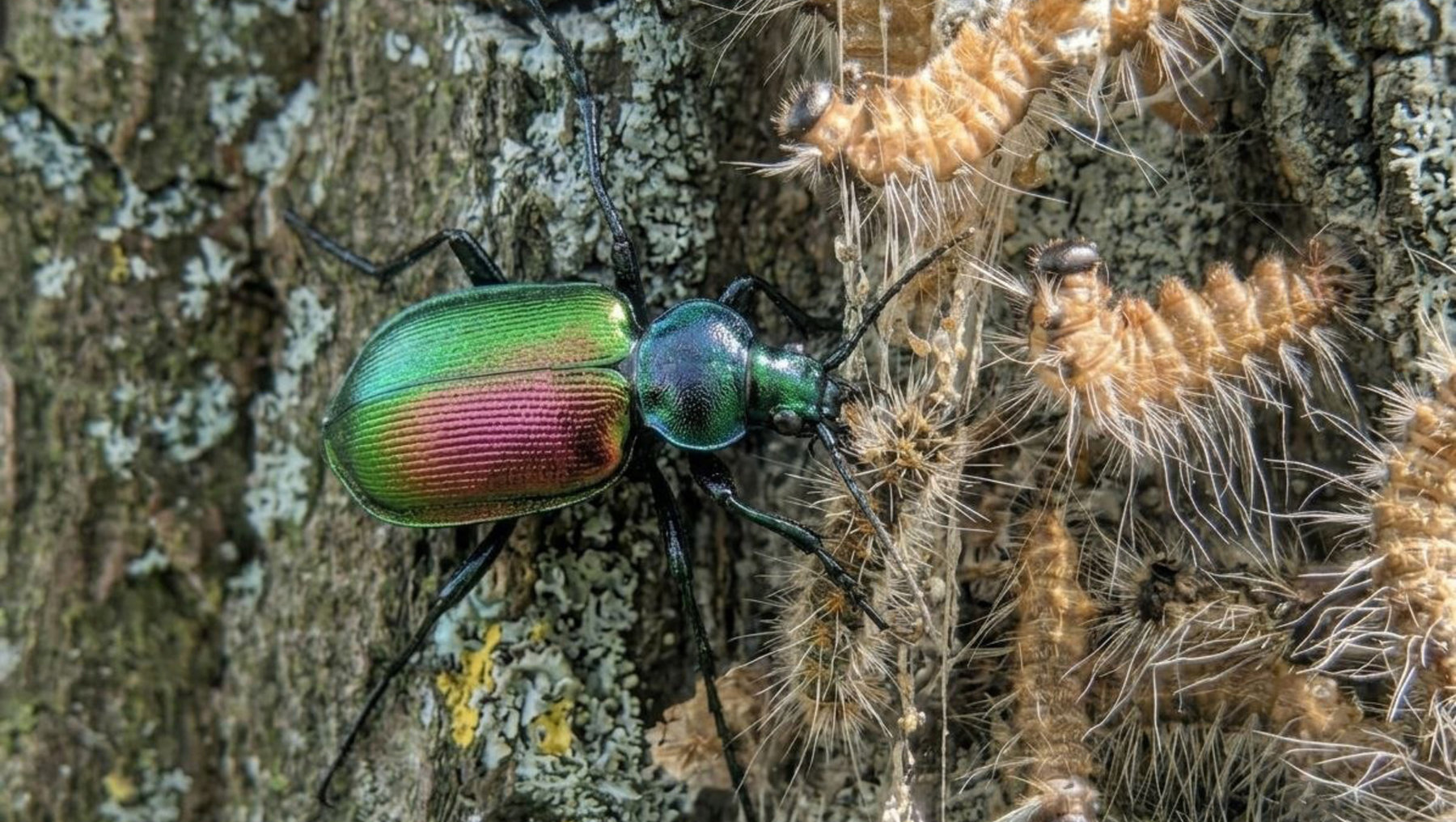
As part of a research project, female scientists and students at Anhalt University of Applied Sciences have identified a significant natural predator of the oak processionary moth (Thaumetopoea processionea): the great pupa predator (Calosoma sycophanta). Specimens of this striking ground beetle were found both in the Drömling region and in the Dessau-Roßlau area. This is a particularly significant discovery for Saxony-Anhalt, as the species had been considered extinct or missing since the 1960s.
“This rediscovery is a minor sensation. The beetle was last sighted here in Saxony-Anhalt in the 1960s. It likely migrated from Brandenburg due to the now abundant food supply there. We hope that it will establish itself permanently here and be able to rebuild stable populations,” says Dr. Peer Hajo Schnitter of the Saxony-Anhalt State Office for Environmental Protection.
The Great Pupa Predator feeds primarily on the caterpillars and pupae of the oak processionary moth, thereby contributing to the natural regulation of its population. The fact that the beetles have now been found in regions that have been severely affected by the oak processionary moth for years underscores their ecological importance.
Health Risks to Humans Increasingly in the Spotlight
The oak processionary moth is a native species of moth whose caterpillars develop stinging hairs starting in the third larval stage. If these hairs come into contact with human skin or mucous membranes, they can trigger allergic reactions. Due to the sharp increase in the moth’s population over the past few decades, the associated health risks are currently a frequent focus of media and public attention. To minimize the impact on human health, the species is frequently controlled in residential areas and other areas with high human traffic. Caterpillar nests are vacuumed off oak trees, or appropriate biocides are sprayed from the ground or from the air.
Understanding and Promoting Natural Predators
Since 2021, Anhalt University of Applied Sciences has been investigating sustainable strategies for managing the oak processionary moth in several research projects. The focus is on preventive measures to promote natural enemies. “Climate change and biodiversity loss resulting from intensive land use could be contributing factors to the increased spread of the heat-loving oak processionary moth,” explains project leader Prof. Dr. Annett Baasch of Anhalt University of Applied Sciences. For example, the research is examining the influence of caterpillar-eating breeding birds in nest boxes, as well as the presence of other insect predators. The large chrysalis predator is one of the oak processionary moth’s natural enemies and can help control its population. “By better understanding and promoting the oak processionary moth’s natural enemies, we strengthen natural regulatory mechanisms and lay the foundation for sustainable, biodiversity-friendly management strategies.”
The fact that the Great Pupa Predator has now been found in both of the project’s study regions is very positive news for the ecological balance. Because of its size and striking, metallic-gold shell, the Great Pupa Predator is easy to spot—a real eye-catcher. It is a good flyer and known for being able to travel long distances in search of food sources. Its name reveals its preferred food: butterfly caterpillars and pupae. While even the Great Pupa Predator cannot stop mass outbreaks of the oak processionary moth, it is an essential component in the complex network of relationships and regulatory mechanisms.
The research project “Studies and Knowledge Transfer on the Sustainable Management of the Oak Processionary Moth in Peri-urban and Rural Areas,” funded by the state of Saxony-Anhalt, will run until the end of 2026. The project partners are the Drömling Biosphere Reserve, together with the Drömling municipalities, and the Lower Nature Conservation Authority of the City of Dessau-Roßlau.
