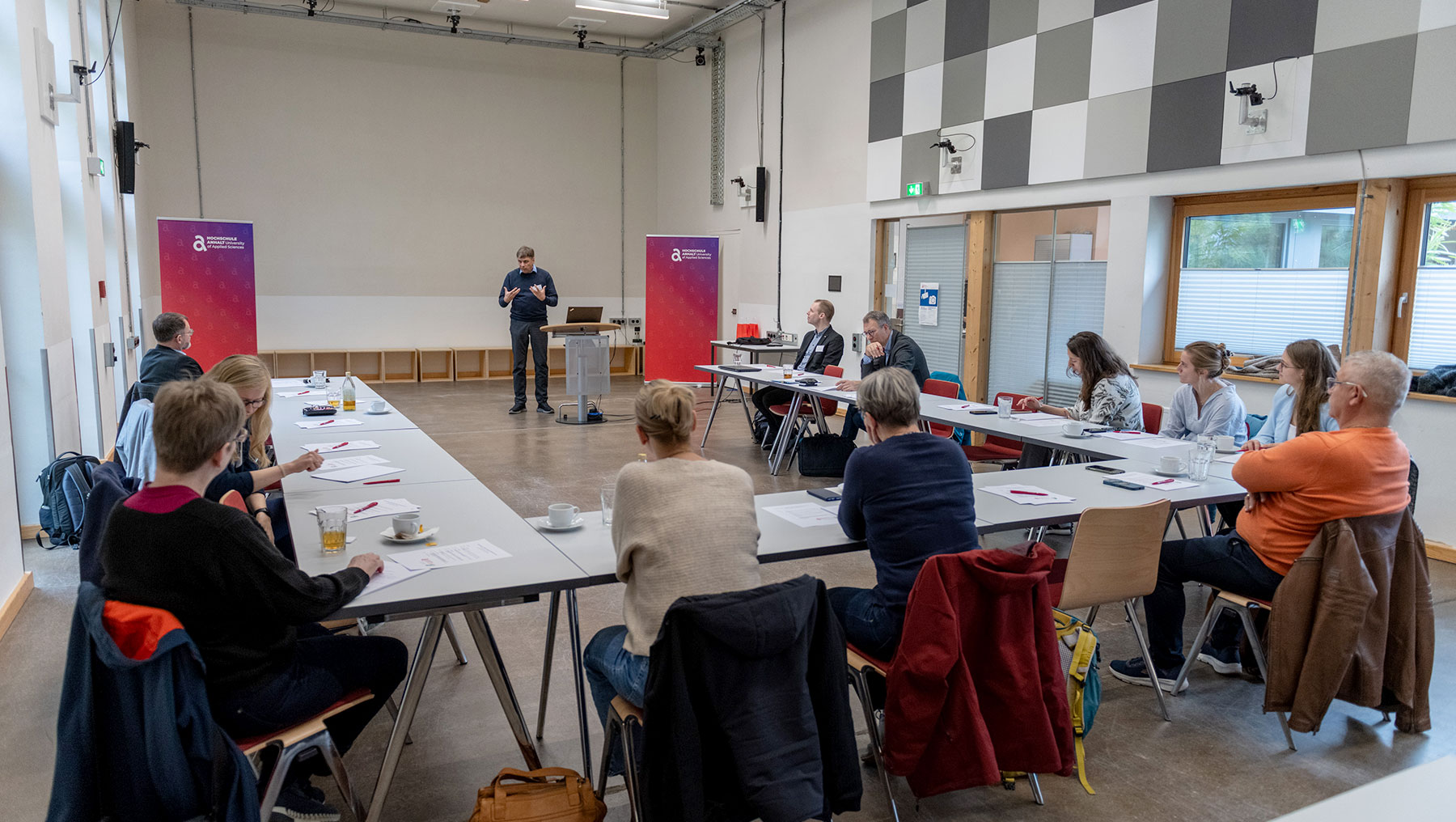
Safe food requires more than just clean hands and germ-free production lines. That is why Anhalt University of Applied Sciences, in collaboration with the Professor Hellriegel Institute, hosted the first Bernburg Food Safety FORUM on October 29, 2026, on the Campus Bernburg. The symposium is aimed at specialists and executives in the food industry—particularly those in quality assurance and quality management—as well as food safety regulators and researchers.
This new event series is intended to complement the continuing education courses on food hygiene and microbiology offered annually in the spring by Anhalt University of Applied Sciences’ Laboratory for Hygiene Research, which have long been a staple of the Central German food industry. After all, food hygiene is important, but it is by no means the only factor companies must consider to ensure their products are truly safe. “Even beyond microbiology, the challenges facing food safety have been growing steadily for years,” says Prof. Dr. Christoph Wiedmer, professor of food science at Anhalt University of Applied Sciences and initiator of the conference. “To ensure that specialists and executives in the food industry can stay up to date in all areas of food safety, our Department, together with the Professor Hellriegel Institute, has launched the Bernburg Food Safety FORUM.”
The conference focuses on current issues and new scientific and technical developments in the field of food safety, as well as new regulatory requirements. During the opening session, five speakers from academia, food inspection agencies, and Economics provided practical insights into a broad spectrum of topics currently of concern to authorities and companies. Dr. Jörg Rau from the Stuttgart Chemical and Veterinary Testing Office kicked off the event by describing the potential dangers of contamination intentionally caused by food terrorism and outlining ways companies can prevent it. Another presentation by Dr. Holger Sieg of the Federal Institute for Risk Assessment addressed microplastics as a challenge in consumer health protection and the associated challenges in analysis and assessment. Under the title “Quality Management Reimagined,” Dr. Peter Wendt of LMS—Private Institute for Food Management and Service GmbH—then addressed the question of how the use of AI agent systems can transform this field. Prof. Dr. Christoph Wiedmer of Anhalt University of Applied Sciences then described how foods containing hemp and CBD operate at the intersection of narcotics, pharmaceutical, and food laws, and presented new developments regarding the legal and toxicological assessment of these products. The session concluded with a presentation by Eckard Bösch, Bavarian Control Authority for Food Safety and Veterinary Affairs (KBLV), in which he used case studies from the dairy industry to illustrate that food safety risks can lurk throughout the entire value chain.
Between the presentations, participants from the business sector, food safety authorities, and management consulting firms also had ample opportunity for lively discussions, the exchange of experiences, and networking.
A continuation of the event series is already planned: The 2nd Bernburg Food Safety FORUM will take place on September 30, 2027.
More information: www.hs-anhalt.de/bfl
