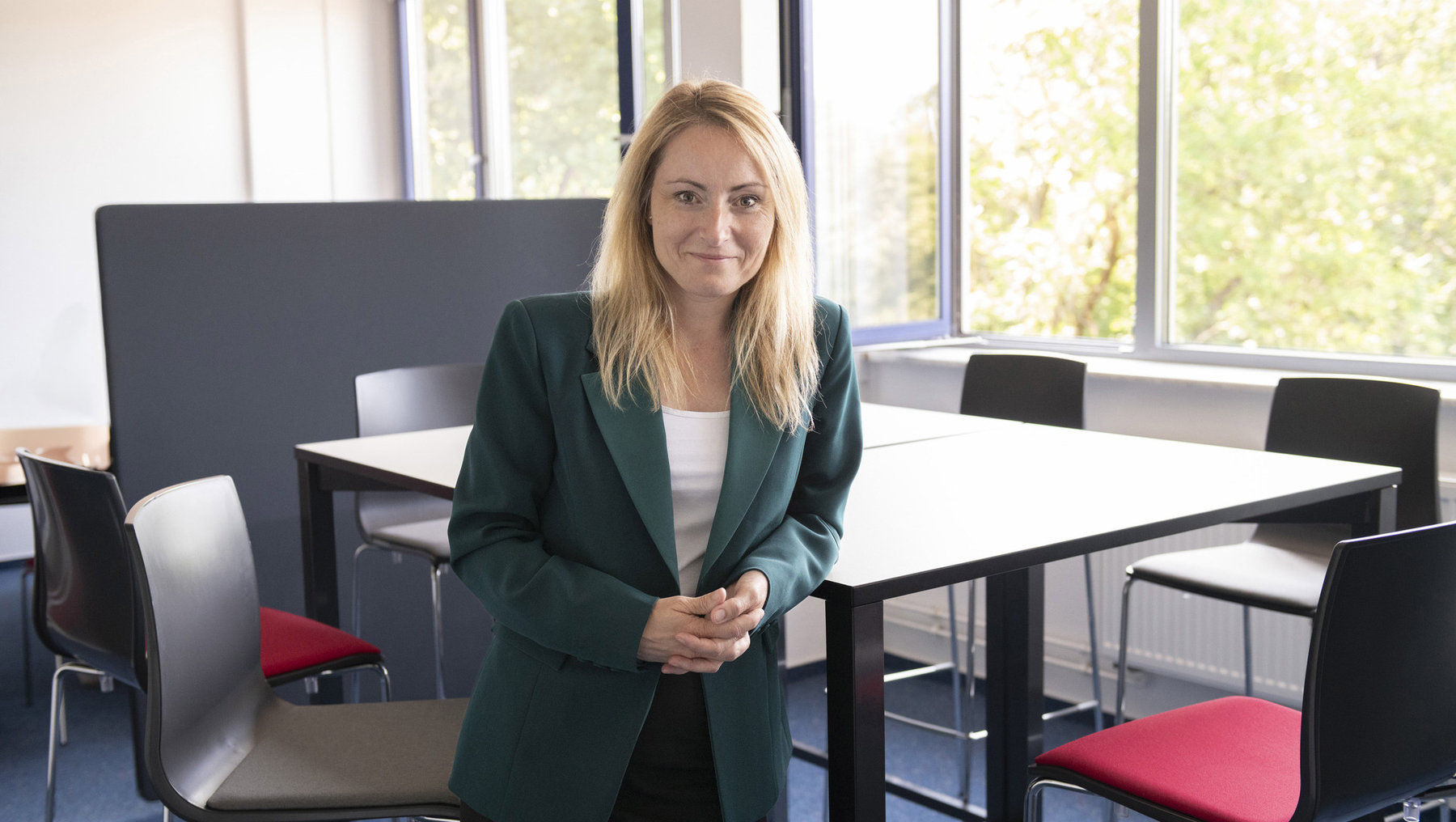
Prof. Dr. Christiane Naumann is Professor of Entrepreneurship and Business Management at Anhalt University of Applied Sciences. In this interview, she talks about international educational projects, working with founders - and why uncertainty can be a good starting point.
Prof. Dr. Naumann, you have been at Anhalt University of Applied Sciences for a year now. How did you get into teaching?
I worked in Economics for many years, initially at Siemens - in rail automation, in international project business and later in strategy development in Switzerland. At some point, I wanted to switch to the education sector. In 2016, I taught at Anhalt University of Applied Sciences for the first time, as part of an MBA module in Ghana on the subject of strategy. That was a great experience - practical, international and exactly my topic in terms of content. From then on, it was clear that I wanted to pursue this further.
What happened next?
I did my doctorate - at the Berlin University of the Arts, accompanied by a teaching position at the HTW Berlin in the fields of project management and innovation management. At the same time, I developed and supervised international education projects, including in Vietnam, China, Ghana and the Philippines - often involving university cooperation, further education and, most recently, securing skilled workers. This international involvement has always been important to me and also shapes my work at Anhalt University of Applied Sciences.
What do you teach at the university's Campus Bernburg?
I teach in the field of "Entrepreneurship and Business Creation" and supervise the bachelor's degree program in International Business (IBS). It's often about how to develop ideas, think about business models, implement innovations - and not lose heart in the process. In addition to teaching, I am also a Degree Program Advisor in IBS and accompany many international students. In this context in particular, I try to create a practical approach to setting up a company.
What does "practical" mean in concrete terms?
I work closely with the university's start-up center and actively involve it in the modules. The students develop their own ideas, conduct interviews with potential customers, develop prototypes and validate their concepts. The aim is not only theoretical understanding, but also the experience: I can really try this out. One group from the module even decided to pursue their idea further - that makes me very happy.