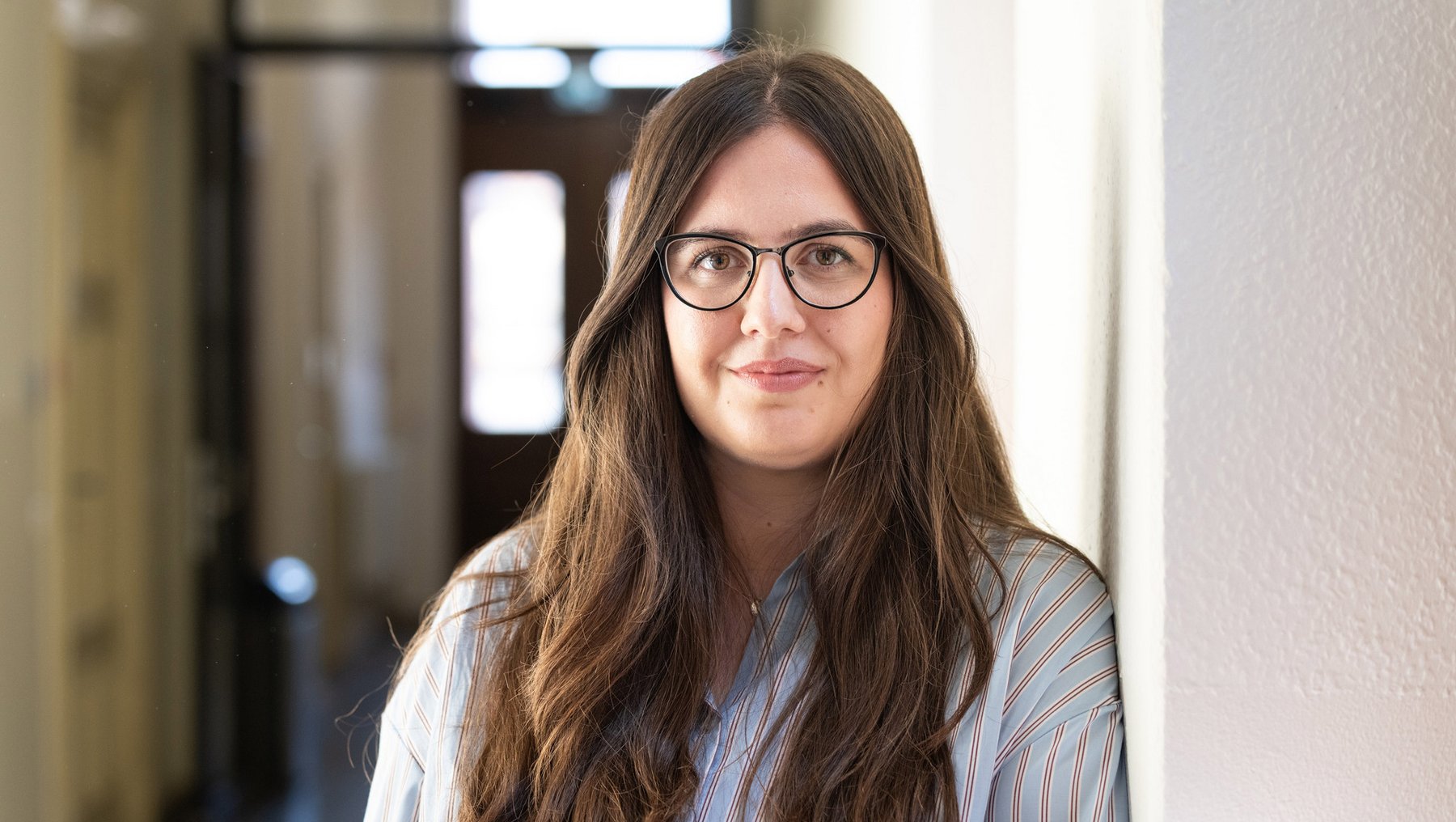
When Adea Paci came to Germany from Kosovo four years ago, the language of instruction she used in everyday life, the government agencies, the university, and she didn’t know a single person. Today, as a student in the International Business degree program at Anhalt University of Applied Sciences in Bernburg, she herself serves as a point of contact for anyone currently in that situation. For her very good course work and this commitment, she also received the university’s DAAD Award. We spoke with her about the surprise, her journey to Germany, and her next goals.
Were you surprised when you found out about the DAAD Prize?
Very much so! The news came just under two weeks ago. Professor Naumann sent me a message; I looked at my phone and just thought, “What? What is this?” I really couldn’t believe it. In that moment, the last four years flashed through my mind in fast forward. I thought: Then I really am on the right path, and all the detours in my life have been worth it.
In addition to very good course work, commitment is also a key factor for this award. Tell us a bit about what you do.
My involvement began four years ago when I came to Germany as an international student. Everything is new, you don’t know anyone, and you think: I’m the only one facing these challenges. Where do I go? Who do I ask? How do I make friends?” Later, I realized that others felt the same way. Together with my fellow students, I then thought about how we could help newcomers—with academic questions and administrative issues, but also with visas and the immigration office.
Why do you do this, even though your studies are already demanding?
Because what brings me the most joy is making life a little easier for new students at the beginning. I show them where to go in the city, which professor to contact, and how the university’s systems work. To this day, students write to me asking if I can help. I’m always happy to say yes. My friends say, “Why are you surprised? You already did this in Kosovo.” When you do something every day, you stop realizing that it’s not something to be taken for granted.
Does that have to do with your background?
I think so. There were a lot of older people in my neighborhood who didn’t have anyone. When an elderly lady came by with heavy grocery bags, we kids would immediately say, “Give me a bag—we’ll walk you home.” We also helped each other with homework in the neighborhood.
Was that part of a buddy program?
No, it just happened naturally. For example, if someone couldn’t set up their email or wanted to transfer credits from another college. I always remembered my own early days: a PDF here, a form there, plus all these documents. You’re faced with a mountain of work and have to tackle it all on your own. If someone’s situation was like mine, I could help. If not, I’d say, “I can help you up to this point; we’ll figure out the rest on the SSC portal or with older students.” The IBS community at the university is really strong. Students from every semester are involved, and you can always ask questions—whether it’s about semester-related topics, studying abroad, or finding housing.
In the second semester, Professor Naumann noticed that I often took the initiative myself and offered me the position as a student mentor. I was happy to accept. Welcoming first-semester students was a new experience for me, too—almost as if I were getting to know the campus all over again.
How did you end up at Anhalt University of Applied Sciences?
After graduating from high school in Kosovo, I wasn’t sure exactly what I wanted to study. I started with financial mathematics but realized it wasn’t the right path for me. Then the opportunity arose to study in Germany. My cousin explained the process to me and helped me find a university. I was born in Germany but grew up in Kosovo.
I researched where I could study and came across Anhalt University of Applied Sciences. From the website and the videos, I noticed: There really are a lot of international students here. That creates a bond—it’s an icebreaker—and you make friends faster. That’s exactly how it turned out. And the professors aren’t hierarchical. You can just ask them a question in the cafeteria. They go out of their way to help us build a community and network with one another.
What are your next goals?
First, I’ll finish my lab, which runs until mid-March. I’m doing it in German on purpose because I want to keep improving my language skills. After that, I’ll work on my bachelor’s thesis. I’m currently thinking about the topic. After that, I’d like to pursue a master’s degree—I’m not sure where yet. Ideally, I’d like to stay in Germany afterward if I find a good job. And I’d like to stay connected to the community, either as a volunteer or later as an alumna.
What does this award mean to you?
The prize comes with 1,000 euros, which helps me a lot as a student—for things like transportation costs and rent, for example. But the title means even more to me. The money will eventually be spent, but the title lasts forever. It has also boosted my self-confidence. I’ve realized that what I do is valued. That means a great deal to me.
