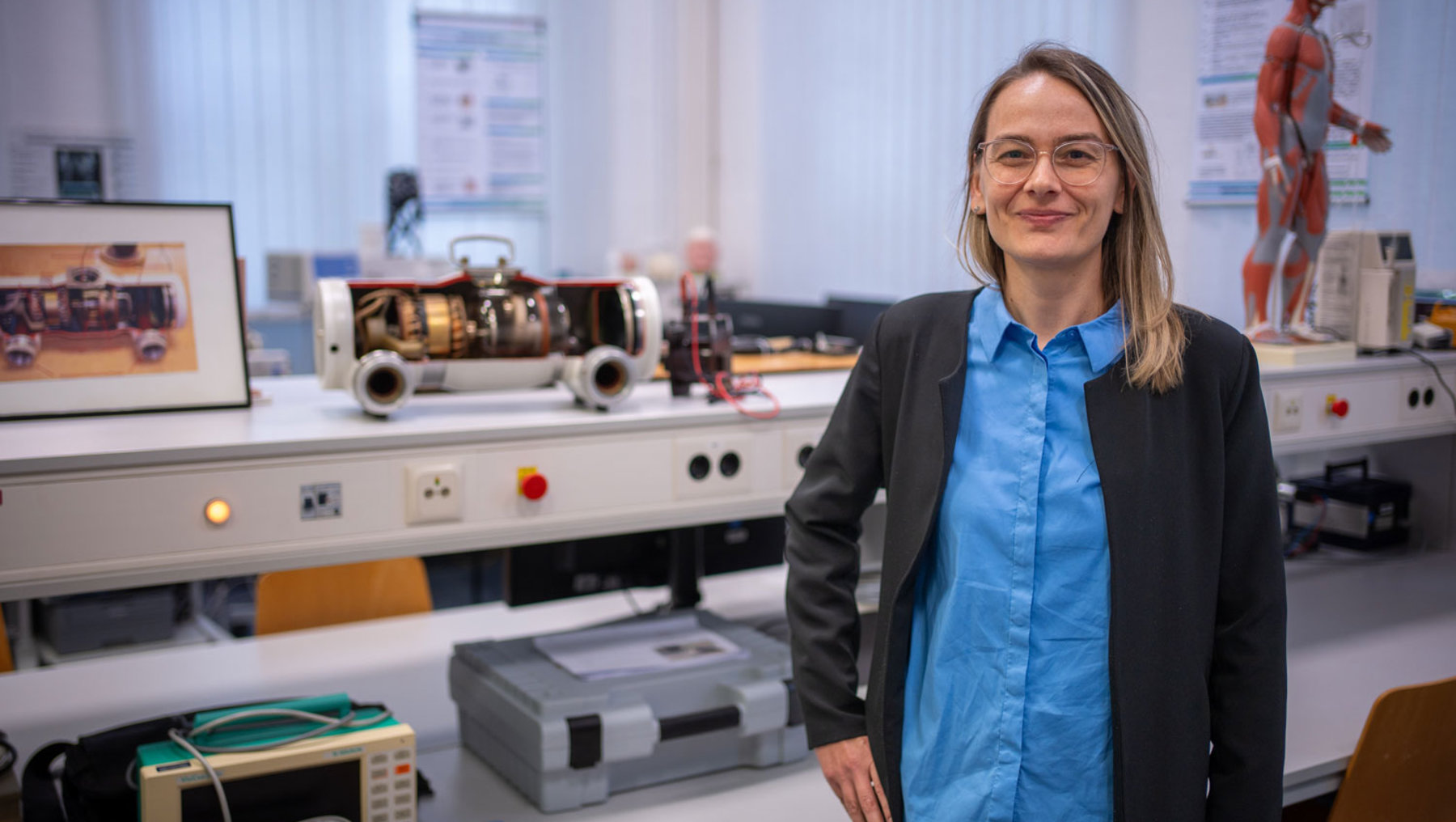
"The future is characterized by innovation and practical application," says Professor Marianne Maktabi about her subject area, "Biomedical Information Processing" at Anhalt University of Applied Sciences. In this interview, she talks about her first impressions of the campus, the challenges in teaching and her visions for the future of technology. She also reveals which subject poses a particular challenge in terms of keeping students interested and the methods she uses to do just that.
Professor Maktabi, you have been Professor of Biomedical Information Processing at Anhalt University of Applied Sciences since July 1, 2024. How were your first few weeks in Campus Köthen and how did you experience the campus and the students?
As I've already been working here as a deputy professor since April 2022, the official appointment wasn't a big change for me. So not much has changed, apart from the new formal responsibility. The students are still the focus of my work and it is very important to me to prepare them optimally for their future careers. The first few weeks in July were the last of the semester and the students were already very focused on their examinations. My job was to provide them with the necessary calm and confidence so that they could master the challenges in a good way. It's about motivating them and giving them the knowledge they need to confidently tackle biomedical issues.
How do you design your teaching methods to convey complex topics such as biomedical signal and image processing in an understandable way?
I attach great importance to practical relevance. Theoretical foundations are of course indispensable, but the real learning effect only occurs when students can apply what they have learned in projects. That's why I combine interactive lectures with practical project work. This not only deepens specialist knowledge, but also trains important skills such as teamwork, which play a major role later in professional life.
What are the biggest challenges for students on your courses and how do you help them to overcome them?
One of my very dry course topics is biostatistics. Here I have to make sure that the students don't lose interest, because it is extremely important to fully understand and correctly carry out the investigations of biosignals. In order to arouse and maintain the students' interest, I rely on interactive learning units and practical tasks. Thanks to the small internship groups, I can also respond to the students individually and ensure close supervision. The engineering profession is also very diverse. To make this breadth tangible, I regularly organize excursions to trade fairs, companies or specialist lectures that give students practical insights.
What research projects are you currently working on at Anhalt University of Applied Sciences?
My current research projects focus on non-invasive imaging technologies and the analysis of the data obtained. A particular focus is on hyperspectral imaging in conjunction with artificial intelligence methods. I carry out these research projects in close collaboration with clinicians and companies from the region, which also promotes the transfer of knowledge between science and practice.
How do you see the future of biomedical information processing in the next 20 years? Which technologies will have the greatest impact?
Demographic change and the increasing shortage of specialists in healthcare will mean that many work processes will have to be automated. Robotics, artificial intelligence and modern telecommunications infrastructures will play a decisive role in this context. These technologies could help to meet the increasing demand in the treatment, therapy and care of patients while ensuring the quality of care.
What advice would you give to your younger self who is just entering the world of biomedical research?
Network early and seek out exchanges with like-minded people. Communication is key - both in science and in professional life.
Prof. Maktabi, thank you very much for the interview.
