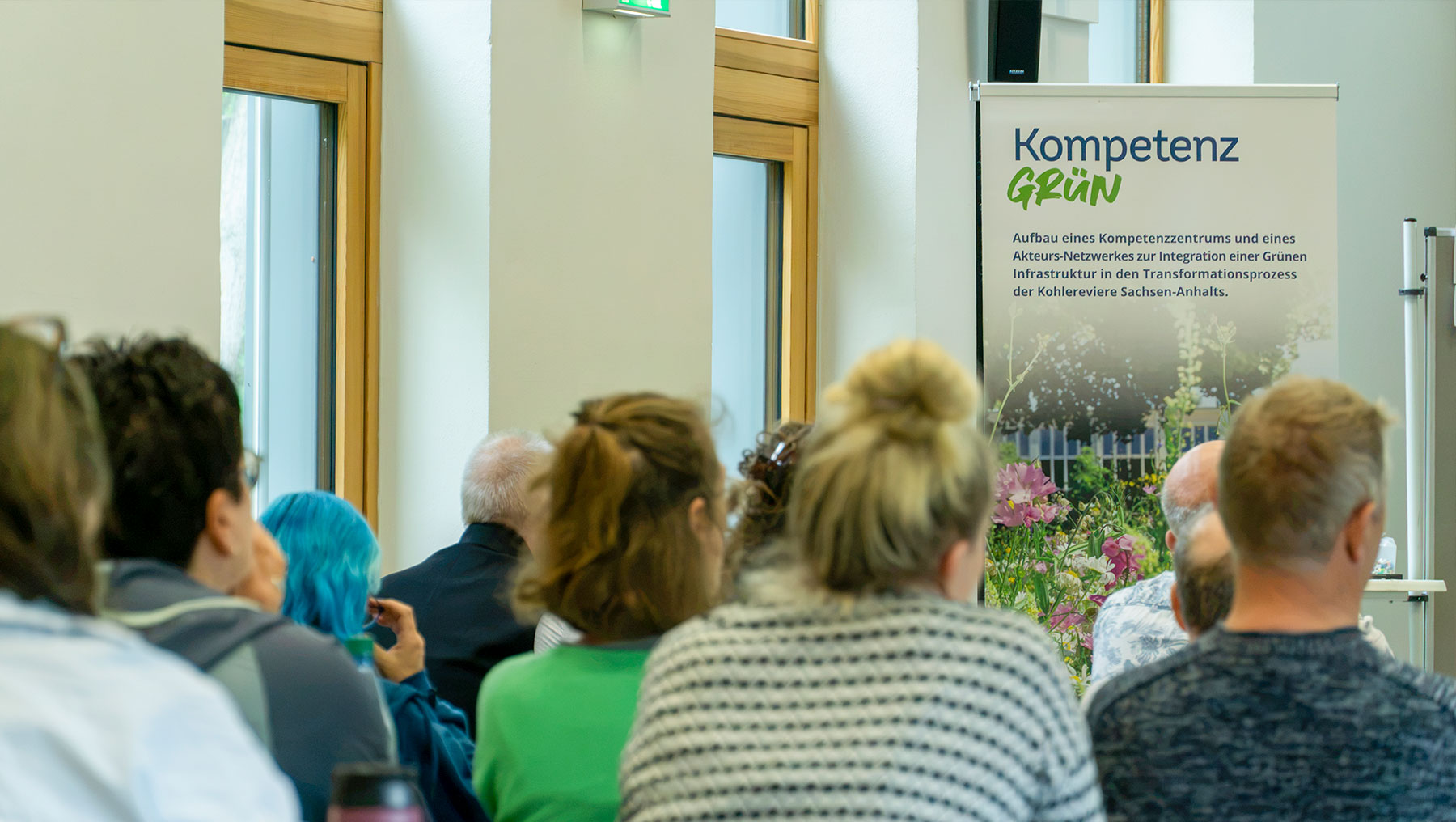
On September 24, 2026, the KompetenzGrün project brought its network together for the first time. The meeting took place at the Innovationswerkstatt (Building 51 - Bernburg). About 45 people came to discuss natural flowering areas: how to create, maintain, and finance them.
From the First Seeding to the Network
The project officially launched on November 29, 2023, with a symbolic seed-sowing ceremony on the university’s Campus Köthen. Then-Prime Minister Dr. Reiner Haseloff presented the grant award notification for KompetenzGrün. Since then, the federal government has funded the project with two million euros from the STARK program. The program supports regions where the phase-out of coal is transforming Economics. Present right from the start: native wildflowers from the region, which the project relies on.
Green Infrastructure for a Region Undergoing Structural Change
Professors Sabine Tischew, Anita Kirmer, and Annett Baasch lead the project. It supports the districts of Anhalt-Bitterfeld and Burgenlandkreis in Saxony-Anhalt’s coal-mining region with measures for biodiversity and climate protection. As early as 2023, the team announced plans to build a network of stakeholders from the region. In doing so, they encountered widespread interest in increasing biodiversity. The KompetenzGrün team has since transformed more than 35 green spaces into near-natural flowering meadows in collaboration with local stakeholders. Regional wild plants now grow here that are more resilient to heat and drought than, for example, mowed lawn species. They also provide insects with a reliable food source throughout the year. Nearly three years after the grant approval was issued, this network has now convened for its first meeting.
From Mowed Lawns to Near-Natural Flowering Meadows: Practical Questions
Despite their many advantages, near-natural flowering meadows are still the exception rather than the rule today. Short-mowed lawns usually dominate the landscape of green spaces. This raises many practical questions. Which species are suitable for the area? How should the soil be prepared? Who maintains the area, and what does it cost? Where does the funding come from? How do you explain the change to residents?
The participants at the network meeting in Bernburg arrived with these very questions in mind—including those who are just beginning to explore the topic: representatives from a solar park, housing cooperatives, administrative agencies, and municipal maintenance departments, as well as private individuals.
Creating Sustainable Flowering Meadows: Listening, Participating, Collaborating
Prof. Dr. Anita Kirmer opened the meeting. Three practical presentations followed. Stefanie Rittners from Energieversorgung Halle (EVH) explained how the municipal utility is transforming its spaces from lawns into biodiverse areas. Thomas Neumann presented how Oschersleben is ecologically enhancing a historic hiking trail. Thomas Suk reported on near-natural green spaces in Zeitz. Vera Senße from the project team summarized the key success factors.
After the presentations, the participants got to work themselves. At various stations, they discussed public outreach, maintenance, and financing. On the network wall, they posted offers and requests, similar to a bulletin board. One person offered practical tips on flowering meadows, while another shared knowledge about biochar. This process involves heating plant material in the absence of oxygen, producing a charcoal that can be incorporated into the soil. A total of 22 valuable contributions were posted on the network wall.
Thus, the afternoon was all about exchange: Many guests talked with one another, discussed ideas, and exchanged business cards. The regional office of the Natural Climate Protection Action Program (ANK) provided advice at an information booth on funding opportunities, including KfW Funding Guideline 444, “Natural Climate Protection in Municipalities.”
“The transition toward greater diversity in our green spaces can only succeed if we work together. The presentations by our network partners beautifully demonstrated how much is already in motion and how we can learn from one another. Engaging more in dialogue helps us all develop concrete and feasible solutions to the daily challenges we face in practice,” says Anita Kirmer, project manager at KompetenzGrün.
Outlook: The KompetenzGrün Learning Platform
In parallel with the near-natural flowering meadows, KompetenzGrün has developed a learning platform over the past three years. Here, interested parties can find everything on the topic in various formats—such as downloadable guides and videos—ranging from the establishment and maintenance of flowering areas to seed selection and practical examples. It’s also possible to submit a consultation request via the project website.
About KompetenzGrün
KompetenzGrün is a project of Anhalt University of Applied Sciences, where research on ecological restoration, habitat management, and multifunctional land use has been conducted for more than 20 years. It is funded through the federal STARK program by the Federal Ministry for Economic Affairs and Energy. The Saxony-Anhalt Ministry of Science, Energy, Climate Protection, and Environment contributes to the funding. The Federal Office for Economic Affairs and Export Control serves as the approving authority.
For more information, visit www.kompetenzgruen.de.
