Digital methods make Mechanical Engineering more efficient. But the simulations that can be performed throughout the design process also hold great potential for making Mechanical Engineering more sustainable. In this interview, Prof. Dr. Klaus Günzel and his colleague Richard Täger explain how this can be achieved.
Sustainability in Mechanical Engineering: The Potential of Simulation Throughout the Design Process
-
 © HS Anhalt | Anna Werner
Mr. Täger, you have long been familiar with simulation techniques in Mechanical Engineering. How would you describe their advantages?
In our experience, simulations significantly reduce development time, as fewer physical prototypes need to be built and tested. This not only saves time but also reduces the associated energy and material costs. Furthermore, simulation techniques enable optimized maintenance processes and thus extend the service life of components. Under the umbrella term “predictive maintenance,” these methods are increasingly being adopted by companies. Simulation enables predictions about the wear behavior and service life of components, which supports maintenance planning during machine operation. This allows maintenance intervals to be optimized and unplanned downtime to be minimized, which in turn improves resource efficiency.
Prof. Günzel, that already touches on some aspects of sustainability. Where do you see a need for research regarding simulations that accompany the design process?
Currently, I see the greatest potential in the field of automated simulations combined with machine learning—that is, model fitting. This allows us to improve the accuracy of real-world data through simulations, thereby providing added value for Mechanical Engineering applications. This research lays the foundation for toolkits that are universally applicable and beneficial to society as a whole. The further we advance in this area, the more we as Mechanical Engineering professionals should also focus on predicting the societal and environmental impacts of technology.
A solid education in engineering is absolutely essential here. Ideally, we should expand this to include subjects such as philosophy and ethics, which address the societal impacts of technology and have always been closely linked to the engineering sciences.
AI is also playing an increasingly significant role in simulation. I have respect for newly discovered effects arising from the large-scale deployment of AI, but I am also particularly hopeful for groundbreaking new capabilities in well-established simulation domains, such as solid mechanics simulation. That is why I encourage students to explore AI in the field of the finite element method—FEM for short—from both a research and an engineering perspective.
One area of application for this combination of classical mechanical simulation and AI technology would be medical technology—in particular, implantology.
What's new about all this is that we are serious about decoupling economic growth from resource consumption and are making this a central focus of our research and teaching in Köthen.
Prof. Dr. Klaus Günzel
In light of global warming and growing resource scarcity, Mechanical Engineering is under pressure to operate more sustainably. Can you use an example to explain how simulations conducted throughout the design process can help with this?
By utilizing the simulation techniques that I teach and apply, lightweight design concepts can be incorporated into machines, for example, which is important from an environmental perspective. When it comes to this topic, the question of materials is the first thing that comes to mind. We face a dilemma here: plastics, fiber-reinforced composites, and aluminum, for example, form the basis for engineering-based lightweight construction in the automotive and aerospace sectors. The environmental impacts associated with extracting the raw materials for plastics and aluminum, their manufacturing, and their recycling at the end of the product life cycle pose major technical challenges. Research into substitutes for these lightweight construction materials and, at the same time, efforts to enhance their recyclability are therefore of great importance.
Our simulations are important tools in this context, as they replace real-world prototype testing and enable resource-efficient development processes. I therefore find the task of reshaping global volume markets in the field of materials to be highly relevant. And to return to your question: what’s new about all this is that we are serious about decoupling economic growth from resource consumption and are making this a central focus of our research and teaching in Köthen.
Mr. Täger, you have already been involved in several projects in Mechanical Engineering at Anhalt University of Applied Sciences. What opportunities do students have to participate in these new developments?
I would say that research and teaching go hand in hand here. Students benefit from these projects by gaining up-to-date knowledge and working on interesting papers or theses for the semester or as part of their graduation work. Our students also pursue their passion for technology through their own initiatives. They are supported in this by the university’s extensive software library, which is also available to them for experimenting at home. In addition, last year we set up special workstations for students in Hall 61, each equipped with its own tools. These have already been used for a variety of projects, such as building soapbox cars or developing mealworm feeding systems.
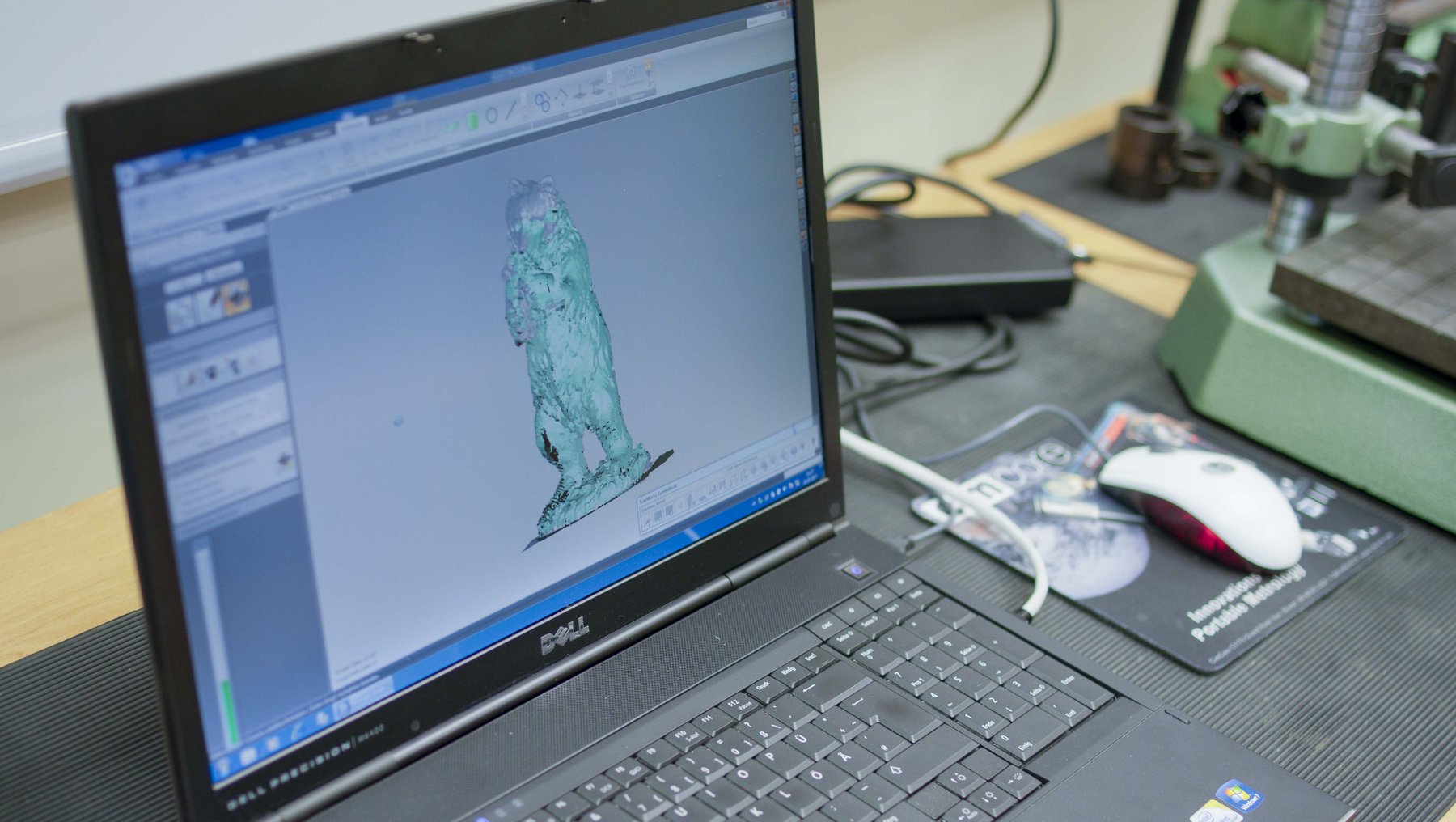
A somewhat larger, multi-semester project involves converting a Mercedes 190e to electric propulsion. State-of-the-art simulation techniques are used in this process: Students first create a digital twin of the vehicle using 3D scanning and then apply various simulation methods. This allows them to carry out the conversion virtually and identify and resolve potential problems in advance, before the actual conversion is implemented in practice.
We showcase additional examples on our Instagram channel, fb6.emw, which I manage together with Jana Wiebach and Martin Wiesner. Although the channel is still in its early stages, you can already see completed and ongoing projects there—for example, the spider robot developed by Christopher Kral using a digital twin. When ideas like these arise, we do everything we can to support our students.
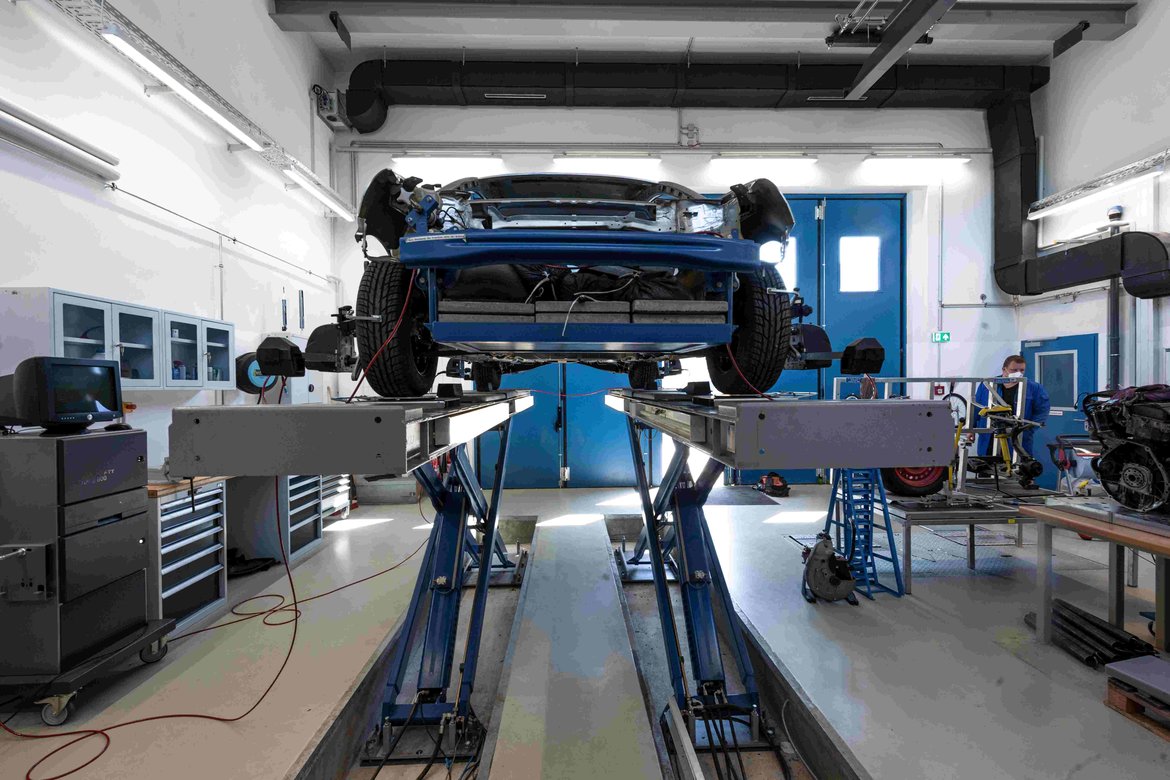 © HS Anhalt | Zerina Kaps
In the mechanical engineering building at Anhalt University of Applied Sciences: Students are using simulation techniques to convert vehicles to electric power.
Prof. Günzel, how do you assess the state of Mechanical Engineering with regard to the application of techniques such as the finite element method? Is this a matter of the company's size?
SMEs are already using these tools, and there are specialized providers catering to small businesses. Larger companies integrate multiple sub-technologies into their research and development efforts, which drives product development forward. They often have their own laboratories, which facilitates more complex simulations but also incurs high costs. Open-source solutions offer an interesting alternative here.
Open-source solutions—whose developers, for example, rely on donations from industrial users—are also an exciting alternative to proprietary software. Here, too, the need for a solid education in the principles of Electrical Engineering and mechanical design, as mentioned above, is crucial for the successful application of these simulation tools. I would like to build on this and speak with local companies to discuss opportunities for refining modeling activities. To do so, I am leveraging contacts through the dual education program at Anhalt University of Applied Sciences and other student-related initiatives.
I’m also in contact with other simulation groups within the university, such as the fluid simulation group in the Department of Applied Biosciences and Process Engineering.
Overall, the application of FEM in Mechanical Engineering is less and less a question of company size and more a question of technical requirements and the potential the method offers for solving specific problems. FEM and multibody simulation enable companies of all sizes to develop and optimize their products more efficiently, more cost-effectively, and with higher quality.
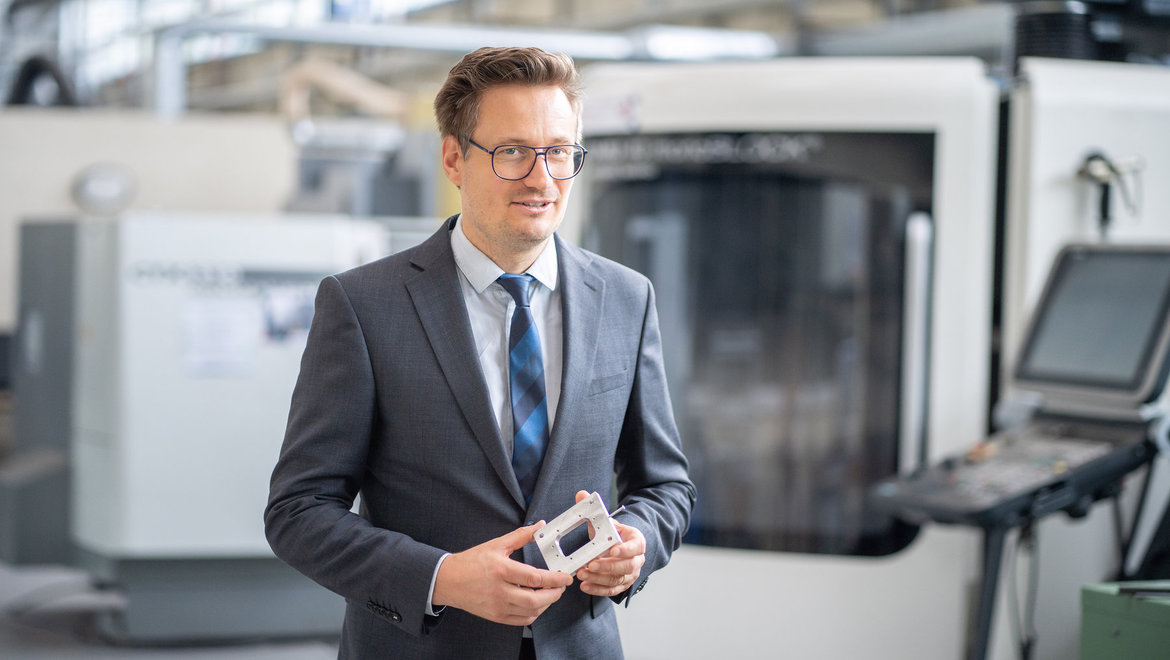 © HS Anhalt
Prof. Dr. Klaus Günzel: In the background is the mechanical engineering building at Anhalt University of Applied Sciences. Here, students can get hands-on experience thanks to a wide range of opportunities and benefit from the research projects.
On your personal page, you've already announced topics for student papers. What are they?
There are exciting topics such as FEM development, aeroelasticity of fixed-wing aircraft, and much more. You can access the list of my topics—in both English and German—through a Moodle course.
A key priority is to teach how these disciplines are interconnected and to promote practical applications. Even our student interns are involved in projects so that they can gain their first engineering experience during their labs. There is a special focus on laboratory-based work involving simulation throughout the design process and 3D scanning.
Mechanical Engineering is a broad field. Which sectors of the economy does your research focus on?
A key area is mobility. I’m bringing a research topic from the aviation industry to the university. Tom Scholz and I are conducting research in collaboration with the two SMEs, DG Aviation GmbH and IFF E&C GmbH, in the field of aeroelasticity in gliders. You might ask, what does this have to do with sustainable mobility? A great deal, because we believe the target technology resulting from this basic research will be fundamental to future commercial aircraft that are significantly more fuel-efficient. We are also coordinating this effort with the DLR.
Another exciting mobility topic is automotive engineering. We recently gained a strong industry partner in TÜV Süd.
We’re exploring our own approaches to technological advancement. One new technology involves the refurbishment of passenger car body panels. Richard Täger recently investigated this innovative approach together with bachelor’s student Wasim Jazzar to obtain initial assessments.
Another
project in our vehicle engineering department focuses on the electric retrofit of the Daimler W201 and the creation of a digital twin. This is a wonderful source of topics for student projects, which are very good. There are many subject areas involved: battery technology, simulation of vehicle mechanics, and more.
In closing, I would like to highlight the inspiring international atmosphere in Köthen. In my lectures—such as the one on machine dynamics—I teach, among other things, d’Alembert’s principle. D’Alembert was not only a prominent scientist but also a philosopher whose works formed fundamental building blocks for the models of democracy and the rule of law. His intellectual contributions influenced the ideas of the Enlightenment and indirectly laid the foundation for our modern state. For me, this brings us full circle to the multifaceted Mechanical Engineering education in Köthen!
Prof. Dr. Klaus Günzel...
which recently appointed him to Anhalt University of Applied Sciences. In the Department of Electrical, Mechanical and Industrial Engineering, his research focuses on simulation throughout the design process. This field has shaped his career throughout his undergraduate studies, doctorate, and work as a development engineer at Bosch, Vorwerk, and in the automotive industry. In addition to publications on an innovative numerical model for the head-neck system, the 44-year-old has already secured several patents. Learn more on his personal website: https://www.hs-anhalt.de/hochschule-anhalt/service/personenverzeichnis/person/prof-dr-klaus-guenzel.html
Richard Täger…
He is a technical instructor in the Department of Electrical, Mechanical and Industrial Engineering. In addition, he teaches the elective courses in Vehicle and Chassis Engineering and is involved in various research and teaching projects. More information about the Department’s opportunities and activities can be found on this page: https://www.hs-anhalt.de/hochschule-anhalt/emw/uebersicht.html
Redaktion
Inquiries and questions to
...Prof. Dr. Klaus Günzel by phone: +49 (0) 3496 672330 or by email: klaus.guenzel(at)hs-anhalt.de
...Richard Täger by email: richard.taeger(at)hs-anhalt.de
